
Oak vascular mycosis
Ophiostoma piceae
Description
Symptoms
Initial signs include the wilting and yellowing of foliage during the summer months. Leaves may become chlorotic and drop prematurely, creating a sparse canopy appearance.
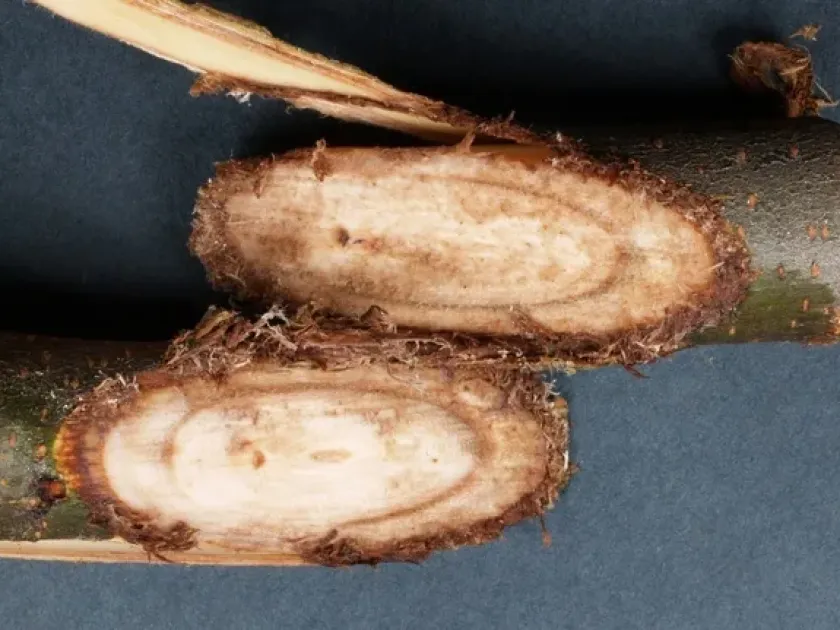
A cross-section of affected branches or the main trunk typically reveals dark vascular discoloration. This staining is a classic symptom of vascular-invading fungi.
The tree often exhibits crown dieback, starting from the upper parts of the canopy. Over time, the dead branches become prominent, a condition frequently referred to as stag-headedness.
Bark necrosis and small exit holes from wood-boring insects are frequently observed on infected trees, signaling the presence of the vectors that carry the fungus.
As the infection progresses, the tree's overall vigor declines significantly, making it susceptible to secondary pathogens and further insect attacks.
Pathogen
The causal agent of this disease is the fungus Ophiostoma piceae. It is an ascomycete fungus that colonizes the vascular tissues of oak trees, often resulting in severe physiological disruption.
This fungus is primarily associated with the blue stain of wood but acts as a vascular pathogen when it compromises the xylem, the tissue responsible for water transport in the tree.
The life cycle includes both asexual (conidia) and sexual (perithecia) reproduction phases. Spores are primarily dispersed by beetles, particularly bark beetles that bore into the tree's trunk.
Once inside the tree, the fungal mycelium grows rapidly through the vessels, secreting metabolites that lead to the clogging of the vascular system and internal tissue damage.
Ophiostoma piceae is known for its high resilience in the environment, allowing it to persist in woody debris, insect galleries, and soil for extended periods.
Conditions for development
Environmental stress, particularly prolonged drought, is the most critical factor predisposing trees to infection. Drought weakens the tree's defense mechanisms against fungal colonization.
Optimal conditions for fungal development include moderate to high temperatures combined with high humidity, which favor the rapid proliferation of conidia and infection of wounds.
Physical injuries to the tree, caused by logging operations, storms, or animal activity, provide direct entry points for the fungus to penetrate the inner layers of the bark.
High stand density in forests creates a microclimate with stagnant air and moisture, which facilitates the transmission of the disease between adjacent trees.
The presence of high populations of bark beetles is a major driver of the disease, as these insects act as the primary biological carriers of the fungal spores.
Why it matters
Oak vascular mycosis causes significant economic damage to the timber industry by degrading the quality of wood. The fungal staining makes the lumber visually and structurally inferior.
Ecologically, the disease leads to the large-scale death of oak trees, which disrupts forest ecosystems. The loss of oak canopy cover negatively impacts local biodiversity.
The disease can spread rapidly, turning healthy forest patches into infection centers within a few growing seasons, making control extremely challenging and costly.
Dead and dying trees pose a safety hazard in public parks and residential areas, as they can suddenly drop heavy branches or fall entirely due to structural decay.
The disease also hinders the natural regeneration of oak forests, as the affected trees fail to produce viable seeds or succumb before reaching reproductive maturity.
Protection
The primary control measure involves the systematic removal and destruction of infected trees to eliminate the source of inoculum and reduce insect breeding sites.
Integrated pest management (IPM) focusing on controlling bark beetle populations is essential to mitigate the transmission of the disease throughout the forest.
Maintaining high forest health through proper silvicultural practices, such as thinning and ensuring adequate soil moisture, helps trees resist fungal infection.
Quarantine measures are necessary when transporting timber from infected areas to prevent the spread of the pathogen to unaffected geographic regions.
In high-value ornamental or park settings, trunk injections with specialized fungicides can be used, though this is not practical for large-scale forest management.
Discussion
No discussions yet — be the first.