
Ophioparma ventosa
Ophioparma ventosa
Description
Symptoms
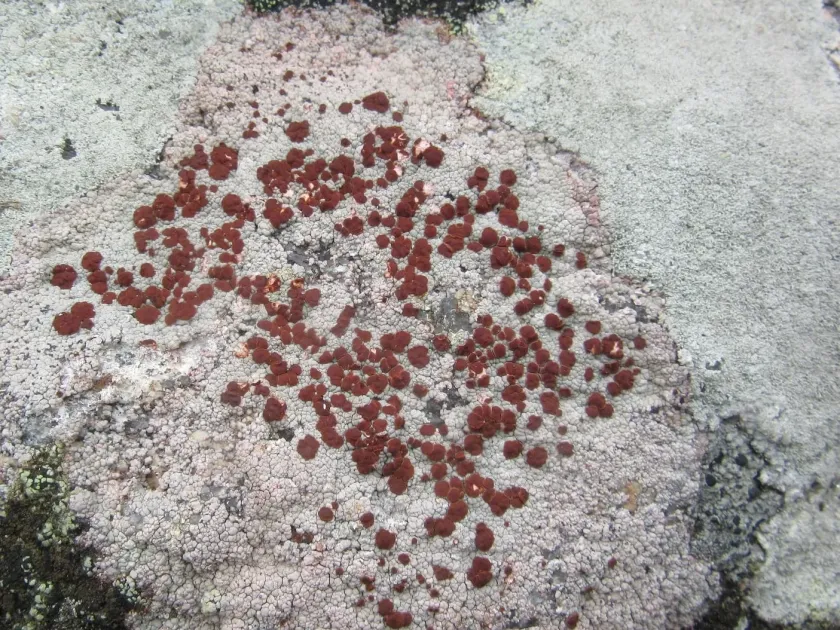
Ophioparma ventosa is a crustose lichen that forms a hard, patch-like growth on its chosen substrate, such as rock or tree bark.
The thallus appears as a greenish-grey or yellowish-green crust that is tightly attached to the surface, making it difficult to remove.
A distinctive feature of this species is the presence of large, vibrant red or orange apothecia, which act as the reproductive structures.
The growth pattern is relatively slow, spreading across the surface over many years without causing any structural damage to the base.
These signs are often mistaken for fungal infections, but the morphology of the thallus and fruit bodies is unique to this lichen species.
Pathogen
It is important to clarify that Ophioparma ventosa is not a plant pathogen; it is a symbiotic organism consisting of a fungus and an alga.
This organism belongs to the lichenized fungi, which do not feed on host tissues and do not penetrate into the living cells of plants.
The fungus provides the structural foundation and protection from UV radiation, while the alga contributes nutrients through photosynthesis.
The classification of this species falls under the Lecanoraceae family, which is widely studied for its ecological significance rather than pathology.
Therefore, describing it as a disease is scientifically inaccurate as it lacks parasitic traits associated with agricultural crop infections.
Conditions for development
The development of Ophioparma ventosa is strictly governed by environmental conditions, particularly high air quality and humidity.
It prefers cold, exposed, and windy environments, which is reflected in its scientific name, and it is common in mountainous or northern regions.
The lichen is a highly sensitive bioindicator, as it cannot survive in areas with significant air pollution, especially from sulphur dioxide.
Optimal light exposure is necessary for the algal component to successfully perform photosynthesis, supporting the growth of the lichen colony.
Stable, long-lived surfaces such as weathered granite rocks or the thick, corky bark of mature trees are ideal substrates for its establishment.
Why it matters
This lichen causes no harm to agricultural crops or garden plants as it does not compete for water or nutrients with the host plant.
While it may cover the surface of bark, it does not interfere with the plant's metabolic processes or physiological functions.
In the rare event of excessive growth on ornamental trees, it is viewed purely as an aesthetic concern rather than a biological threat.
Ophioparma ventosa does not release harmful substances or toxins that could negatively affect plant health or surrounding soil quality.
The presence of this lichen should be viewed as an indicator of a clean, stable environment rather than an indicator of a diseased plant.
Protection
There is no need for control measures, as Ophioparma ventosa does not pose a threat to plant productivity or the economic value of crops.
If removal is desired for cosmetic purposes, it should be done using gentle mechanical methods like soft brushing during dormant seasons.
Maintaining vigorous and healthy plant growth through proper horticultural practices will naturally limit the spread of lichen colonies.
The use of chemical sprays to control lichens is strongly discouraged, as they may harm the plant or disrupt the local beneficial ecosystem.
Prevention is centered on site management and ensuring that trees are in a state of good health, which naturally discourages heavy colonization.
Discussion
No discussions yet — be the first.