
Cordyceps sinensis
Ophiocordyceps sinensis
Description
Symptoms
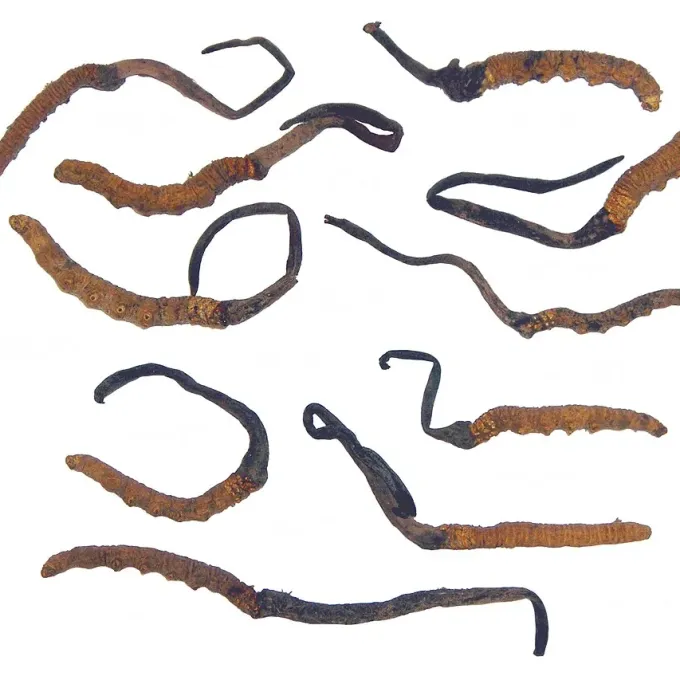
The primary sign of infection is the presence of a mummified larva in the soil, from which a slender, dark-colored fruiting body protrudes above the soil surface.
Visually, the fruiting body appears as a thin stalk or "grass-like" sprout that emerges from the ground, often matching the length of the larva beneath the soil.
Upon examination, the larva appears rigid and hardened, with its internal tissues fully replaced by white fungal mass that preserves the insect's original segmentation.
The upper part of the fruiting body contains perithecia, microscopic structures where spores mature, which are essential for the propagation and dispersal of the fungus.
In the field, infected hosts can be identified by the characteristic stalk growing from the ground and the distinct discoloration of the soil around the site of emergence.
Pathogen
The causative agent is the entomopathogenic fungus Ophiocordyceps sinensis, which belongs to the Ascomycota division. Unlike plant pathogens, this organism specializes in parasitizing larvae of insects, particularly those of the ghost moth family.
The life cycle of the fungus occurs in the soil layers of high-altitude alpine meadows. Spores penetrate the insect's cuticle, after which the mycelium begins to aggressively consume the host's internal organs.
As the fungus develops, it replaces the host's tissues with its own mycelium, while maintaining the external shape of the insect. This allows the host structure to remain intact until the fruiting body emerges.
Recent mycological research has reclassified this organism into the genus Ophiocordyceps, highlighting its specific biological adaptation to a narrow range of hosts in mountain environments.
While not a plant pathogen, the biology of this fungus is of significant interest to agricultural science for the potential development of biological control agents against soil-dwelling pests.
Conditions for development
The development of Ophiocordyceps sinensis is strictly dependent on specific high-altitude conditions, typically found in the Himalayan and Tibetan plateau regions.
The optimal temperature range for spore germination and mycelial growth is between 5 and 15 degrees Celsius, combined with high soil moisture levels.
Favorable conditions occur during the spring thaw and summer monsoon seasons, which provide the necessary humidity for fungal proliferation in the topsoil.
Soil structure is critical, as loose, organic-rich soil promotes both the migration of fungal spores and the activity of the larvae required for the fungus's life cycle.
Climate change and rising temperatures in high-altitude regions pose a threat to the natural habitat and population stability of this specific fungal species.
Why it matters
In terms of commercial agriculture, Ophiocordyceps sinensis is not considered a plant disease as it possesses no capability to infect or harm agricultural crops.
The organism does not damage roots, stems, or foliage of cultivated plants, and therefore poses no threat to harvest yields in traditional farming systems.
Its role in the environment is essentially that of a natural insect population regulator, which may provide incidental benefits by controlling certain soil pests.
There are no economic losses associated with this fungus in the agricultural sector, as it is strictly limited to insect hosts in specific alpine ecological niches.
The scientific focus remains on isolating its unique metabolites, which could lead to the production of eco-friendly bio-pesticides for use in protecting high-value agricultural commodities.
Discussion
No discussions yet — be the first.