
Stem ophiobolosis
Ophiobolus acuminatus
Description
Symptoms
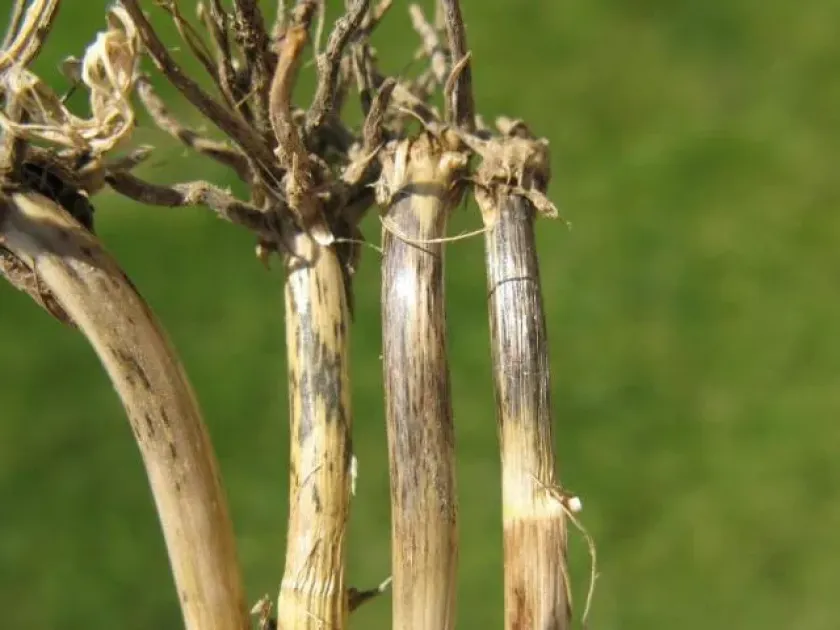
The disease is characterized by the appearance of necrotic, greyish, or dark brown spots on the lower parts of the stems. As the infection progresses, these spots expand and may coalesce into larger lesions.
Tissues in the affected areas become softened and weakened. The disruption of nutrient and water flow leads to premature wilting and drying out of the entire plant or specific stems.
Small black dots, representing the fungal perithecia, can be observed on the surface of dead stems under high humidity. This is a diagnostic sign used to identify the presence of the pathogen in the field.
Plants affected by the disease often exhibit poor grain filling, resulting in shriveled and underdeveloped kernels. This significantly impacts the overall crop yield and quality.
Ophiobolosis often manifests in localized patches within a field, making it recognizable during scouting as distinct areas of poor plant health compared to surrounding healthy crops.
Pathogen
The causative agent of stem ophiobolosis is the fungus Ophiobolus acuminatus, a member of the Ascomycota phylum. It is primarily a saprotrophic organism that thrives on decaying plant material but can act as a pathogen on weakened crop stems.
The life cycle of the pathogen is centered on plant debris. It produces fruiting bodies known as perithecia, where spores are formed. These spores are disseminated by wind and rain splash during favorable conditions.
The fungus can persist in the soil for several seasons, surviving on stubble and straw. Initial infection occurs when spores come into contact with healthy plant tissues during wet periods.
The mycelium of Ophiobolus acuminatus secretes powerful enzymes capable of degrading cell walls. This enzymatic activity allows the pathogen to penetrate deeply into the stem tissues, disrupting the plant's vascular system.
This fungus is highly adaptable to various environmental conditions, with optimal growth temperatures ranging from 15 to 22 degrees Celsius, allowing it to remain active across different climate zones.
Conditions for development
High moisture levels in both soil and air are critical for the development and spread of Ophiobolus acuminatus. Prolonged rainfall periods significantly increase the risk of infection.
Dense planting configurations, which restrict airflow and maintain humidity levels within the canopy, provide an ideal environment for the fungus to establish and spread effectively.
Continuous monocropping without adequate breaks in the rotation leads to a rapid buildup of the pathogen's inoculum in the soil, making it increasingly difficult to control in subsequent years.
Poor soil aeration and the presence of compacted layers can stress the plant's root system, making it more susceptible to opportunistic fungal attacks, including stem ophiobolosis.
Early-season cool and wet weather often favors the initial infection stage, as the fungus is well-adapted to cooler temperatures, giving it a head start over the emerging crop.
Why it matters
The primary damage caused by stem ophiobolosis is a significant reduction in grain yield. The destruction of stem tissue limits the plant's ability to transport nutrients, resulting in grain yield loss.
Infected stems are structurally weakened, which frequently leads to lodging. This makes harvesting difficult and results in significant mechanical losses of the grain during the harvesting process.
The quality of the harvested crop is severely compromised, characterized by low test weight and reduced germination potential, making the grain unsuitable for future seed use.
By causing premature senescence, the pathogen forces the plant to shut down its photosynthetic processes early, preventing full grain maturity and overall crop health.
The presence of the pathogen in a field creates a long-term management challenge, requiring farmers to implement more intensive and costly disease prevention strategies in future seasons.
Protection
The cornerstone of managing stem ophiobolosis is the implementation of a diverse crop rotation, avoiding the continuous cultivation of susceptible host crops on the same field for several years.
Deep plowing and proper management of crop residues are essential to promote the rapid decomposition of infected debris, which significantly reduces the pathogen's survival rate.
Seed treatments with broad-spectrum fungicides provide a crucial early-season barrier against soil-borne infections, protecting seedlings during their most vulnerable stages.
Strategic application of foliar fungicides during the tillering and jointing stages can effectively manage the disease if conditions favor an outbreak, based on regular field monitoring.
Choosing resistant or tolerant crop varieties is the most sustainable approach, as it reduces reliance on chemical control methods while ensuring stable yields under varying environmental pressures.
Discussion
No discussions yet — be the first.