
Mycena leaiana
Mycena leaiana
Description
Symptoms
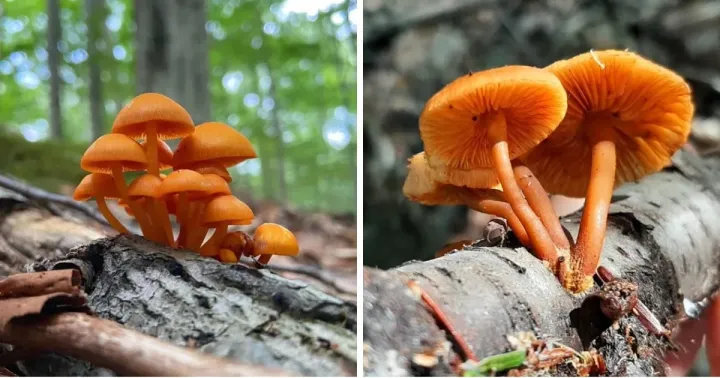
The most distinctive visual sign is the presence of densely clustered, bright orange or saffron-colored fruiting bodies.
The caps are typically convex, and the stems often exude a sticky, orange-colored liquid, especially in younger specimens.
The gills are adnate, sometimes with an orange hue, often showing the same characteristic sticky texture as the stem.
These clusters are frequently found emerging from decaying stumps, fallen logs, or branches in hardwood forests.
In addition to the fruiting bodies, the substrate often displays a subtle orange staining caused by the mycelial development.
Pathogen
Mycena leaiana is a species of fungus in the Mycenaceae family, widely recognized for its vibrant appearance in forest habitats.
It acts strictly as a saprotroph, meaning it derives nutrients from decaying organic matter rather than attacking living hosts.
The fungus plays a significant role in the forest ecosystem by breaking down complex lignocellulosic materials in dead wood.
It is not a plant pathogen and does not cause diseases in agricultural or horticultural crop species.
Research confirms that M. leaiana lacks the specialized parasitic mechanisms required to infect or damage living plant tissues.
Conditions for development
Mycena leaiana thrives in high-humidity environments typical of shaded, temperate woodland regions.
The fungus prefers hardwood substrates, particularly maple and beech logs that have reached a stage of early-to-mid decay.
Optimal development of fruiting bodies occurs during damp, cool weather, often following periods of heavy or consistent rainfall.
The mycelium resides deep within the wood fibers, utilizing the moisture and nutrients to proliferate during the growing season.
Forest canopy density plays a role in creating the microclimate necessary for the sporulation and expansion of the fungal colony.
Why it matters
This fungus presents no threat to agricultural productivity, orchard health, or field crop development.
As a decomposer, it performs a beneficial ecological function by recycling carbon and nitrogen back into the forest soil.
There are no known reports of it causing structural damage to living trees or interference with plant physiological processes.
It should not be confused with wood-rotting pathogens like Armillaria, which pose risks to healthy or weakened trees.
Its presence is purely an indicator of available dead wood material in a specific area.
Protection
No protective or chemical control measures are necessary for Mycena leaiana, as it poses no harm to cultivated plants.
In cases where fungal growth is undesirable on stored timber, maintaining low moisture levels is the standard preventive approach.
Proper stacking of wood to ensure adequate airflow and prevent saturation is sufficient to inhibit the growth of the fungus.
Sanitation practices, such as removing overly moist or decaying debris from the vicinity, will naturally limit the fungus's habitat.
Chemical intervention is unnecessary and ineffective for managing saprotrophic organisms that are integrated into natural cycles.
Discussion
No discussions yet — be the first.