
Montagnea arenaria
Montagnea arenaria
Description
Pathogen
Montagnea arenaria is a gasteroid fungus belonging to the order Agaricales, adapted specifically to arid and semi-arid environments. It is important to note that this fungus is a saprotroph, not a plant pathogen, and does not attack living agricultural crops.
In its natural habitat, it acts as a decomposer, feeding on dead plant debris buried in sandy soils. Its biological role is to facilitate the mineralization of organic matter in extreme conditions where bacterial decomposition is often inhibited.
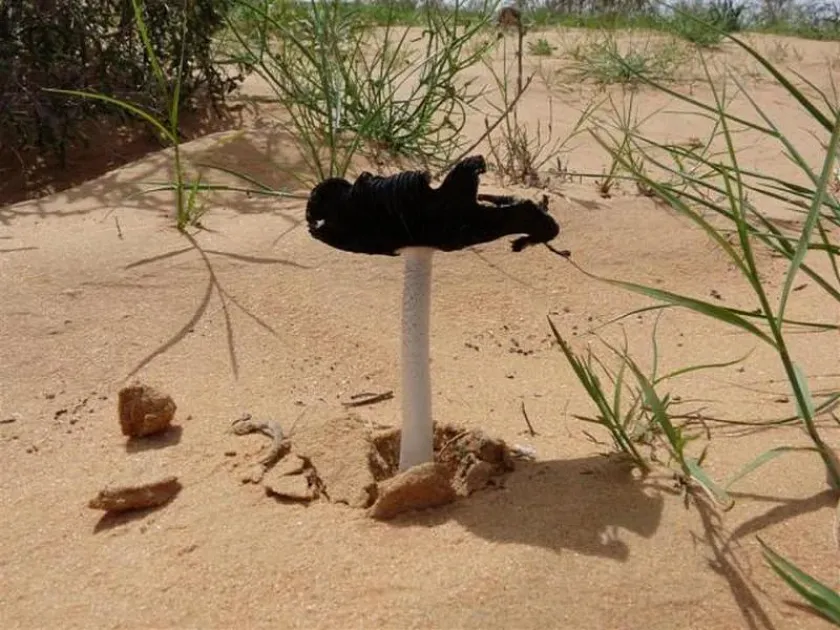
The morphology of the fungus, characterized by a slender stipe and a fan-shaped pileus, is highly specialized for spore dispersal in open, windy areas. This structure allows the fungus to efficiently release its spores into the air currents characteristic of desert regions.
Biological studies indicate that the mycelium of this species is highly resilient to desiccation. It remains dormant within the soil matrix, awaiting the appropriate environmental triggers to produce its characteristic fruiting bodies.
This species is of significant interest to mycologists studying evolutionary adaptations in fungi. Its ability to thrive in nutrient-poor, sandy environments distinguishes it from the majority of other macrofungi.
Conditions for development
The primary habitat for Montagnea arenaria is sand dunes, deserts, and semi-arid plains. The fungus requires loose, well-draining sandy substrates to support its vegetative growth and the development of fruiting bodies.
Temperature fluctuations are a defining feature of its environment, and the fungus has evolved to tolerate extreme diurnal ranges. It primarily develops after sporadic rainfall events that temporarily increase soil moisture levels.
Nutrient availability is limited to decaying organic matter found within the sand. The fungal mycelium explores the subterranean layers for fragments of buried vegetation, which are essential for its energy requirements.
Wind is the primary vector for spore distribution, which is a survival strategy in open landscapes. The dry nature of the pileus ensures that spores are easily dislodged and carried over significant distances by desert winds.
Environmental stability of the dune ecosystems is crucial for the long-term persistence of these populations. Any significant soil disruption or agricultural conversion can lead to the loss of suitable niches required for the life cycle of the species.
Discussion
No discussions yet — be the first.