
Monosporascus root rot
Monosporascus eutypoides
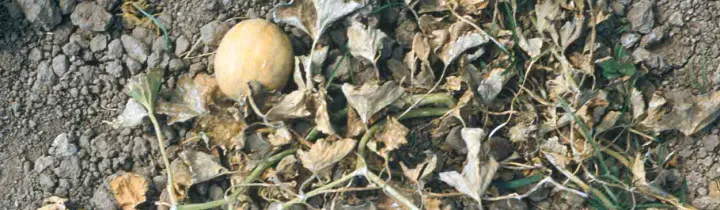
Description
Symptoms
Initial symptoms are often subtle and manifest as mild yellowing of the foliage, typically starting on the oldest leaves during the peak vegetative growth phase.
As the disease progresses, plants exhibit severe wilting during the hottest hours of the day, with partial recovery occurring during the cooler night hours.
The most diagnostic signs appear on the root system. Roots show extensive necrotic lesions and browning, while the bark often peels away, leaving the inner vascular cylinder exposed.
Microscopic examination or close inspection of the roots reveals small, black, spherical structures known as perithecia, which are the fruiting bodies of the fungus.
In advanced stages, fruit production is stunted. Fruits on infected vines are generally smaller, have lower sugar content, and may fail to reach marketable maturity.
Pathogen
The disease is caused by the soil-borne fungus Monosporascus eutypoides, a member of the Ascomycota phylum. This pathogen is notorious for its ability to survive in harsh soil environments.
It survives in the soil primarily as perithecia and sclerotia. These durable structures allow the fungus to persist for several years, even in the absence of a host crop.
The fungus colonizes the root system, specifically targeting the vascular tissues. Once inside, it impedes water and nutrient uptake, leading to the gradual decline of the plant.
The life cycle of the pathogen is closely tied to the physiological processes of the host. The fungus responds to specific root exudates that help it locate and infect the crop roots effectively.
Biological resilience is a hallmark of this species, as it can thrive in a wide range of soil types, especially those that are warm and well-drained but prone to periodic water stagnation.
Conditions for development
Monosporascus eutypoides is a heat-loving pathogen. The development and spread of the disease are most aggressive when soil temperatures exceed 25–30 degrees Celsius.
Excessive irrigation, combined with high soil temperatures, creates a conducive environment for rapid fungal proliferation and root infection.
High soil salinity is a significant predisposing factor. Plants subjected to salt stress have weakened roots, making them more susceptible to the intrusion of fungal hyphae.
Monocropping is the primary driver of infection buildup. Growing cucurbits continuously on the same land facilitates the exponential increase of the pathogen population in the soil.
Human activity, including the movement of contaminated equipment and tools between fields, acts as a primary vector for the dispersal of the fungus across larger areas.
Why it matters
The disease is highly destructive, capable of causing yield losses ranging from moderate to catastrophic levels, sometimes resulting in total crop failure in heavily infested fields.
Economic losses are compounded by the degradation of fruit quality. Produce from infected plants is often rejected due to poor appearance, low weight, and lack of flavor.
The accumulation of the pathogen in the soil renders the field unsuitable for future cucurbit production for several consecutive years, limiting crop choices.
Root system impairment makes the plants highly vulnerable to secondary infections from other soil-borne pathogens, leading to rapid plant mortality in the field.
Management costs increase significantly due to the need for soil treatments, specialized grafting, and intensive crop monitoring required to mitigate the damage.
Protection
Implementing long-term crop rotation is the most effective cultural practice. Moving cucurbits away from infested areas for at least 4–5 years helps reduce pathogen inoculum.
Soil solarization, using clear plastic mulch during the hottest months, is a widely used method to heat the soil and suppress fungal populations before planting.
Grafting susceptible cultivars onto rootstocks resistant to Monosporascus species has become the industry standard for maintaining productivity in infested areas.
- Ensuring proper soil drainage and aeration.
- Maintaining optimal soil fertility and pH levels.
- Sanitizing farm tools and machinery to prevent spread.
Biological control agents, such as specific Trichoderma strains, are being explored as a supplementary measure to protect the rhizosphere from pathogen colonization.
Discussion
No discussions yet — be the first.