
Monilia fruit rot
Monilinia yunnanensis
Description
Symptoms
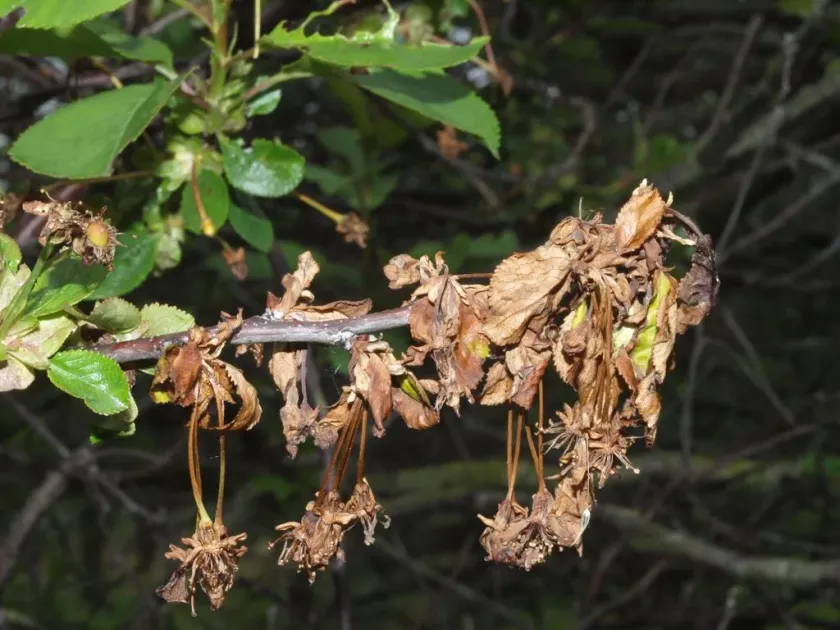
The first signs of blossom blight appear immediately after flowering: flowers suddenly turn brown and wither but remain attached to the branches. Infected leaves also darken and curl, giving the branches a charred, scorched appearance.
Gummosis (oozing of sap) is often observed on young shoots, and cracks or cankers may develop on the bark, indicating deep tissue infection. Under high humidity, grayish-yellow spore tufts form on these affected areas.
During the summer, the disease manifests as brown rot on the fruit. It starts as a small brown spot that rapidly expands to cover the entire fruit; the skin often remains firm even as the pulp decays.
Concentric circles of numerous yellowish-gray spore tufts develop on the surface of the rotting fruit. Eventually, the fruit turns black, hardens, and transforms into a "mummy" that may persist on the tree for several seasons.
If the infection occurs shortly before harvest, fruit may drop en masse or dry out on the branches, making the produce completely unsuitable for consumption or processing due to significant tissue degradation.
Pathogen
The pathogen responsible for this disease is the ascomycete fungus Monilinia yunnanensis (along with related species M. fructigena and M. laxa). It primarily affects stone fruit crops, including cherries, plums, peaches, and apricots.
The life cycle of the pathogen consists of two phases: a spring phase involving the infection of blossoms and shoots, known as blossom blight, and a summer phase affecting the fruit, commonly referred to as brown rot. The fungus overwinters as mycelium in infected branches and in mummified fruit left on the tree or ground.
Primary infection occurs in the spring when ascospores are released from overwintered fruiting bodies or through conidia produced on infected plant parts. The fungus enters the plant through blossoms, buds, and mechanical wounds in the bark.
The fungus develops by invading the plant's vascular system, causing the death of tissues. Monilinia yunnanensis is highly aggressive, rapidly adapting to environmental conditions and forming new infection sites throughout the growing season.
The fungus is highly resilient, capable of surviving harsh winter conditions and acting as a persistent source of inoculum that activates as soon as favorable weather conditions return in the spring.
Conditions for development
Cool, wet weather during the flowering period provides the ideal environment for Monilia outbreaks. The optimal temperature for spore germination ranges from +15°C to +20°C in high humidity.
Frequent fog, heavy dew, and prolonged rain during bloom trigger massive infection cycles. Water acts as the primary vector for spore dispersal, washing inoculum from infected areas onto healthy tissues or neighboring trees.
Poor orchard management, such as overly dense canopy growth, creates stagnant air pockets that favor fungal growth. Lack of airflow within the canopy makes the tree susceptible even during periods of moderate humidity.
Pest damage, particularly from insects like the fruit moth, provides an entry point for the fungus. In these puncture wounds, the fungus develops almost instantly whenever even minimal moisture is present.
Neglecting sanitation—specifically leaving infected fruit and branches in the orchard—creates a permanent reservoir of infection that leads to annual outbreaks whenever weather conditions become favorable.
Why it matters
Monilia is considered one of the most destructive diseases of stone fruits, potentially destroying 80-100% of the crop in years with high disease pressure. Beyond fruit loss, the disease weakens the overall health of the tree.
Widespread blossom blight and shoot dieback lead to significant loss of vegetative mass, reducing tree productivity and potentially leading to tree mortality over several years if not managed properly.
Infected fruit is entirely unsuitable for fresh market, storage, or processing. Even a small number of infected fruits in storage can lead to the rapid spoilage of an entire batch within days.
The infection spreads rapidly throughout the orchard, moving from tree to tree via wind and insects. This necessitates extensive labor and financial investment to contain outbreaks and restore orchard health.
Chronic infection results in long-term damage, including persistent gummosis and the formation of perennial cankers on scaffold branches, which significantly shortens the lifespan of the orchard.
Protection
The primary control strategy is strict adherence to agrotechnical practices: timely pruning and removal of all infected branches (including some healthy wood), along with regular collection and disposal of all rotted fruit.
It is essential to conduct regular canopy thinning to improve air circulation and reduce humidity levels within the tree structure. Cleaning tree trunks of dead bark and treating wounds promptly minimizes the risk of pathogen entry.
Chemical control involves the application of fungicides during critical growth stages: the first application at the "green tip" or pre-bloom stage, the second immediately after flowering, and subsequent applications as needed based on weather forecasts.
Systemic fungicides (triazoles, strobilurins) or contact-based copper fungicides (early spring) are recommended. Rotating different classes of fungicides is critical to prevent the development of fungal resistance.
- Removal of all mummified fruits from trees in late autumn.
- Whitewashing trunks to protect against sunscald and bark cracking.
- Effective integrated pest management to prevent fruit skin damage.
- Proper tree spacing to prevent orchard overcrowding.
Discussion
No discussions yet — be the first.