
Japanese apricot brown rot
Monilinia mumeicola
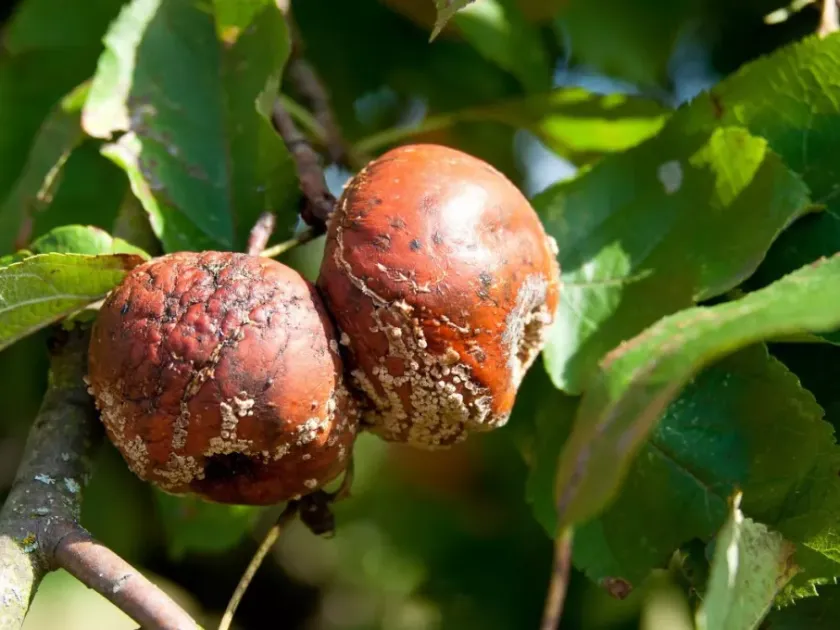
Description
Symptoms
The first sign of the disease in spring is the sudden wilting and drying of flowers. These blighted blossoms turn brown and remain attached to the branches for a long time.
As the infection progresses, it spreads from the floral stalks to the young shoots and fruit-bearing twigs. Bark fissures often appear on affected areas, sometimes accompanied by gum exudation.
Under high humidity, ash-gray or yellowish spore masses (conidial pustules) appear on the surface of wilted flowers, leaves, and affected twigs, serving as the primary inoculum source.
Leaves on infected branches turn black rapidly, curl up, and dry out, creating an appearance similar to fire damage. Severe infections can lead to the total dieback of entire limbs.
During the fruit maturation period, dark, spreading rot spots appear on the fruit. These expand quickly until the entire fruit is covered, eventually mummifying on the branch.
Pathogen
The causative agent of this disease is the ascomycete fungus Monilinia mumeicola. It is a highly specialized pathogen belonging to the order Helotiales, known for specifically targeting stone fruits.
This fungus primarily affects the Japanese apricot, also known as ume (Prunus mume). The pathogen overwinters as mycelium within infected branches and mummified fruits left on the tree or fallen to the ground.
The disease manifests mainly as blossom blight, which is most severe during the early spring. The fungus enters the plant through flowers and young shoots, spreading rapidly through the vascular system.
The life cycle of the pathogen is closely linked to the phenological stages of the tree. In spring, the fungus develops conidial spores, which are dispersed by wind, rain, or insects to susceptible host tissues.
The biology of Monilinia mumeicola is characterized by its high aggressiveness under specific climatic conditions. It can quickly colonize reproductive organs and annual growth, leading to necrotic tissue death.
Conditions for development
The development of brown rot is favored by cool, rainy weather during the flowering period. High air humidity and moderate temperatures are ideal for spore germination.
The spread of the pathogen is actively facilitated by precipitation, which splashes spores from infected tree parts onto healthy organs or adjacent trees.
Poor canopy ventilation due to a lack of pruning creates a microclimate with high humidity, allowing the fungus to propagate much faster than in well-maintained orchards.
Trees weakened by pest infestations or poor soil conditions are significantly more susceptible to infection by Monilinia mumeicola.
Dense plantings contribute to a high inoculum density, making the disease much harder to manage if proper horticultural practices are not strictly followed.
Why it matters
The primary economic impact of this disease is the rapid loss of the fruit harvest. Flower infection prevents fruit set, often leading to a total loss of production for that season.
Blossom blight can destroy a large percentage of fruit-bearing wood, significantly weakening the tree and reducing its overall productivity for future years.
The infection of young shoots hinders the formation of new fruit buds, which may result in a lack of crop even in the following growing season.
Without systematic control measures, affected trees can face severe canopy decline, leading to long-term tree mortality due to deep necrosis.
Infected fruits are unsuitable for fresh consumption or processing, as the fungal growth degrades quality and introduces toxins that spoil the harvest.
Protection
The most important control measure is regular sanitation, which includes pruning and burning all blighted branches and twigs, ensuring cuts are made into healthy tissue.
It is essential to collect and destroy all mummified fruits, as these are the primary reservoirs for Monilinia mumeicola during the dormant winter season.
Preventive fungicide applications, specifically copper-based sprays before and immediately after flowering, are highly effective in reducing primary infection rates.
Proper wound care on the bark is crucial, as any mechanical damage can act as an entry point for fungal spores.
- Implement thinning pruning to improve airflow within the tree canopy.
- Use systemic fungicides registered for stone fruits during critical growth phases.
- Maintain optimal tree health through balanced fertilization and pest management.
Discussion
No discussions yet — be the first.