
Microcalicium disseminatum
Microcalicium disseminatum
Description
Symptoms
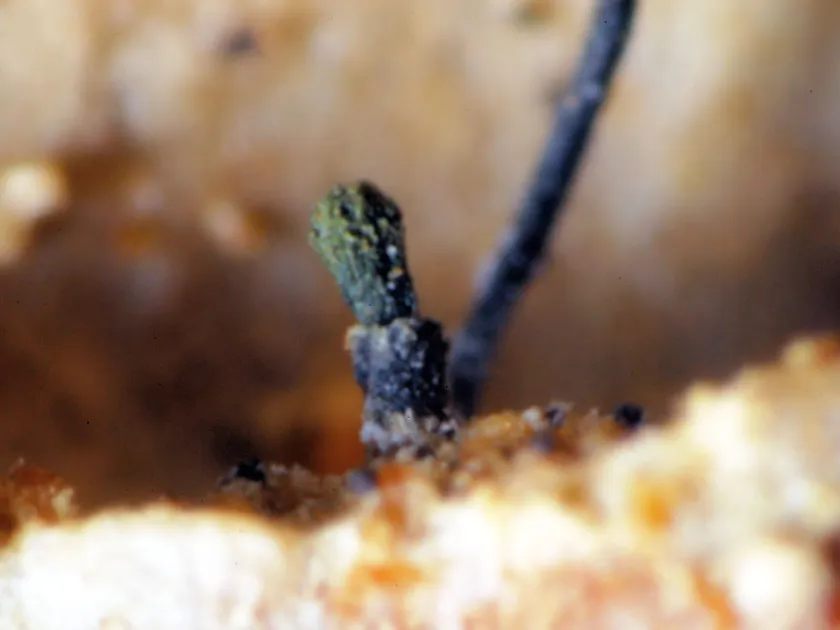
The primary indicators of its presence are minute, black, pin-head-sized fruiting bodies scattered across the thallus of the host lichen.
These structures are often difficult to spot without high-magnification equipment, making field identification challenging for non-specialists.
Infected areas may show signs of slight discoloration or thinning of the lichen tissues, which reflects the localized feeding behavior of the fungus.
Over time, the host lichen might show signs of senescence that are accelerated by the growth of the fungal mycelium embedded within its structure.
Correct identification requires distinguishing these fungal structures from other similar lichenicolous species through microscopic spore analysis.
Pathogen
Microcalicium disseminatum is a fascinating species of lichenicolous fungus, belonging to the order Lecanorales, which grows specifically on lichenized fungi.
Unlike agricultural pathogens that destroy crops, this organism lives in a specialized ecological niche, primarily found on the bark of older trees where lichens thrive.
The fungus is known for its tiny apothecia, which produce spores that facilitate the colonisation of new lichen surfaces within the forest ecosystem.
Biologically, it is categorized as a commensal or a weak parasite that relies on the structural integrity of its host to complete its lifecycle.
Its role in nature is strictly limited to these micro-habitats, and it possesses no capacity to infect vascular plants or agricultural crops.
Conditions for development
The development of Microcalicium disseminatum is heavily dependent on stable, high-humidity environments typical of mature, undisturbed forest settings.
It prefers mature tree bark, which provides a long-term substrate allowing for the successful establishment and reproduction of the fungal population.
Optimal environmental conditions include cool temperatures and protection from harsh weather, which prevent the desiccation of the delicate fruiting bodies.
Dispersal is primarily wind-driven, allowing the spores to travel between trees and colonize new lichen patches throughout the woodland.
A balanced ecological micro-climate is the essential factor that sustains the presence of this fungus within a given region.
Why it matters
Microcalicium disseminatum causes no economic harm to agriculture, forestry, or ornamental landscaping, as it does not affect tree health or crop yield.
It is viewed by forest pathologists as an indicator of ecological stability and habitat maturity rather than a destructive disease agent.
There is no evidence suggesting that this fungus contributes to the decline of host trees, as its impact is restricted to the lichen cover alone.
From a commercial perspective, the damage is effectively non-existent, and it poses no threat to the commercial value of forest timber.
Its presence is considered a part of the natural biological diversity of the forest, serving as a component of the complex ecosystem.
Protection
No control measures are necessary for this fungus because it does not act as a pest or disease agent in any agricultural or horticultural context.
Chemical treatments, such as fungicides, are strictly discouraged as they would cause unintended environmental harm to the forest's micro-flora.
Prevention is not a priority for land managers or farmers, as the fungus does not threaten their assets or operations in any meaningful way.
Management should focus on the preservation of mature tree stands, which naturally supports the biodiversity of which this fungus is a part.
Efforts to monitor the health of forests should differentiate between benign lichenicolous fungi and actual pathogens that affect tree vitality.
Discussion
No discussions yet — be the first.