
Megaspora verrucosa
Megaspora verrucosa
Description
Symptoms
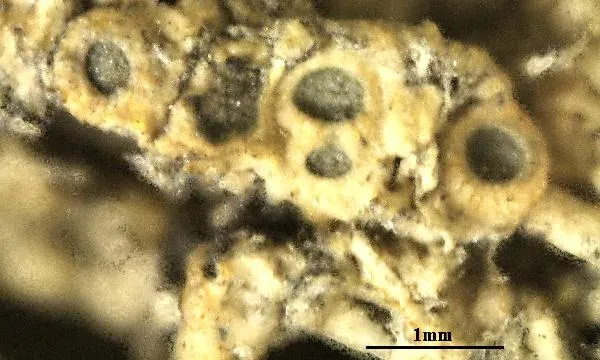
Megaspora verrucosa presents as a crustose lichen that forms grayish-white or ash-colored thalli on the surface of tree bark.
The colonized areas typically resemble a granular or wart-like crust, adhering tightly to the substrate, which makes it challenging to remove without damaging the bark.
A distinctive feature of this lichen is the presence of numerous apothecia, which appear as small dark, disc-like structures embedded within the thallus.
As the lichen matures, it expands across the bark, covering larger areas of the trunk and primary branches, often resulting in a roughened appearance.
Unlike parasitic fungi, this organism does not deeply penetrate the tree tissues, yet its presence often indicates a surface that has become aged or neglected.
Pathogen
The organism is a lichenized fungus identified as Megaspora verrucosa, which exists in a symbiotic relationship with green algae.
It is not a true plant pathogen, as it does not derive nutrients from the tree's sap or tissues, using the tree exclusively as a physical support.
Biologically, it belongs to the group of crustose lichens that have evolved to survive in environments with limited access to water and nutrients.
Reproduction is facilitated by spores produced in the apothecia, which are dispersed by wind and rainfall to colonize new bark surfaces.
The thallus structure is remarkably resistant to harsh environmental conditions, allowing it to colonize both deciduous and coniferous tree species successfully.
Conditions for development
Development is primarily favored by high ambient humidity, low light penetration, and the presence of stable, aging bark on the tree surface.
Lichen colonization is most frequent in poorly managed orchards where trees lack regular pruning, leading to poor air circulation within the canopy.
A lack of sanitary practices, such as failing to clear the trunks of debris or moss, creates an ideal microclimate for the germination of lichen spores.
Micro-cracks and irregularities in the bark act as anchoring points, which explains why older trees are significantly more susceptible than young ones.
Conversely, high levels of air pollution or extremely dry conditions can inhibit the spread of this epiphyte due to its sensitivity to atmospheric quality.
Why it matters
The primary concern is that the thick lichen thalli provide a protective habitat for overwintering pests, including scale insects, aphids, and mites.
The layer of lichen can trap moisture against the bark, potentially leading to increased surface softness and the development of secondary wood-rotting fungi.
Heavy colonization may impede the natural gas exchange of the bark, which can indirectly impact the overall physiological vigor of the tree.
Managing pests becomes significantly more difficult when they are hidden under layers of lichen, as standard insecticide applications may not reach them effectively.
While the lichen itself is not the primary cause of tree death, its presence acts as a indicator of diminished tree health or a lack of proper arboricultural care.
Protection
The most effective method of control involves the mechanical removal of lichen from trunks and branches using stiff-bristled brushes or specialized tools.
Whitewashing the trunks and scaffold branches with a mixture of lime and copper sulfate is a traditional and effective way to sanitize the bark surface.
- Pruning for increased airflow and light penetration throughout the canopy.
- Applying a 5% ferrous sulfate solution during the dormant season to suppress growth.
- Ensuring proper tree nutrition to promote vigorous growth and healthy bark renewal.
Modern copper-based fungicides can be utilized to help inhibit the germination and spread of lichen spores on the bark surface.
Effective management is best achieved through a comprehensive approach to orchard hygiene, rather than treating the lichen as a direct disease.
Discussion
No discussions yet — be the first.