
Megalosporaceae
Megalosporaceae
Description
Symptoms
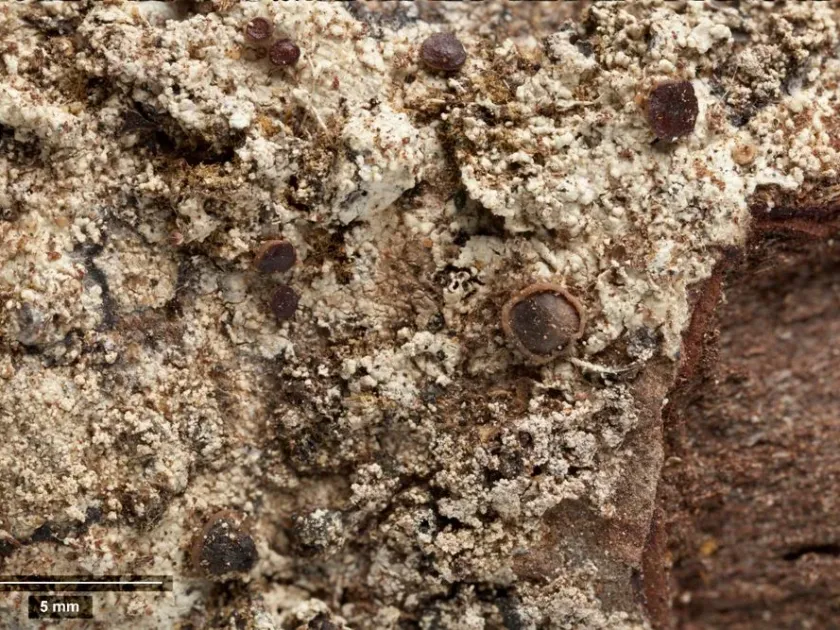
The visual signs of Megalosporaceae include crusty or scaly patches covering the trunk and scaffold branches of trees. They appear as gray, yellow-green, or brownish spots.
A distinctive feature is the presence of apothecia, which are small, disk-like fruiting bodies scattered across the thallus. These structures are essential for the lichen's reproduction.
They are tightly attached to the bark surface, appearing as an integral part of the tree's outer layer. Their appearance is generally permanent once established.
Unlike necrotic diseases or bacterial cankers, Megalosporaceae do not cause soft decay or deep wounds in the bark. The surface underneath the lichen remains firm.
These lichens are most commonly found on older trees with rough, cracked, or weathered bark, whereas young trees with smooth bark are rarely affected.
Pathogen
Megalosporaceae is a family of crustose lichens belonging to the class Lecanoromycetes. While they grow on trees, they are not pathogens in the traditional sense, as they are not parasitic.
These lichens consist of a fungal partner and a photobiont, such as algae. They utilize the tree bark merely as a substrate for attachment and do not invade the living tissues of the host plant.
The name of the family is derived from their characteristic large spores found in the apothecia. As epiphytes, they obtain their nutrition from atmospheric moisture, dust, and rainfall.
In agronomy, they are classified as indicators rather than diseases. Their presence typically signals that the bark surface is stable, moist, and suitable for colonization.
Megalosporaceae are widely distributed across various climate zones, and their biological cycle depends on slow growth and specific environmental conditions.
Conditions for development
High humidity and consistent rainfall are the primary drivers for the development of Megalosporaceae. Moisture allows spores to germinate and colonize new sections of the bark.
Poor aeration within the orchard canopy is a significant contributing factor. When trees are not pruned, the lack of air movement maintains high humidity on the trunks.
Aging trees provide an ideal environment. As bark loses its elasticity and forms crevices, it becomes the perfect habitat for lichen thalli to take root and spread.
The absence of regular maintenance and cleaning of the tree trunks allows these organisms to accumulate over several seasons. Low light conditions in dense orchards also favor their growth.
They are often found in environments with relatively low levels of air pollution. As bioindicators, their decline in a garden may sometimes suggest an increase in environmental pollutants.
Why it matters
Megalosporaceae cause minimal direct harm because they are non-parasitic. They do not extract nutrients from the tree's sap or damage the cambium layer.
The main indirect harm is the potential to create a habitat for harmful insects. Pests like scale insects, mites, and bark beetles often find refuge under thick lichen layers.
By covering the bark, lichens may slightly impede gaseous exchange, though this rarely affects the overall vitality of a healthy tree unless the coverage is extremely dense.
Excessive lichen growth can trap moisture, potentially leading to bark weathering in cold climates. This is more of a symptom of neglect than a direct attack on the plant.
For high-value commercial orchards, the presence of these lichens is often viewed as a sign of aging or a need for rejuvenation pruning to maintain aesthetic and plant health standards.
Protection
Mechanical cleaning is the most effective method for controlling Megalosporaceae. Using wire brushes during the dormancy period can easily remove crusts from the bark.
Chemical control usually involves spraying trees with copper-based or iron sulfate solutions. These treatments help sanitize the bark and inhibit the regrowth of lichens.
- Mechanical removal of lichens using brushes.
- Applying whitewash with copper sulfate to tree trunks.
- Pruning to improve orchard ventilation and sunlight.
- Maintaining vigorous tree growth through proper nutrition and hydration.
Prevention focuses on good orchard management. By replacing aging trees and ensuring healthy bark growth, the environment becomes less hospitable for lichen colonization.
Regular monitoring of the orchard allows for timely intervention before lichens become too established on the trunks and major scaffold limbs.
Discussion
No discussions yet — be the first.