
Dusky puffball
Lycoperdon nigrescens
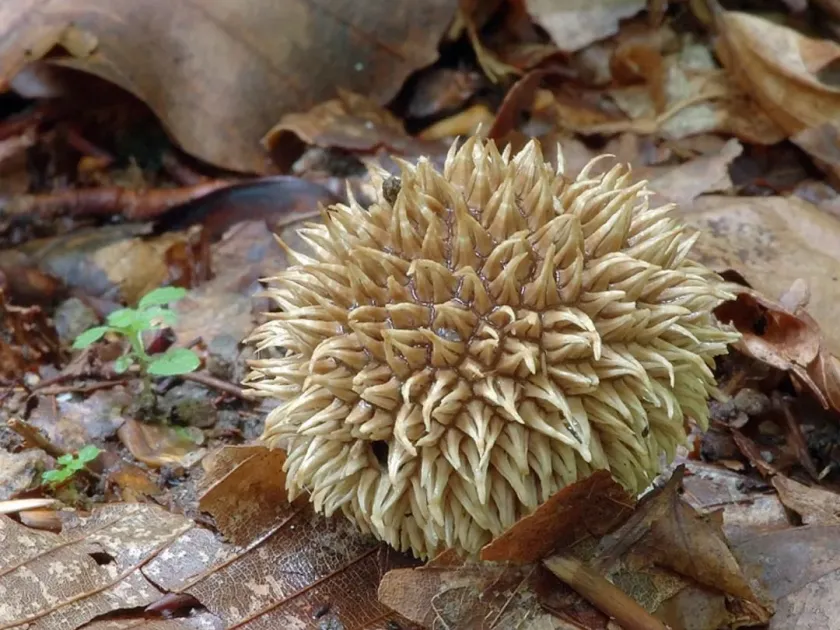
Description
Pathogen
The Dusky puffball (Lycoperdon nigrescens) is a fungus in the Agaricaceae family. It is crucial to clarify that it is not a plant pathogen and does not cause diseases in agricultural crops.
The organism functions as a soil saprotroph. It is an essential part of the ecosystem as it decomposes organic matter, such as dead leaves, twigs, and other forest or garden debris.
The mycelium of the fungus spreads through the upper soil layers, secreting enzymes that break down complex organic materials into simpler, nutrient-rich compounds.
The reproductive cycle involves the formation of spherical fruiting bodies characterized by distinctive dark spines. When mature, these bodies release spores into the wind.
Because it lacks the ability to infect living plant tissue, the presence of this fungus is completely harmless to cultivated plants and requires no phytosanitary intervention.
Conditions for development
The fungus thrives in moist, shaded environments rich in decomposing organic matter. It is commonly found in gardens, forest edges, and grasslands where organic accumulation is high.
Optimal growth occurs during the late summer and autumn when temperature levels are mild and humidity is consistently high, which favors both mycelial growth and fruiting.
Soil composition is critical; the fungus prefers slightly acidic to neutral soils with a high humus content. It rarely establishes itself in dry, sandy, or highly compacted soils.
Environmental factors such as excessive use of chemical fungicides or heavy soil compaction can inhibit its development, as it relies on aerobic conditions in the topsoil.
Proper agricultural practices that improve soil structure, such as mulching, naturally create favorable conditions for the appearance of this beneficial fungus.
Why it matters
Lycoperdon nigrescens does not pose any danger to crops. It does not cause root rot, leaf spots, or any systemic diseases that could reduce harvest quality or quantity.
On the contrary, it provides ecological benefits by recycling organic matter, which increases soil fertility and enhances the availability of essential nutrients for plant roots.
There are no recorded instances of this fungus attacking living plant organs. It occupies an ecological niche that strictly involves the breakdown of non-living material.
The only potential concern for farmers or gardeners is purely aesthetic, as groups of fruiting bodies may appear on decorative lawns, which some might consider a nuisance.
No protection or control measures are necessary. It is highly recommended to encourage the presence of this fungus as it is an indicator of healthy, biologically active soil.
Discussion
No discussions yet — be the first.