
Lophodermella needle cast
Lophodermella maureri
Description
Symptoms
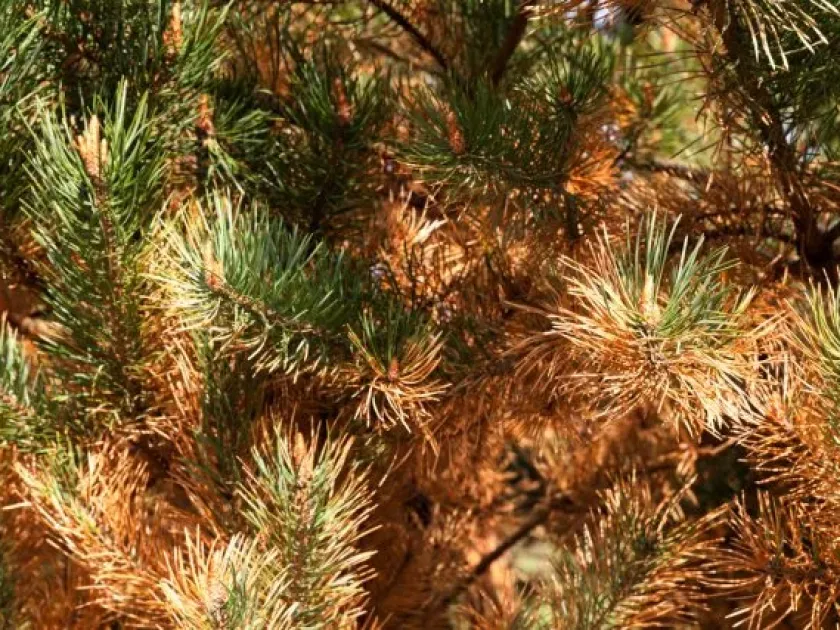
The first noticeable sign of the disease is the yellowing of pine needles in early summer. Needles infected by the fungus turn light brown or yellowish-brown, causing the tree canopy to appear visibly weakened.
Dark transverse bands are clearly visible along the infected needles, representing areas where the fungus forms its fruiting bodies. These lines serve as a characteristic diagnostic feature that helps distinguish Lophodermella from other types of needle cast.
By mid-summer, numerous narrow, elongated hysterothecia—the fungal fruiting bodies—form on the surface of dead needles. They appear as dark brown or black stripes running parallel to the needle axis.
Infected needles often drop prematurely; however, unlike other common needle casts, the mycelium often remains on the branches for longer periods, facilitating sustained spore production.
Severe infection leads to significant thinning of the canopy. In neglected cases, the tree appears sparse, which substantially reduces its aesthetic and physiological functions.
Pathogen
The causative agent of the disease is the specialized ascomycete fungus Lophodermella maureri. It is a microscopic pathogen whose life cycle is closely linked to the development of specific pine species' needles.
The fungus is classified as a parasite that primarily attacks young needles of the current year. The infection penetrates plant tissues, developing its mycelium within them.
The development cycle includes the formation of a sexual stage—hysterothecia—which open during periods of high humidity. Spores are then released and carried by wind and rain to healthy trees.
The pathogen survives in fallen needles, which act as the primary source of infection in forest stands. In spring, spores from the old litter infect new needles, initiating a new cycle of the epidemic.
The biological specialization of the pathogen limits the range of susceptible plants primarily to specific pine species, requiring careful attention when managing forest plantations and nurseries.
Conditions for development
Humid and warm weather during the spring and summer periods promotes the development of Lophodermella needle cast. Frequent rainfall and fog create an ideal environment for fungal spores to germinate on needle surfaces.
Dense plantations are at high risk. A lack of proper canopy aeration prevents needles from drying quickly after rain, creating a favorable microclimate for the pathogen to colonize.
Weakened trees, whether growing in poor soils or suffering from environmental stress, become highly susceptible to fungal infection.
Prolonged rainy periods in May and June, when spore germination and infection of new growth occur, facilitate the mass spread of the disease.
A temperature range of 15–20 degrees Celsius is considered optimal for the development of Lophodermella maureri mycelium and spore production.
Why it matters
The primary damage results from mass premature needle drop, which drastically reduces the tree's photosynthetic capacity. This leads to a significant reduction in annual wood increment.
With systematic infection over several years, trees lose their vitality. Weakened stands become more attractive to secondary pests, such as bark beetles and wood borers.
The disease poses a particular threat to young pine cultures and nurseries, where it can cause mass mortality of seedlings due to the exhaustion of their energy resources.
The reduction in the protective functions of the needles makes trees more vulnerable to unfavorable weather conditions, including winter frosts and spring droughts.
Economic losses are reflected in reduced timber quality and the need for expensive sanitation logging in affected forest areas.
Protection
The most important preventive measure is maintaining optimal planting density. Thinning dense stands improves airflow and reduces the risk of moisture accumulation.
Timely sanitation logging and the removal of fallen infected needles from the forest floor, where the main reservoir of the fungal infection resides, are essential.
In forest nurseries, effective control methods include preventative fungicide applications, particularly those containing copper, during the active growth phase of the needles.
Using resistant planting material and establishing mixed species stands help increase the overall biological resilience of forests against the pathogen.
Monitoring stand health during the spring allows for the early detection of disease outbreaks and prevents further spread to adjacent areas.
Discussion
No discussions yet — be the first.