
Lophium needle cast
Lophium
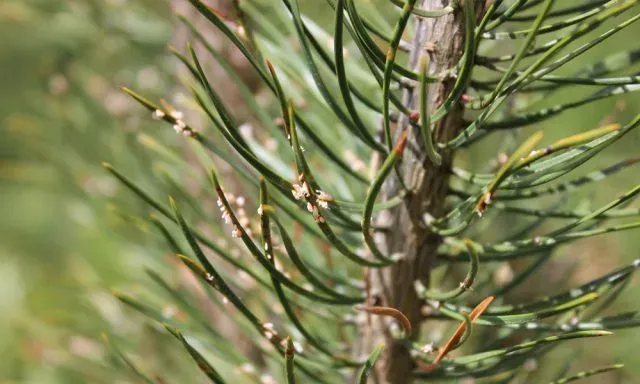
Description
Symptoms
The primary symptom of Lophium needle cast is the yellowing and subsequent browning of needles on young branches and twigs of coniferous trees.
As the infection progresses, small, black, elongated, shell-like structures called apothecia appear on the surface of the affected needles.
These fruiting bodies are arranged longitudinally along the needle and are very distinct, looking like tiny dark lines or ridges on the plant tissue.
The needles eventually turn grey, become brittle, and fall off prematurely, leading to sparse foliage and an unsightly appearance of the plant.
In many cases, the infection starts from the lower branches of the canopy, where humidity levels are higher and airflow is more restricted.
Pathogen
The disease is caused by the ascomycete fungus Lophium mytilinum, which belongs to the order Phacidiales.
It acts mainly as a weak parasite or saprophyte, colonizing tissues that are already under stress or have low vitality.
The pathogen completes its life cycle by producing spores that disperse through wind and splashing rain to infect new host tissues.
The fungus is capable of surviving on fallen needles, which makes the forest floor or the soil beneath trees a significant reservoir for the pathogen.
Biologically, Lophium mytilinum is adapted to thrive in moist microenvironments where it can slowly degrade the epidermis of conifer needles.
Conditions for development
High relative humidity and poor air circulation within the tree canopy are the most critical factors favoring the development of this fungus.
Trees located in shaded areas or deep within dense stands are more prone to infection because they remain wet for longer periods after rainfall.
Stressed trees, whether due to nutrient deficiency, poor soil quality, or pest attacks, are significantly more susceptible to colonization by Lophium.
Mild and humid spring weather provides the optimal conditions for spore germination and the initial establishment of the fungal infection.
Lack of proper pruning and canopy management prevents adequate light penetration, creating a microclimate that is conducive to the disease.
Why it matters
Premature needle drop reduces the tree's photosynthetic capacity, which leads to stunted growth and overall physiological weakness.
In landscaping, the aesthetic damage is severe, as the tree loses its density and visual appeal, often requiring expensive replacement of the plant.
In forestry settings, Lophium needle cast can weaken trees, making them vulnerable to secondary infestations by bark beetles and other borers.
Chronic infection results in the gradual dieback of lower branches, which can eventually lead to the death of the entire tree if the infestation is heavy.
The economic impact involves the costs of repeated fungicide applications and the potential loss of stock in nursery operations.
Protection
Sanitation is the most effective approach: prune and remove infected branches and collect fallen needles to reduce the spore load in the area.
Improve air circulation and light penetration through proper spacing of trees and regular thinning of dense branches to prevent moisture accumulation.
Maintain tree health through proper fertilization and watering practices to improve the plant's natural resistance to fungal pathogens.
Apply preventative fungicide sprays during the early spring growth period, focusing on systemic products that are effective against ascomycetes.
- Monitor trees regularly for the presence of black needle lesions.
- Ensure proper disposal of pruned material to prevent re-infection.
- Use copper-based or systemic fungicides as a preventative measure.
Discussion
No discussions yet — be the first.