
Lopadium disciforme
Lopadium disciforme
Description
Symptoms
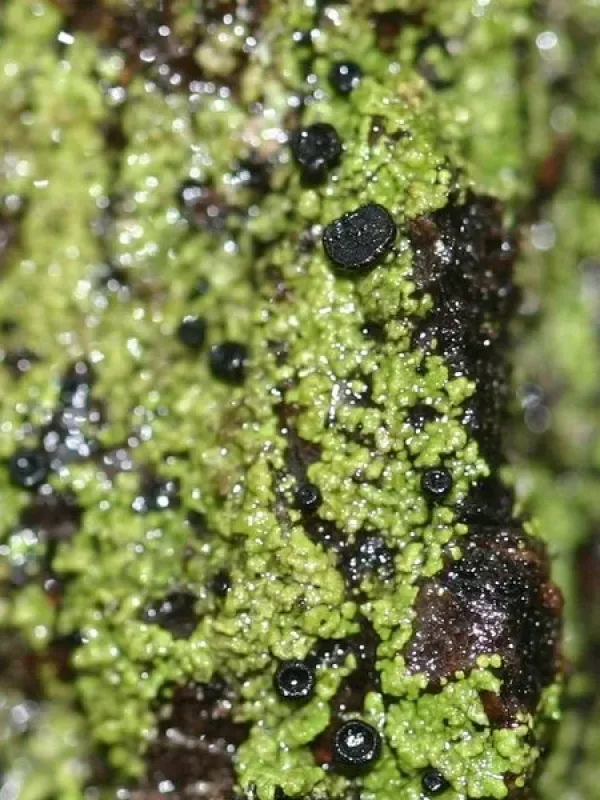
Lopadium disciforme presents as a crustose lichen that adheres tightly to the bark of deciduous trees, often forming distinct, flattened patches.
The thallus of the lichen is usually grayish to whitish, creating a visible contrast against the rough, dark bark of mature fruit trees.
The diagnostic feature of this species is its apothecia, which are disc-shaped fruiting bodies that often appear darker than the thallus itself.
These lichens can grow in colonies that eventually merge to cover large sections of the trunk, branches, or even entire limbs if left unchecked.
While not a disease in the traditional sense, the presence of these crusts can make the bark appear aged, weathered, or severely neglected.
Pathogen
Lopadium disciforme is not a plant pathogen; it is a symbiotic organism known as a lichen, consisting of a fungal mycobiont and an algal photobiont.
It acts as an epiphyte, meaning it uses the tree bark only as a structural substrate for support and does not feed on the tree's sap or tissues.
As a biological entity, it is classified within the division Ascomycota and relies on the surrounding environment for moisture and nutrients.
The organism reproduces through spores produced in its apothecia, which are dispersed by wind and rain to colonize new substrates on the tree.
In agronomic terms, it is considered a secondary colonizer that thrives on surfaces, but it does not possess the mechanisms to infect host plant cells.
Conditions for development
Lopadium disciforme flourishes in environments with consistently high relative humidity and low airflow around the tree canopy.
Orchards with dense, unpruned canopies provide the shaded and moist conditions required for this lichen to establish and expand rapidly.
The species prefers older trees with textured or fissured bark, which provides more surface area and shelter for the lichen to gain a foothold.
Reduced sunlight and poor garden ventilation exacerbate the growth of these organisms, making them more common in poorly managed orchards.
Periods of frequent rainfall or persistent fog are critical factors that promote the colonization and maturation of these lichen colonies.
Why it matters
The primary concern with this lichen is its ability to trap moisture against the tree bark, which can lead to localized bark softening and decay.
The dense cover of the lichen can act as a refuge for various garden pests, including scale insects and mites, providing them with protection from predators.
Excessive moisture retention creates a favorable microenvironment for secondary pathogenic fungi that can cause actual tissue necrosis or cankers.
While the lichen itself is non-parasitic, its presence often indicates a tree under stress or one that has not received adequate pruning or care.
Extensive coverage may slightly impede the bark's ability to undergo normal gas exchange, potentially affecting the tree's overall vigor over time.
Protection
Effective management focuses on improving tree health and modifying the environment to be less favorable for lichen establishment.
- Implement regular pruning to increase air circulation and light penetration throughout the canopy.
- Mechanically scrub the bark surface during the dormant season to physically remove established lichen colonies.
- Apply lime wash or Bordeaux mixture to the trunks and limbs as a protective and disinfectant measure.
- Utilize copper-based fungicides during early spring spray programs to eliminate lichen spores.
- Maintain optimal orchard nutrition and health to support vigorous bark growth and natural tree defense mechanisms.
Discussion
No discussions yet — be the first.