
Leucocintractia smut of sedges
Leucocintractia leucodermoides
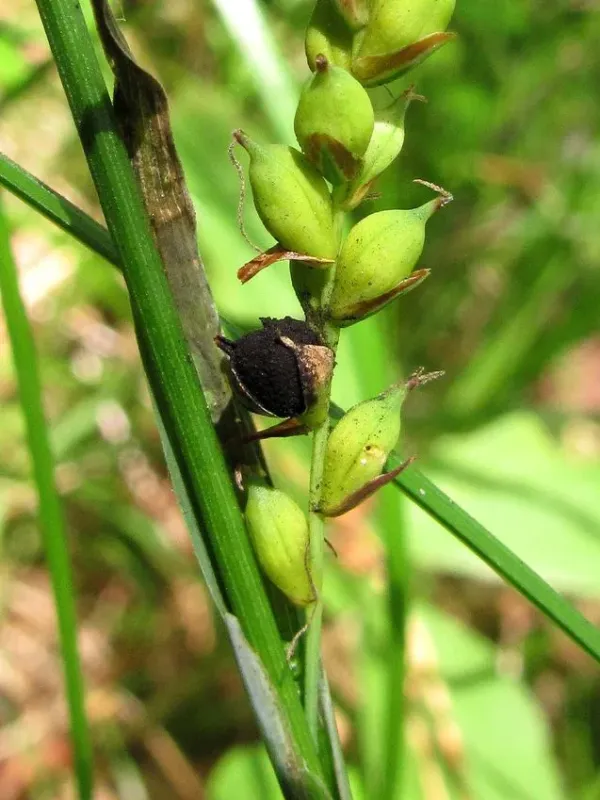
Description
Symptoms
The primary external sign of the disease is the deformation of sedge inflorescences. As the infection progresses, the spikelets develop an atypical shape, often enlarging and becoming loose and distorted.
Inside the infected spikelets, instead of healthy seeds, dense black masses of fungal teliospores are formed. Externally, this manifests as a black, powdery substance covered by remnants of the plant's epidermis.
As the spores mature, the membrane of the infected organs ruptures, and the spores are actively dispersed by wind and rain droplets. This leads to mass cross-contamination of neighboring plants within the population.
Plants affected by Leucocintractia smut often show stunted growth and poor development. Premature yellowing and drying of generative shoots are common, significantly reducing the total biomass of the stand.
In some cases, the pathogen triggers tissue hypertrophy, causing inflorescences to appear unusually large and amorphous, which serves as a clear indicator of systemic infection.
Pathogen
The causal agent of this disease is a basidiomycete fungus from the smut group, Leucocintractia leucodermoides. This pathogen is a highly specialized parasite that exclusively affects plants of the Cyperaceae family.
The fungus maintains an endophytic lifestyle, developing within the tissues of the host plant throughout the entire growing season. During its life cycle, it produces teliospores, which serve as the primary source of infection.
The fungal mycelium spreads systemically, gradually colonizing the plant's reproductive organs. Through this parasitic relationship, the pathogen accesses the nutrients necessary for the formation of its spore masses.
Morphologically, the fungus spores are adapted for long-term survival in the soil and plant debris. They possess thick walls that ensure resistance to harsh temperature fluctuations and moisture levels.
The life cycle of the pathogen is strictly synchronized with the phenological phases of the host plant. Infection often occurs via seeds or through contact between healthy tissues and spores released during the sedge's flowering period.
Conditions for development
The development of Leucocintractia leucodermoides is facilitated by high humidity in both air and soil during the early stages of sedge growth. Excessive rainfall creates a perfect environment for spore germination.
Temperature plays a critical role: moderately cool and moist weather during the spring provides the optimal conditions for infecting young seedlings or regenerating shoots.
The spread of the pathogen is intensified in areas with high plant density. Dense stands promote the formation of a humid microclimate within the vegetation layer, favoring fungal growth.
The lack of crop rotation in fodder lands or the permanent presence of sedges in the phytocenosis creates ideal conditions for the accumulation of inoculum in the soil.
Windy weather during the spore maturation period facilitates long-distance transport, leading to epiphytotic outbreaks of the disease across neighboring areas.
Why it matters
The main damage is the total or partial loss of seed productivity in affected plants. Because the pathogen targets the inflorescences, the seeds become non-viable and unable to reproduce.
The quality of green biomass is reduced, as infected plants lose nutritional value and may contain fungal metabolic byproducts that are unsuitable for livestock consumption.
In cases of widespread infection, the species diversity of meadow communities is threatened, especially where sedges play a key role as edifiers or vital components of the grassland ecosystem.
The disease weakens the host plant's immune system, making sedges more susceptible to secondary pathogens and further environmental stresses.
The economic impact on specialized seed-production fields can be critical, often resulting in the mandatory disposal of entire seed lots harvested from infected sites.
Protection
The most important preventative measure is the use of healthy, spore-free seed material. Seed treatment with systemic fungicides can effectively eliminate surface-borne infections.
It is recommended to mow the grass before the fungus enters the sporulation phase. Removing and destroying infected plants prevents the accumulation of spores in the soil for the next season.
In intensive farming, rotating crops and periodic mowing followed by deep plowing of plant residues are effective methods to manage the disease pressure.
Chemical control is justified only in seed production. Products containing triazoles or other modern systemic fungicides have demonstrated high efficacy in suppressing this pathogen.
- Ongoing monitoring of phytosanitary status during early growth phases.
- Prompt eradication of localized infection clusters.
- Strict adherence to spatial isolation between seed crops and natural sedge populations.
Discussion
No discussions yet — be the first.