
Scale insect (Coccidae)
Lecania
Description
Symptoms
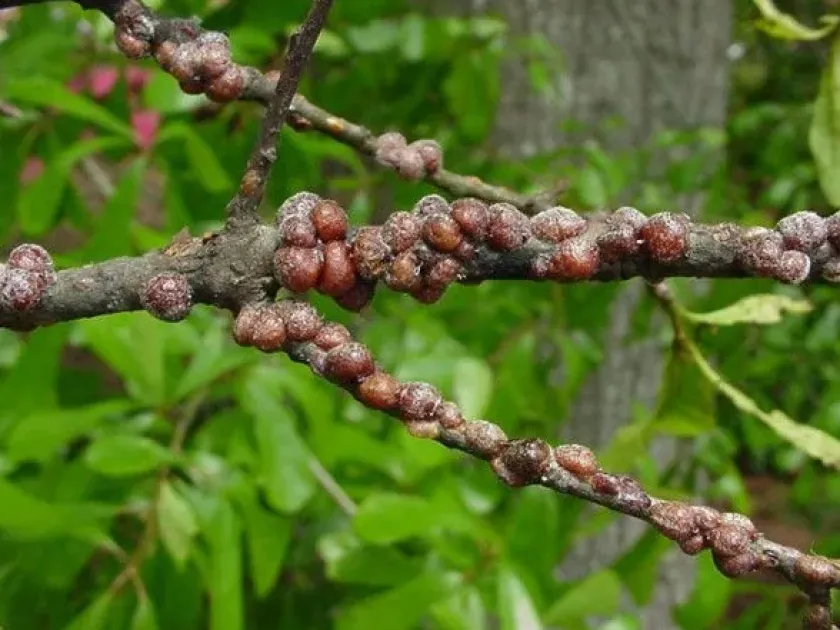
The most common sign of infestation is the presence of small, waxy, or leathery bumps on the branches, twigs, and the undersides of leaves, often brown or yellowish in color.
Another telltale sign is the secretion of honeydew, a sticky, sugary substance that coats the leaves and branches, often leading to the growth of sooty mold.
Sooty mold manifests as a black, soot-like fungal growth on the leaves, which restricts light absorption and interferes with the plant's essential photosynthetic activity.
Heavily infested plants often exhibit stunted growth, yellowing foliage, and premature leaf drop, as the insects continuously deplete the plant's nutrient reserves.
In severe cases, young shoots may appear deformed or withered, and the plant may show signs of severe general decline, becoming vulnerable to other pathogens.
Pathogen
Scale insects belonging to the family Coccidae are sap-sucking pests that pose a significant threat to a wide range of fruit trees, ornamental plants, and greenhouse crops.
Unlike armored scales, soft scales (Coccidae) lack a separate protective cover; instead, their own body wall thickens and hardens to provide protection against environmental factors.
These insects exhibit high sexual dimorphism: females are typically sedentary, while males are winged and short-lived, primarily focused on reproduction.
Their life cycle includes an egg stage, a crawler stage (nymph), and an adult stage. The crawlers are the only mobile life stage responsible for spreading the infestation to new hosts.
Because they are prolific, these pests can quickly establish large colonies on stems, twigs, and leaves, severely impacting the host plant's physiological processes.
Conditions for development
High humidity and poor air circulation within the plant canopy create an ideal environment for scale insects to thrive and for nymphs to settle and mature.
Overcrowding of plants in gardens or greenhouses promotes the rapid spread of crawlers from one plant to another, leading to a quick escalation of the pest population.
Plants that are under physiological stress due to improper watering, nutrient deficiencies, or soil compaction are significantly more susceptible to scale infestation.
Greenhouse environments with stable, warm temperatures without a clear dormant period allow scale insects to reproduce and feed continuously throughout the year.
New infestations are most commonly introduced to a location through the movement of infested nursery stock that hasn't been properly quarantined or inspected.
Why it matters
Scale insects feed by inserting their stylets into plant tissue and extracting phloem sap, which deprives the host of vital energy required for growth and reproduction.
The honeydew produced by these insects acts as a food source for ants, which in turn protect the scale insects from natural predators, further exacerbating the problem.
The accumulation of sooty mold inhibits photosynthesis, leading to reduced energy production and potentially causing the death of specific plant organs or even the entire plant.
Heavy infestations can lead to significant aesthetic damage, making ornamental plants unattractive and potentially rendering fruit crops unmarketable due to contamination.
The overall impact of scale insects can lead to long-term decline in plant vigor, rendering the host more susceptible to drought, cold, and secondary infections.
Protection
Effective management begins with strict cultural control, including thorough inspection of any new plants before introducing them into the landscape or greenhouse.
Mechanical control, such as scrubbing branches with a soapy brush or alcohol-soaked cloth, can be effective for small, localized infestations on ornamental shrubs.
Systemic insecticides are generally the most effective method for controlling scale insects, as they are absorbed into the plant's vascular system, killing the feeding pests.
Pruning out and destroying heavily infested branches can help reduce the pest population density and prevent the spread of crawlers to uninfected parts of the plant.
- Use of horticultural oils to suffocate overwintering stages of the pest.
- Monitoring for crawler activity to time insecticide applications accurately.
- Encouraging natural predators such as lady beetles and parasitic wasps.
Discussion
No discussions yet — be the first.