
Lasallia
Lasallia
Description
Symptoms
Lasallia is a genus of foliose lichens that are frequently mistaken for pathogenic diseases because they colonize the trunks and branches of woody plants.
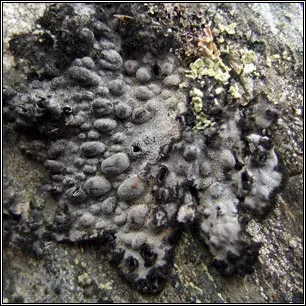
Visually, they appear as large, leathery plates or tattered patches that are firmly attached to the bark by a single central bundle of hyphae, known as a holdfast.
The thallus color ranges from grayish-brown to almost black, and the surface is often wrinkled or bumpy, making them highly visible against the bark texture.
Unlike true parasitic fungi, lichens do not have a mycelium that penetrates deep into the cambium or wood, and they do not cause decay in living plant tissues.
They are most commonly found on mature trees in orchards with high air humidity where canopy ventilation is restricted or bark growth is slow.
Pathogen
Lasallia is not a pathogen in the traditional agronomic sense, as it is a symbiotic organism consisting of a fungus and an alga living together.
Biologically, it is an epiphyte—a plant or organism that uses the tree purely as a substrate for structural support without extracting nutrients from the host.
The fungal component provides protection for the algal cells against intense UV radiation and retains the moisture necessary for the lichen's survival.
Reproduction occurs mainly through vegetative means via thallus fragments, which are dispersed by raindrops or gusts of wind to new areas on the bark.
The presence of lichens often indicates specific environmental conditions, as their metabolism is highly sensitive to pollutants and air quality.
Conditions for development
The development of Lasallia populations is most intense in high-humidity environments where bark surfaces remain damp for extended periods.
Poor ventilation and low light levels within the tree canopy are key factors that prevent bark from drying out, facilitating lichen growth.
Trees located in environmentally clean areas are more susceptible to colonization, as these lichens cannot tolerate high levels of sulfur dioxide or urban smog.
Mature trees with rough, fissured bark provide ideal anchoring points for lichen spores and subsequent thallus development.
A lack of regular maintenance, such as canopy pruning and bark cleaning, allows these epiphytes to gradually cover larger areas over many years.
Why it matters
The primary concern regarding Lasallia is that its colonies can provide shelter for overwintering pests, such as scale insects, aphids, and mites.
Dense lichen coverage on young trees may mechanically hinder normal bark expansion, potentially causing stress as the trunk increases in girth.
Persistent moisture held by the lichen layer against the bark surface can occasionally encourage secondary decay organisms or mosses.
In ornamental settings, heavy lichen colonization is often viewed as aesthetically unappealing, detracting from the overall neatness of the landscape.
While the lichen itself is not toxic to the tree, its mass presence often signals that the tree’s physiological vitality could be improved through better care.
Protection
The most effective management strategy is regular pruning of the canopy, which improves light penetration and ensures adequate airflow around the trunks.
Mechanical removal can be performed by gently scraping the bark with a wire brush during the dormant season to eliminate established lichen colonies.
Applying a dilute solution of ferrous or copper sulfate after cleaning acts as a disinfectant, helping to prevent the germination of new spores.
Regular whitewashing of the trunk with a lime-based mixture is a traditional practice that creates an unfavorable environment for lichen recolonization.
- Canopy thinning and pruning
- Mechanical bark scraping
- Copper-based fungicide applications
- Maintaining tree vigor
- Applying protective lime wash
Discussion
No discussions yet — be the first.