
Laboulbeniales
Laboulbeniales
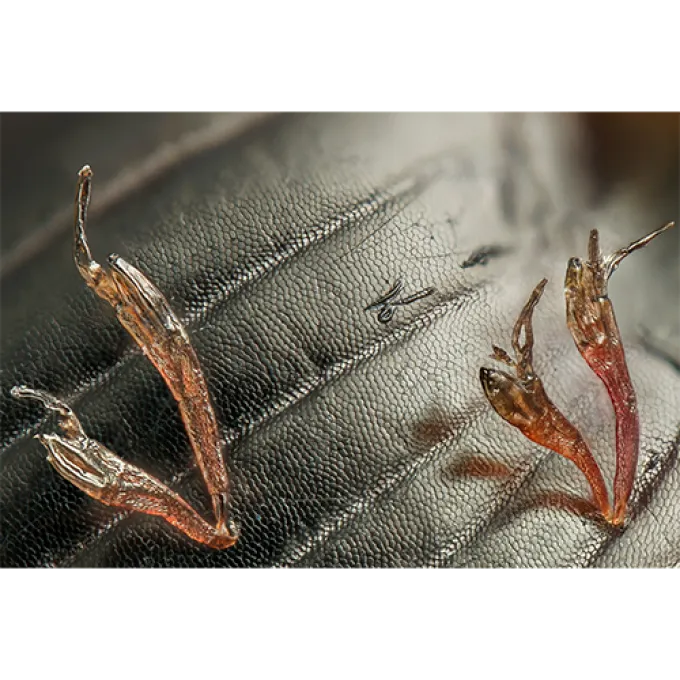
Description
Symptoms
The presence of Laboulbeniales is visible only as tiny, hair-like or bristle-like outgrowths on the exoskeleton of an insect.
These fungal structures may appear in clusters on specific body parts of the insect, such as the legs, elytra, or abdomen.
Because they are microscopic, an expert or a high-powered magnification tool is usually required to identify the presence of these fungi.
In cases of heavy infestation, a thin, fuzzy layer might be observed on the surface of the insect, but this is rare and subtle.
There are no symptoms such as leaf spots, rotting, or wilting on crops, as the fungi are entirely restricted to insect surfaces.
Pathogen
Laboulbeniales are a unique order of fungi within the Ascomycota division, highly specialized for living on the bodies of arthropods.
It is crucial to clarify that these fungi do not act as plant pathogens and have no negative impact on agricultural crops or vegetation.
The fungal body, known as a thallus, is microscopic and attaches to the insect's exoskeleton using a specialized structure called a haustorium.
They are obligate ectoparasites, meaning they grow strictly on the outer surface of their host and do not invade internal tissues.
The scientific study of these organisms falls under the branch of mycology and entomology, focusing on the co-evolution of parasites and their insect hosts.
Conditions for development
The development and transmission of these fungi are highly dependent on high population densities of specific insect hosts.
Spore dispersal occurs predominantly through direct physical contact between insects, often during mating or aggregation behaviors.
Environmental humidity and temperature levels play a role in the growth of the fungal thallus, but these factors do not impact crop health.
These fungi exhibit extreme host specificity, meaning a particular species of fungus will only infest a specific group of beetles or mites.
The life cycle is fully synchronized with the host's activity, ensuring that the parasite is moved from one insect to another efficiently.
Why it matters
Laboulbeniales cause no harm to plants and should not be considered a disease in any agricultural or horticultural context.
They do not consume plant sap, damage plant cells, or contribute to any reduction in crop quality or yield volume.
Their impact on the insect host is generally negligible, as they rarely cause the death of the insect, preferring to maintain the host's vitality.
Even when found on beneficial insects, the biological interference is usually minor and does not affect the pollination or pest control duties of the insect.
Consequently, there is no economic loss associated with the presence of these fungi in farming operations.
Protection
No control measures are required for Laboulbeniales in agriculture since they are not plant pathogens.
The use of fungicides or other chemical treatments for these fungi would be entirely ineffective and unnecessary for crop management.
Farmers should focus their plant protection efforts on actual pathogens and insect pests that directly affect the production cycle.
The presence of these fungi indicates a diverse ecosystem where arthropod populations are present, which is a normal biological condition.
No preventive practices are needed, as these organisms pose zero risk to the cultivation of any agricultural or horticultural crops.
Discussion
No discussions yet — be the first.