
Hypomyces rosellus
Hypomyces rosellus
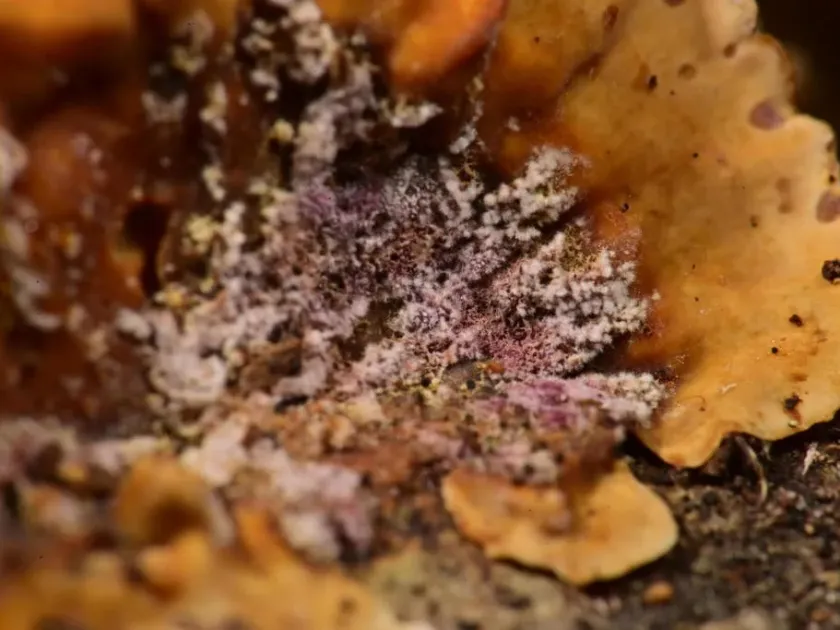
Description
Symptoms
The disease first manifests as a fine, white, fluffy mycelial growth that spreads over the casing layer and mushroom caps, often resembling a spider web, hence the name cobweb disease.
As the pathogen matures, the white mycelium often transitions to a characteristic pink, salmon, or reddish-brown color due to the formation of abundant spores.
Infected fruiting bodies lose their structural integrity, become soft, and eventually begin to decay, emitting a distinct, unpleasant, musty odor indicative of secondary bacterial rot.
Growth of the host mycelium ceases in the affected area, resulting in bare patches on the growing beds and a total failure of the mushrooms to develop into marketable produce.
- White, web-like mycelium on the casing surface.
- Development of pink or reddish pigmentation.
- Softening and decay of mushroom tissues.
- Stunted or completely inhibited mushroom development.
- Persistent bad odor in the growing room.
Pathogen
The causative agent of the disease is Hypomyces rosellus, a specialized mycoparasitic fungus that belongs to the Ascomycota division. It is widely known in the mushroom industry as the cause of cobweb disease.
The pathogen exists in an asexual state known as Dactylium dendroides. During this stage, it produces large quantities of microscopic conidia that serve as the primary source of infection for subsequent spreads.
Dissemination occurs rapidly through air currents, water droplets used during irrigation, and via tools, clothing, or pests that carry spores throughout the mushroom growing facility.
The fungus acts by colonizing the mycelium and fruiting bodies of the host, secreting enzymes that degrade tissue and inhibit the growth of the cultivated mushroom species.
Due to its rapid growth rate and ability to produce spores continuously under high humidity, Hypomyces rosellus represents a significant threat to commercial mushroom production worldwide.
Conditions for development
High relative humidity, typically exceeding 90–95%, is the primary environmental factor that promotes the germination of conidia and the rapid colonization by Hypomyces rosellus.
The fungus thrives in temperature ranges between 18°C and 25°C, which perfectly overlaps with the environmental requirements for growing commercial mushrooms like Agaricus bisporus.
Poor ventilation and air stagnation within the growing chambers create localized pockets of high humidity and spore concentration, facilitating the infection of healthy mushrooms.
Water droplets on the surface of mushrooms or the casing layer provide the necessary moisture for spores to germinate, making frequent, improper overhead watering a significant risk factor.
Inadequate sanitation practices, such as failing to remove mushroom scraps, encourage the buildup of pathogen inoculum within the facility, leading to persistent disease pressure.
Why it matters
The primary economic impact is the rapid destruction of crops. Once introduced, the disease can quickly cover an entire growing tray, rendering all mushrooms unsalable.
Because the fungus destroys the tissue of the host, the infected crop loses its quality and cannot be recovered, leading to substantial financial losses for the grower.
The persistence of spores in the structural components of the facility, such as shelves and walls, necessitates rigorous disinfection cycles, which increase production costs.
Infected crops serve as an uncontrolled source of spores, threatening the entire facility if immediate action is not taken to isolate the diseased areas from healthy ones.
The stress caused by the infection can make the remaining mushroom mycelium more vulnerable to secondary pathogens, potentially leading to total crop collapse in extreme cases.
Protection
Strict sanitation is the most effective defense. Removing all debris, cleaning tools regularly, and using properly sterilized casing materials significantly reduce the initial infection risk.
Controlling the microclimate is crucial; reducing humidity through improved ventilation and avoiding direct overhead spraying on maturing mushrooms helps suppress pathogen activity.
Upon initial detection, affected areas must be immediately isolated and treated by covering with salt or lime, followed by careful physical removal of the diseased section and surrounding soil.
Post-harvest facility disinfection using high-temperature steam or specific fungicides is mandatory to kill dormant spores and ensure the room is safe for the next production cycle.
Integrated pest management, including the control of phorid and sciarid flies that carry spores, is essential to minimize the vector-mediated spread of the disease within the farm.
Discussion
No discussions yet — be the first.