
Hypocreopsis lichenoides
Hypocreopsis lichenoides
Description
Symptoms
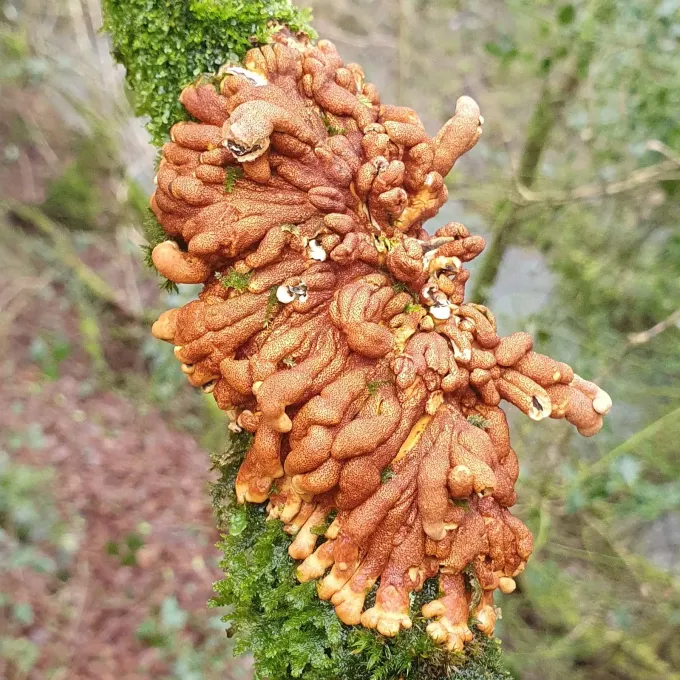
The most distinctive visual indicator of Hypocreopsis lichenoides is the presence of yellow-brown to orange-colored, lobed, and radiant stromata.
These formations grow on the surface of fungal hosts, often camouflaging the original host completely and appearing as if they are part of the host's body.
The texture of these stromata is often wrinkled, leathery, or waxy, giving them a strong resemblance to lichen species, which is why the species was named as such.
Upon closer inspection, one can identify small openings on the surface, known as perithecia, where the fungus discharges its spores into the surrounding air.
These growths are typically found on the bark of dead or decaying hardwood trees, specifically where its host fungi have established themselves.
Pathogen
Hypocreopsis lichenoides is a fascinating species of sac fungus belonging to the family Hypocreaceae. It is recognized as a strictly mycophilous fungus, meaning it spends its life cycle feeding on other fungi.
Unlike common plant pathogens, it does not infect the tissues of higher plants. Instead, it colonizes the fruiting bodies of wood-decaying fungi, primarily those within the Hymenochaete genus.
The biological nature of this organism is quite specific, as it relies entirely on the presence of its host to derive nutrients and complete its reproduction cycle.
It produces distinct, tough, and leathery structures known as stromata, which allow it to propagate through the release of spores once matured.
Because of its specific habitat requirements, it is a rare find and is considered a valuable biological indicator for ancient and well-preserved woodland areas.
Conditions for development
The growth and spread of Hypocreopsis lichenoides depend heavily on high humidity and a stable, protected forest microclimate.
It is almost exclusively found in old-growth forests or areas with a high density of deadwood where its specific host fungi thrive.
Shaded environments, such as the lower stems of birches, hazels, or willows, provide the necessary conditions for this fungus to colonize and form its characteristic stromata.
The fungus is most active during periods of high precipitation and mild temperatures, which support the vitality of its primary host.
As an ecologically sensitive species, it is rarely found in modern agricultural landscapes or disturbed environments where the natural forest structure has been altered.
Why it matters
Hypocreopsis lichenoides is entirely harmless to agricultural crops, fruit trees, and the forest ecosystem as a whole.
It does not possess the ability to digest plant matter directly, so it does not contribute to the decay or damage of trees in any way.
In fact, it can be considered a natural biological factor that regulates the spread of certain wood-decaying fungi, although its impact on total forest health is minimal.
There is no economic risk associated with this fungus, and it should not be viewed as a pest that requires intervention or monitoring.
Its presence is purely of scientific interest, serving as a sign of high biodiversity and ecological stability within the forest.
Protection
No control measures are necessary for Hypocreopsis lichenoides because it does not pose a threat to plants or human-managed landscapes.
In fact, as a rare and ecologically valuable species, it should be protected rather than eliminated if spotted in natural woodland settings.
Agricultural and forestry best practices, such as maintaining healthy tree populations, do not need to account for this fungus at all.
If the fungus happens to appear on a dead log in a garden, it can be left alone as it represents a natural component of local biodiversity.
Education regarding its role as a mycophilous, non-pathogenic fungus helps prevent unnecessary alarm and promotes the conservation of rare woodland species.
Discussion
No discussions yet — be the first.