
Hyphoderma
Hyphoderma
Description
Symptoms
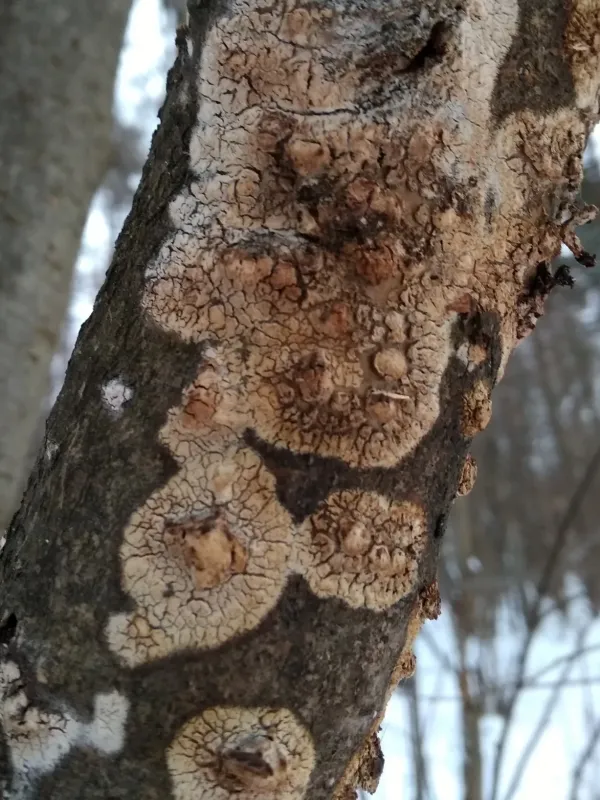
The most visible sign of Hyphoderma is the presence of thin, crust-like or effused fruit bodies on the bark of trunks or branches. They often appear as white, cream, or yellowish patches.
Infected wood exhibits signs of white rot; it becomes pale, bleached, and eventually develops a soft, stringy or spongy texture. The internal structural integrity of the wood is significantly compromised.
Above-ground symptoms on the host include canopy thinning, chlorosis, and premature leaf drop. These occur because the fungus disrupts the plant's ability to transport water and minerals effectively.
In advanced cases, one might observe dieback of secondary branches or even large scaffold limbs. The presence of mycelial mats under the loosened bark is also a common diagnostic indicator.
- Thin crust-like fungal growths on bark.
- Soft, bleached wood texture.
- Progressive dieback of limbs.
- Weakened wood prone to breakage.
Pathogen
Hyphoderma is a genus of wood-decay fungi belonging to the order Polyporales. These fungi are primary agents of white rot, which involves the enzymatic degradation of lignin and cellulose within wood tissues.
While most species are saprotrophic, playing a vital role in forest nutrient cycling, certain members of the genus can act as opportunistic pathogens on stressed or injured trees in orchards and urban landscapes.
The fungus produces microscopic mycelia that permeate the host's vascular system, drawing nutrients and breaking down structural components, which eventually leads to the softening of the wood.
Hyphoderma reproduces by forming crust-like fruit bodies on the surface of bark or decaying wood. These fruit bodies release basidiospores that are dispersed by wind or water to find new host surfaces.
The biological impact of the fungus depends heavily on the host's physiological state. Once established, the mycelium can persist for many years, slowly consuming the internal structure of the tree.
Conditions for development
Hyphoderma thrives in environments with high ambient humidity. Prolonged rainfall, fog, and poor air circulation within a canopy provide the necessary moisture for rapid fungal growth and fruiting.
Infection usually occurs through wounded surfaces. Mechanical injuries from gardening equipment, storm damage, or improper pruning cuts are the most common entry points for spores.
The ideal temperature range for mycelial growth is typically between 15°C and 25°C. Warm, humid weather patterns significantly accelerate the colonization of the host tree.
Trees under stress—whether due to drought, nutritional deficiencies, or root compaction—are substantially more susceptible to colonization compared to healthy, vigorous trees.
Neglected landscapes containing decaying stumps, logs, or woody debris serve as major reservoirs for the fungus, increasing the inoculum pressure on nearby living trees.
Why it matters
The primary harm caused by Hyphoderma is the degradation of the tree's structural support. This increases the risk of limb failure or whole-tree collapse, which poses a significant safety concern.
By consuming the xylem, the fungus severely limits the tree's hydraulic capacity. This results in the loss of vitality, stunted growth, and a marked reduction in fruit production in orchard settings.
Once the rot becomes extensive, the damage is often irreversible. The tree may survive for several years, but its physiological function will continue to decline until mortality occurs.
The fungus acts as a persistent source of infection within the ecosystem, spreading to susceptible neighboring trees and potentially leading to localized outbreaks in dense stands.
Economic losses include the cost of professional tree removal, risk mitigation, and the loss of long-term investments in perennial fruit-bearing or ornamental plantings.
Protection
Good sanitation practices are fundamental to managing Hyphoderma. Infected wood should be pruned out immediately and disposed of away from the site to prevent further spore dispersal.
All major pruning cuts should be sealed with appropriate wound dressings or fungicides to prevent opportunistic infections during the vulnerable healing process.
Promoting overall tree vigor through balanced fertilization, proper irrigation, and adequate mulching is key to enhancing the tree’s natural defenses against wood-decay pathogens.
Tools used on infected trees must be sterilized with a bleach solution or high-percentage alcohol before moving to healthy plants to prevent the accidental transfer of the fungus.
In high-value trees, therapeutic treatments involving systemic fungicides or careful surgical removal of decayed heartwood may be attempted, though professional arboricultural assessment is highly recommended.
Discussion
No discussions yet — be the first.