
Helvella macropus
Helvella macropus
Description
Symptoms
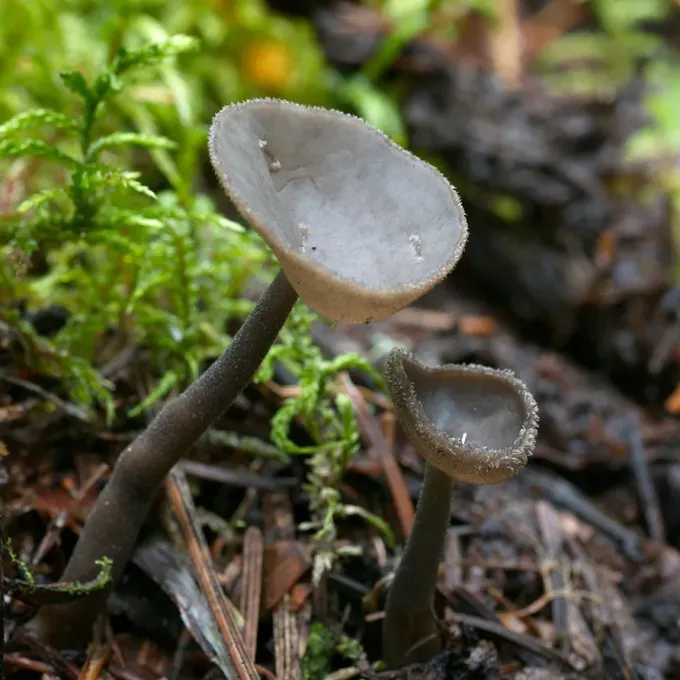
The primary sign of its presence is the appearance of fruiting bodies, typically observed from late summer through mid-autumn. These apothecia are cup-shaped or saucer-shaped, measuring approximately 2 to 5 centimeters in diameter.
The color of the fruiting body ranges from grayish-brown to dark brown, occasionally appearing nearly black. The surface texture can be slightly fuzzy or finely scaly, which often provides camouflage against the leaf litter background.
The stem is distinct, usually lighter in color than the cap, and cylindrical in shape. It is often buried within the substrate, which may require careful inspection of the ground to identify the fungi growing in the area.
Under humid conditions, the fruiting bodies appear more resilient and may darken in color. During the peak of the season, multiple specimens may be found in close proximity if the nutrient availability in the soil is high.
Microscopic analysis reveals the presence of elliptical spores. When the fungus reaches maturity, these spores are released in large quantities, often forming a light-colored spore deposit near the cluster of the apothecia.
Pathogen
Helvella macropus is a species of fungus in the Helvellaceae family. It is crucial to define that this fungus is not a plant pathogen; it does not cause diseases in agricultural or forest crops, as it functions exclusively as a soil saprotroph.
The fungus resides in forest soils and leaf litter, where it actively decomposes organic material. By breaking down dead plant matter, it plays a vital role in nutrient cycling, which is essential for the overall health of forest ecosystems.
The mycelium of Helvella macropus spreads through the upper soil layers and decomposing organic debris. It does not penetrate living tissues or roots, and therefore, it remains completely harmless to plants during its entire lifecycle.
Taxonomically, it belongs to the order Pezizales. The reproductive cycle involves the formation of cup-shaped apothecia, where spores are produced and released to disperse through the air, facilitating the colonization of new suitable forest habitats.
Despite being a fungus, it lacks the parasitic characteristics required to be classified as a plant disease. Its presence in the soil is an indicator of ecological balance and the availability of organic matter for biodegradation.
Conditions for development
High moisture levels in both soil and air are essential for the development of Helvella macropus. It prefers shaded forest environments where humidity is preserved by dense canopy cover and thick leaf litter.
Moderate temperatures ranging from 15°C to 22°C (59°F to 72°F) support the growth of the mycelium and the subsequent formation of fruiting bodies. Excessive heat and low humidity can cause the young fruiting bodies to dry out prematurely.
The soil type should be rich in humus to provide a consistent food source for the fungus. It thrives in locations where there is a deep layer of decomposing leaves, twigs, and needles, which are necessary for its metabolic activities.
Shade is a critical factor for its survival. Direct sunlight rapidly evaporates moisture from the soil surface, preventing the fungus from maintaining the hydration levels required for its reproductive cycle.
Spore dispersal relies heavily on air currents and wind. Once the spores land on a damp, nutrient-rich substrate, they germinate and form a new mycelial network, ensuring the expansion of the colony within the forest floor.
Why it matters
Helvella macropus poses no threat to crops, orchards, or managed forests. It is not a parasite, and its biological activities are confined to the decomposition of non-living biomass, making it an environmentally beneficial organism.
It does not secrete toxins or cause vascular blockages in plants. Consequently, there is no risk of yield reduction, necrosis, or plant mortality associated with its presence in the soil environment.
Some amateur gardeners may mistake its presence for a plant disease, but professional agronomic evaluation confirms that the species is non-pathogenic and harmless to high-value agricultural plantings.
Even in dense populations, the fungus does not compete significantly with living plants for water or mineral resources. Its impact on the root environment is neutral or slightly positive due to the promotion of soil organic decomposition.
The economic impact of this fungus is negligible, as it requires no intervention and does not cause damage to plants, equipment, or structures within the vicinity of its growth.
Protection
No chemical or biological control measures are required for Helvella macropus because it is not an agricultural pest or pathogen. Standard disease management protocols should not be aimed at eradicating this saprotroph.
The use of broad-spectrum fungicides for the management of other diseases may inhibit the fungus, but this should be considered an unintentional consequence rather than a management objective.
Maintaining the ecological integrity of a field or garden often involves preserving natural soil organisms. Eliminating fungi like Helvella macropus would not enhance the health or productivity of the crops.
If manual removal is preferred for aesthetic reasons in landscape or park settings, this can be done simply by collecting the fruiting bodies, which does not necessitate specialized protective gear or chemicals.
The most effective strategy is to allow the fungus to remain in its natural environment, as it plays a natural, self-regulating role in the breakdown of organic waste and the support of soil health.
Discussion
No discussions yet — be the first.