
Haematommataceae lichens
Haematommataceae
Description
Symptoms
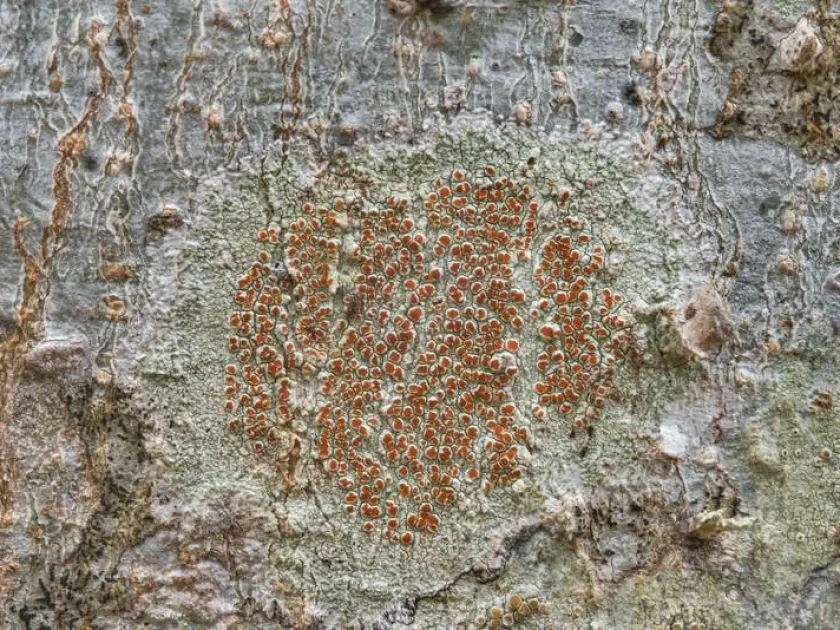
Haematommataceae lichens appear on tree trunks and scaffold branches as specific patches or crusts. They often exhibit a grayish, greenish, or whitish hue that clings tightly to the bark surface.
A key diagnostic feature is the presence of apothecia—fungal fruiting bodies that look like small, bright, disc-shaped growths in reddish, orange, or brownish colors.
Unlike other epiphytes, Haematommataceae lichens develop slowly, gradually covering significant areas of the bark, which alters the visual texture of the tree surface over time.
With prolonged infestation, the bark in areas where lichens accumulate becomes more brittle, and micro-cracks may develop, allowing other pathogens to enter easily.
The infestation usually starts on the northern, more shaded and humid side of the trunk, gradually spreading around the entire circumference if no control measures are taken.
Pathogen
The disease is caused by a symbiotic organism belonging to the Haematommataceae family, consisting of a fungal mycobiont and an algal phycobiont in a biological union.
The fungal component is responsible for anchoring to the substrate (tree bark) and absorbing minerals, while the alga provides organic compounds through photosynthesis.
This organism is not a parasite in the traditional sense, but it uses the tree exclusively as a surface for attachment, thriving on environmental resources rather than host sap.
The life cycle includes both vegetative reproduction via thallus fragments and sexual reproduction through spores produced in specialized fruiting structures.
The biological resilience of these lichens is due to their ability to enter a state of dormancy during unfavorable conditions, making them extremely hardy organisms.
Conditions for development
The primary factor in the spread of Haematommataceae lichens is high air humidity in orchards, especially in dense plantings with poor air circulation.
Neglected orchards that do not undergo regular sanitary pruning create an ideal microclimate for spore germination and the establishment of lichen colonies.
Weakened trees with damaged bark or slow growth rates are most susceptible to colonization, as lichens find it easier to attach to older, rougher bark surfaces.
A lack of proper maintenance, including regular trunk whitewashing and cleaning mosses from the bark, facilitates the rapid expansion of these epiphytes across the plot.
Shaded areas where moisture persists on the trunk surface after precipitation are considered optimal conditions for their metabolic activity and growth.
Why it matters
The main danger is that lichens create a favorable shelter for overwintering pests, such as scale insects, mites, and spores of various pathogenic fungi.
A dense crust of lichen on the trunk obstructs oxygen access to the bark tissues, which significantly slows down gas exchange processes and stresses the tree's health.
The presence of lichens often signals a decrease in the tree's immune system, frequently accompanied by nutrient deficiencies or impaired water balance.
In severe cases, complete coverage by lichens leads to premature bark senescence, reducing yields and decreasing the tree's overall productive surface area.
The harm is manifested indirectly by suppressing the tree's vital functions and creating secondary infection hotspots that directly damage the orchard's condition.
Protection
The primary measure is mechanical cleaning of the bark using scrapers or wire brushes during the tree's dormancy, which removes the lichen thallus without harming the cambium.
After mechanical cleaning, it is recommended to disinfect trunks with an iron sulfate solution, which effectively destroys remaining spores and lichen fragments.
Important roles are played by crown thinning and pruning, which improve air ventilation within the canopy and reduce overall humidity in the trunk zone.
Whitewashing trunks with lime mixed with copper sulfate remains a classic and effective preventive technique that inhibits the establishment of lichen spores.
To improve orchard health, maintain high agronomic standards: timely fertilization and proper irrigation enhance tree vigor and resistance to any epiphytic infestations.
Discussion
No discussions yet — be the first.