
Gymnopus fusipes
Gymnopus fusipes
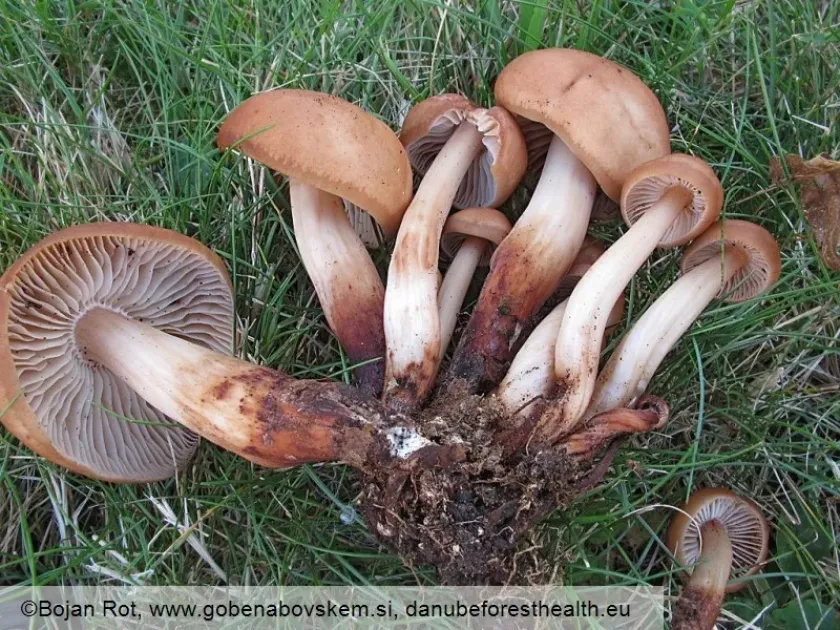
Description
Symptoms
The most visible symptom is the appearance of dense, reddish-brown mushroom clusters at the base of the trunk or on exposed roots, typically appearing in late summer or autumn.
Infected trees exhibit gradual decline, including chlorosis (yellowing of leaves), premature defoliation, and significantly reduced annual shoot growth.
Inspection of the root system often reveals deep decay, where the wood turns a reddish-brown color with thin white mycelial threads penetrating the tissues.
As the disease progresses, major structural roots die off, compromising the tree's anchorage and increasing the risk of windthrow during storms.
The internal wood becomes brittle and structurally compromised, eventually turning into a crumbly substance, which indicates severe colonization by the pathogen.
Pathogen
The disease is caused by the basidiomycete fungus Gymnopus fusipes (formerly Collybia fusipes). This pathogen acts as a wood-decay fungus targeting the root systems and the root collar of hardwood trees, particularly oaks.
The fungus functions as both a facultative parasite and a saprotroph, capable of colonizing living roots and decaying woody debris. Its mycelium actively decomposes lignin and cellulose.
A distinctive biological feature is the production of dense clusters of reddish-brown fruiting bodies at the base of infected trees. The stalks of these mushrooms are typically spindle-shaped, which is characteristic of this species.
Spores of the fungus are dispersed by wind or through direct root-to-root contact in densely populated forest stands. The fungus can persist in the soil for extended periods, awaiting a host.
The enzymatic activity of the fungus breaks down the internal wood structure, leading to loss of mechanical strength and eventual structural failure of the host plant.
Conditions for development
High soil moisture is the primary condition favoring the growth of Gymnopus fusipes, as it facilitates spore germination and mycelial spread within the roots.
Trees under physiological stress, such as those suffering from drought, soil compaction, or defoliation by insects, are significantly more susceptible to infection.
The spread of the fungus is highly effective in dense forests where root systems are interconnected, allowing the mycelium to move easily between neighboring trees.
The pathogen thrives in temperate climates, showing adaptability to various soil types and environmental fluctuations common in woodland ecosystems.
Poor drainage and stagnant water around the root zone create an environment where the fungus can rapidly colonize stressed woody tissues.
Why it matters
The primary impact of the fungus is the destruction of the root system, which severely limits the tree's ability to transport water and essential nutrients from the soil.
The resulting physiological weakness makes the infected trees highly vulnerable to secondary pests and opportunistic pathogens, accelerating the decline process.
Structural decay of the roots poses a safety risk in parks and residential areas, as the tree may fall unexpectedly due to instability caused by root rot.
Economic damage in forestry includes the loss of timber value, as the rot makes the wood unsuitable for commercial use due to internal degradation.
Unmanaged infections can lead to the formation of gap-sized dead zones in forests, negatively affecting biodiversity and ecosystem health.
Protection
Effective management requires maintaining forest hygiene, including the removal of infected trees and their stumps to prevent the fungus from spreading via root contact.
Care should be taken during site work to avoid causing mechanical damage to the roots, which serves as an entry point for fungal spores.
Promoting diverse forest stands with varied species composition can help slow down the spread of root-rot pathogens compared to pure monocultures.
Regular monitoring of forest health is essential for the early detection of symptoms, allowing for timely sanitary interventions to protect healthy trees.
Applying biological or chemical treatments to fresh stumps after clearing infected areas can help neutralize the pathogen and prevent further infection in the vicinity.
Discussion
No discussions yet — be the first.