
Gloeophyllaceous fungi
Gloeophyllaceae
Description
Symptoms
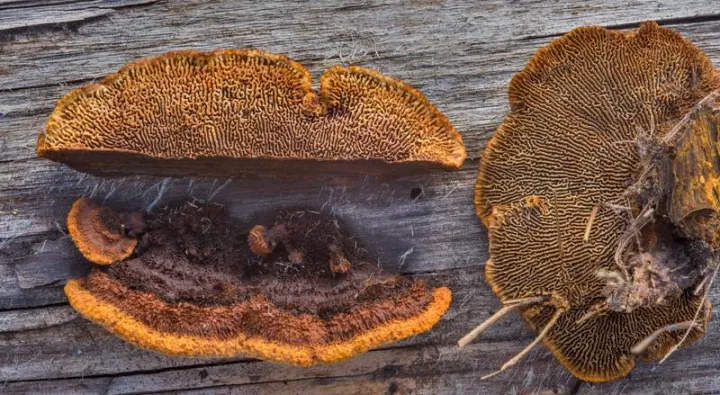
The first visual sign of infestation is the appearance of characteristic fungal fruiting bodies on the wood surface. These take the form of rigid, often effused or shelf-like formations.
The color of the fruiting bodies ranges from rusty brown to dark brown, distinguishing them from other polypores. The hymenophore often exhibits a lamellate or labyrinthine structure.
The infested wood acquires a specific brown hue, becoming brittle and fragile. In advanced stages, the material begins to crack across the grain, resulting in cubic rot.
Upon pressure, the infested area crumbles easily, losing its initial structural integrity. This makes affected objects extremely hazardous for use in construction.
The inner structure of the material becomes porous as the fungus completely consumes carbohydrate components, leaving only modified dark-colored lignin.
Pathogen
Gloeophyllaceous fungi (family Gloeophyllaceae) are a group of basidiomycete wood-decaying organisms. The most well-known and dangerous representative is Gloeophyllum sepiarium, which causes intense timber destruction.
This pathogen belongs to specialized decomposers capable of affecting both living trees and dry timber currently in industrial or residential use.
The fungus mycelium penetrates deep into the material structure, where it initiates an active enzymatic process of cellulose decomposition. Biologically, these are aggressive organisms adapted to survive in harsh conditions.
Unlike many other fungi, Gloeophyllaceae species demonstrate high resistance to extreme temperature fluctuations and moisture deficiency. Their reproductive system ensures rapid spore distribution via air currents.
Genetically, they are linked to the degradation processes of lignin and cellulose, making them some of the most dangerous agents of timber biocorroison globally.
Conditions for development
For active development, the fungus requires wood moisture levels typically between 20 and 60 percent. At critically low humidity, mycelial growth may pause but does not cease entirely.
Optimal temperatures for spore germination and mycelium formation range from +20 to +30 degrees Celsius. Major infection outbreaks are most frequently observed during the summer period.
Gloeophyllaceous fungi are highly dependent on oxygen availability, which is why they most often affect exterior timber components or areas with poor ventilation.
The fungus spores are highly resilient and capable of remaining in a dormant state for several years, awaiting favorable conditions for active parasitism.
Transmission occurs through water, wind, or wood-boring insects that carry the infection from infested areas to healthy structural elements.
Why it matters
The primary damage lies in the total loss of structural load-bearing capacity. Brown rot caused by these fungi proceeds rapidly, often destroying wood within a few seasons.
The fungus affects roof structures, timber floors, poles, fences, and railway ties. This leads to massive economic losses in construction and agriculture.
The danger is compounded by the fact that timber may appear healthy externally while internal decay is already at an advanced stage.
In agroforestry, the fungus attacks weakened trees, accelerating their death and turning forest stands into spore reservoirs that threaten nearby structures.
Indirect damage includes the high costs of replacing critical structural components and the potential risks of building collapse.
Protection
The main control method is the strict adherence to moisture standards during timber storage and application. Preventing material wetting is the key to safety.
Effective preventive measures include deep-penetrating timber impregnation with modern antiseptics, which inhibit the germination of pathogen spores.
- Regular inspection of timber structures for fruiting bodies.
- Ensuring continuous ventilation in roof spaces and basements.
- Prompt removal of infested sections, ensuring a buffer of healthy wood is also cut.
- Isolation of timber from direct contact with soil and concrete surfaces.
In case of infestation outbreaks, deep-penetrating fungicidal compounds must be applied to treat adjacent surfaces.
To prevent spore spread, it is recommended to dispose of heavily infested timber through thermal destruction (burning) at a safe distance from buildings.
Discussion
No discussions yet — be the first.