
Geosmithiosis
Geosmithia
Description
Symptoms
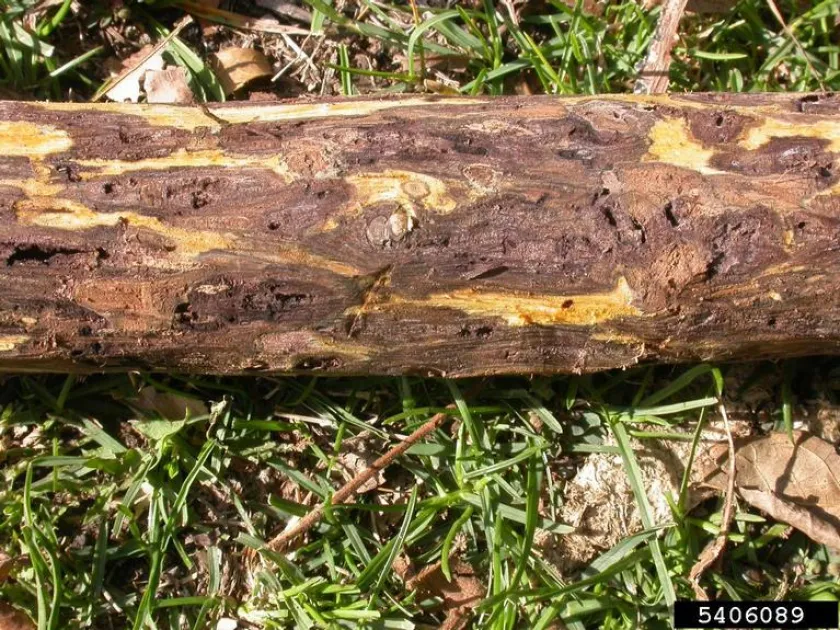
The primary diagnostic sign of geosmithiosis is the presence of small entry holes made by wood-boring insects. Around these entry points, the bark often shows slight discoloration or cracks.
Peeling back the bark in infected areas reveals localized necrosis. The cambium layer typically turns dark brown or black, indicating that the fungus has successfully invaded and killed the host tissues.
As the disease progresses, the canopy shows signs of stress, including premature yellowing and thinning of leaves or needles. This is a direct consequence of the disruption in nutrient and water transport.
A distinctive feature of this fungal infection is the presence of sporulation on the surface of the bark or inside insect galleries. This manifests as a powdery mass that can be white, cream, or yellowish.
- Entry holes from wood-boring insects.
- Localized bark necrosis.
- Darkened cambium layer.
- Premature canopy thinning.
- Visible fungal sporulation on bark surfaces.
Pathogen
The causal agents of this disease are microfungi belonging to the genus Geosmithia. These fungi are often found in close association with bark beetles, which act as primary vectors for spreading the spores to healthy trees.
Geosmithia species are characterized by their specific conidiophores, which form brush-like structures. They are primarily saprotrophic but can act as opportunistic pathogens when trees are weakened by external factors or insect attacks.
The disease is categorized as a bark and vascular necrotrophic infection. Once the fungus enters the tree through insect-made galleries, it colonizes the phloem and cambium, actively consuming the tree's living tissues.
These pathogens have a broad host range, affecting various broadleaf and coniferous species across different geographical regions. Recent research highlights their role in decline syndromes of forest stands worldwide.
The biological success of Geosmithia is closely linked to its ability to survive within the tunnels created by xylophagous insects, allowing it to bypass the tree's natural physical barriers like thick bark.
Conditions for development
The development of geosmithiosis is heavily influenced by tree vitality. Trees suffering from environmental stress, such as severe droughts, waterlogging, or soil compaction, are significantly more susceptible.
The presence and activity of bark beetles serve as the main catalyst for the disease. Higher pest density leads to a greater number of inoculation sites, facilitating the rapid spread of the fungus.
Temperature plays a crucial role in the growth rate of the pathogen. Optimal temperatures ranging from 15 to 25 degrees Celsius encourage the fungal mycelium to expand rapidly through the tree's vascular system.
Humidity levels within the bark and surrounding the tree are essential for spore germination. Higher humidity during the growing season allows the fungus to establish itself more effectively in the phloem.
Improper forestry practices, such as failing to remove logging slash or leaving dead trees in the forest, provide an abundant reservoir for both the beetles and the fungus to multiply.
Why it matters
Geosmithiosis poses a significant threat to timber production and landscape conservation. The loss of cambial activity results in the irreversible stunting or death of the affected tree.
The disease causes substantial financial losses by degrading timber quality. Wood affected by the fungal mycelium often shows staining, which reduces its commercial value in the lumber industry.
In ornamental and urban forestry, the disease can lead to the loss of mature trees, which are difficult and expensive to replace. This impacts the aesthetic and ecological value of public parks and gardens.
Widespread infection within a stand can result in significant mortality, leading to gaps in the forest canopy. These gaps, in turn, alter the microclimate and can invite other opportunistic pests and diseases.
The synergistic relationship between Geosmithia and bark beetles creates a cycle of degradation that is often difficult to control once a forest stand reaches a threshold of infection.
Protection
Proactive management of forest health is the best strategy against geosmithiosis. This includes regular surveys to detect early symptoms and the immediate removal of infested trees to stop the spread.
Managing the population of xylophagous insects is essential. Integrated pest management, including pheromone traps, helps keep beetle numbers below the levels that trigger severe fungal outbreaks.
Improving the resilience of trees through proper care and site selection reduces susceptibility. Healthy, well-watered, and appropriately spaced trees can often defend themselves against minor fungal incursions.
For high-value ornamental trees, surgical treatment may be employed. This involves carefully cutting away the necrotic bark area to reveal healthy tissue and applying professional-grade fungicides.
Disinfection of tools used for pruning or tree care is a critical hygiene step to prevent the accidental transmission of spores from infected trees to healthy specimens.
Discussion
No discussions yet — be the first.