
Fusarium head blight
Fusarium asiaticum
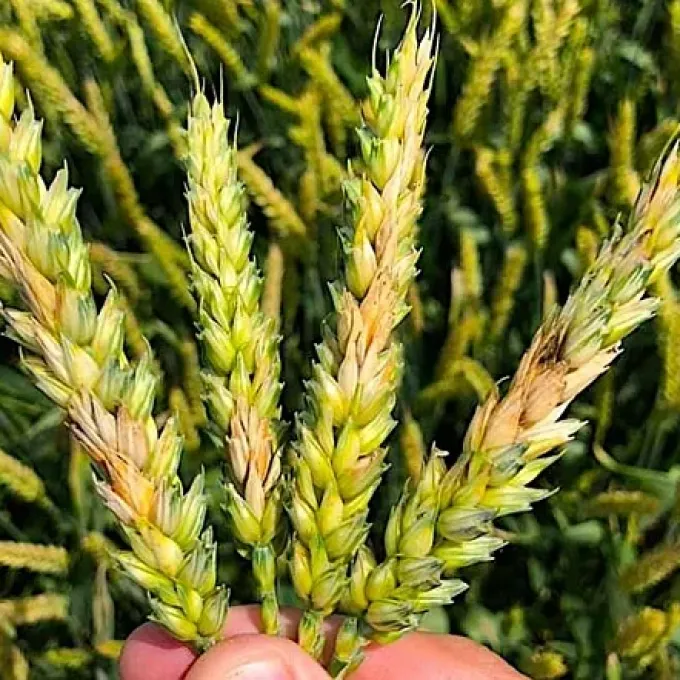
Description
Symptoms
Symptoms typically appear during the milk stage of grain development. Affected spikelets turn prematurely bleached or pale, appearing in stark contrast to the surrounding healthy green tissues.
A characteristic sign is the emergence of a pink or orange-colored mycelial growth and conidial mass at the base of the glumes. This growth is most visible under high humidity conditions.
If the rachis is infected, the nutrient transport to the upper parts of the head is blocked, causing the entire top of the head to die and turn necrotic prematurely.
The infected grains often become shriveled, discolored, and covered with white or pinkish fungal mycelium. In severe cases, the grains may be completely consumed by the pathogen.
- Premature whitening of individual spikelets.
- Visible pink/orange fungal sporulation on the head.
- Formation of shriveled, light-weight, and discolored kernels.
- Potential death of the entire head structure.
Pathogen
The causative agent of the disease is the fungus Fusarium asiaticum, a member of the Fusarium graminearum species complex. This pathogen is highly specialized in infecting the floral tissues of cereal crops.
The fungus survives in crop residues and soil, using them as a reservoir for annual infections. It also spreads via infected seeds, which can transmit the pathogen into the new growing season.
The lifecycle involves the production of conidia that are disseminated by rain splash and wind. During the anthesis stage of wheat, the fungus infects the heads, colonizing the spikelets and developing rapidly under favorable conditions.
Fusarium asiaticum is particularly noted for its high capacity to produce toxic secondary metabolites, such as nivalenol and deoxynivalenol, which contaminate the grain.
Advanced taxonomic research has clearly identified this species as a distinct entity, allowing for targeted breeding efforts and better understanding of its epidemiological patterns.
Conditions for development
The development of Fusarium head blight is heavily dependent on moisture. Frequent rainfall, high humidity, and overcast skies during the anthesis stage provide the necessary conditions for infection.
Temperatures ranging from +20°C to +28°C are optimal for the growth and colonization of Fusarium asiaticum within the wheat head tissues.
Reduced tillage practices, while beneficial for soil structure, often leave large amounts of crop residue on the surface, which promotes the survival and dispersal of fungal spores.
Crop rotation sequences involving wheat after maize significantly increase the risk of infection, as both crops share similar Fusarium species as pathogens.
Microclimatic factors, such as stagnant air and prolonged leaf wetness, create a perfect environment for the conidia to germinate and penetrate the floral tissues effectively.
Why it matters
The primary danger of Fusarium head blight is the accumulation of mycotoxins in the grain. These toxins pose severe health risks to humans and livestock, causing acute or chronic poisoning.
The disease causes a substantial reduction in yield weight and grain quality. Affected kernels often have poor germination rates and produce weak seedlings if used as seeds.
Economic damage is significant, as contaminated grain is frequently rejected by millers and grain traders, forcing farmers to bear the losses of unsold or degraded harvests.
Mycotoxins produced by the fungus are heat-stable and generally survive the milling and baking processes, presenting a persistent food safety concern for the entire supply chain.
In epidemic years, the disease can cause devastating losses, affecting large geographic areas and significantly impacting the availability of safe, high-quality milling wheat.
Protection
Effective management begins with proper crop rotation. Avoiding wheat following maize is essential to minimize the primary inoculum pressure in the fields.
Deep plowing or mechanical shredding of crop residues helps to bury and decompose the infected material, thereby reducing the availability of fungal spores for future infections.
Selecting and planting resistant cultivars is a key component of an integrated pest management strategy, providing a baseline of protection even in favorable environmental conditions.
Chemical control involving the application of fungicides during the early flowering (anthesis) phase is critical. Timing is essential, as the application must occur before the fungus successfully colonizes the grain.
Seed treatment with high-quality fungicides protects the germinating seedlings from soil-borne pathogens and ensures a uniform and healthy crop establishment.
Discussion
No discussions yet — be the first.