
Flavoparmelia soredians
Flavoparmelia soredians
Description
Symptoms
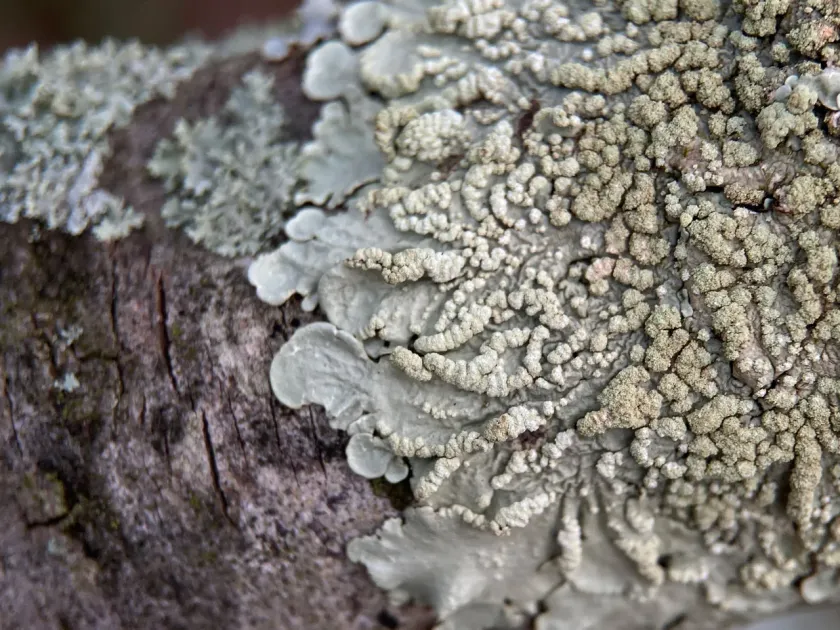
The most prominent sign of infestation is the appearance of yellowish-green or grey circular patches on the trunk and limbs. These patches represent the lichen thallus, which adheres tightly to the bark, gradually expanding outward.
A key identifying feature is the presence of soredia—dusty, granular structures on the surface of the lichen thallus. These structures distinguish it from other crustose lichens that do not show this powdery texture.
Affected bark may lose its natural texture, appearing rougher and potentially showing fine cracks. If the lichen is scraped away, the underlying bark may appear discolored or damp, indicating that the lichen has altered the moisture balance of the tree's exterior.
During dry conditions, the edges of the lichen may curl slightly, revealing the underside and giving the colony a shaggy or layered appearance. This indicates active growth and successful adaptation to varying weather conditions.
Colonies usually start on the shadier, more humid sides of the tree trunk. Over time, if left untreated, the colonies merge, creating a continuous layer that completely masks the original bark, which is a major concern for visual health inspections.
Pathogen
Flavoparmelia soredians is a foliose lichen species that frequently colonizes the bark of trees in orchards and forests. While it is not a pathogenic fungus that invades plant tissues directly, in agricultural contexts, its presence is often viewed as a sign of declining tree vigor.
Biologically, the lichen is a symbiotic organism comprised of fungi and algae. It uses the tree surface merely as a substrate for attachment. However, its growth pattern has significant long-term implications for the host plant's microenvironment.
The lichen propagates primarily through soredia—powdery vegetative propagules that are easily dispersed by wind and rain. This high dispersal capacity allows the lichen to spread rapidly across healthy trees within an orchard.
As an epiphyte, it grows relatively slowly but can form extensive colonies that eventually cover significant portions of the trunk and primary branches. Over time, these colonies become quite thick, effectively isolating the bark from the surrounding environment.
The presence of Flavoparmelia soredians is often an indicator of stagnant air, high humidity, or poor orchard ventilation. It thrives on weakened trees where the natural exfoliation of bark is slower, providing a stable surface for colonization.
Conditions for development
The development of Flavoparmelia soredians is strongly correlated with high ambient humidity. Orchards with dense canopy structures that restrict airflow are at a significantly higher risk for lichen accumulation.
Older trees are especially susceptible due to the nature of their bark. Rough, aged bark provides numerous crevices where moisture and organic debris collect, facilitating the initial spore or soredia attachment.
Poor orchard management practices, particularly the lack of regular pruning, play a major role. Insufficient light penetration into the lower canopy creates the stagnant, shaded conditions that favor the rapid proliferation of epiphytic communities.
While the lichen is resilient to temperature fluctuations, it relies on consistent moisture for its metabolic processes. It can enter a dormant state during dry periods but resumes growth quickly as soon as moisture levels rise.
Proximity to unmaintained areas or forests acts as a source for wind-borne dispersal of soredia. Once an orchard has a few colonized trees, the lichen can spread efficiently to adjacent, healthier trees unless preventive measures are taken.
Why it matters
The primary concern is the interference with gas exchange. Tree bark contains lenticels, which are essential for respiration. A thick layer of lichen acts as a physical barrier, blocking these pores and causing chronic hypoxia in the bark tissues.
Lichen colonies trap moisture against the bark, creating a permanently damp interface. This environment is ideal for secondary infections, including fungal decay and bacterial colonization, which can penetrate deeper into the tree's vascular system.
The structure of the lichen provides excellent protection for various orchard pests. Pests such as aphids, scale insects, and codling moth larvae often overwinter successfully within the sheltered folds of the lichen thallus.
Although the lichen does not extract sap directly, it competes for nutrients and moisture that wash down the bark during rainfall. This competition weakens the tree's overall vigor and reduces its ability to recover from environmental stress.
Long-term colonization leads to premature aging of the bark and reduced tree productivity. Trees heavily covered in lichens are generally more vulnerable to mechanical damage, frost cracks, and additional pathogenic diseases.
Protection
Mechanical cleaning is the most effective initial step. Use soft wire brushes, wooden scrapers, or specialized tools to remove the lichen manually. Ensure that debris is collected on a cloth to prevent further dispersal of soredia in the orchard.
Applying a white wash (lime-based solution) to the trunks after cleaning is standard practice. The addition of copper sulfate to the lime mixture provides a disinfecting effect that prevents the lichen from re-establishing itself.
Regular sanitation pruning is essential for long-term prevention. Opening up the canopy increases air movement and light penetration, effectively creating an environment that is unfavorable for the growth of Flavoparmelia soredians.
Spraying trees with a 3-5% iron sulfate solution during the dormant season effectively kills the lichen. The lichen will darken, die, and eventually peel off the bark naturally as it dries out and is washed away by rain.
Maintaining high tree vitality through balanced fertilization and proper irrigation helps keep the bark healthy and resistant to colonization. A robust, fast-growing bark surface is much harder for lichen to penetrate and colonize successfully.
Discussion
No discussions yet — be the first.