
Oak powdery mildew
Erysiphe quercicola
Description
Symptoms
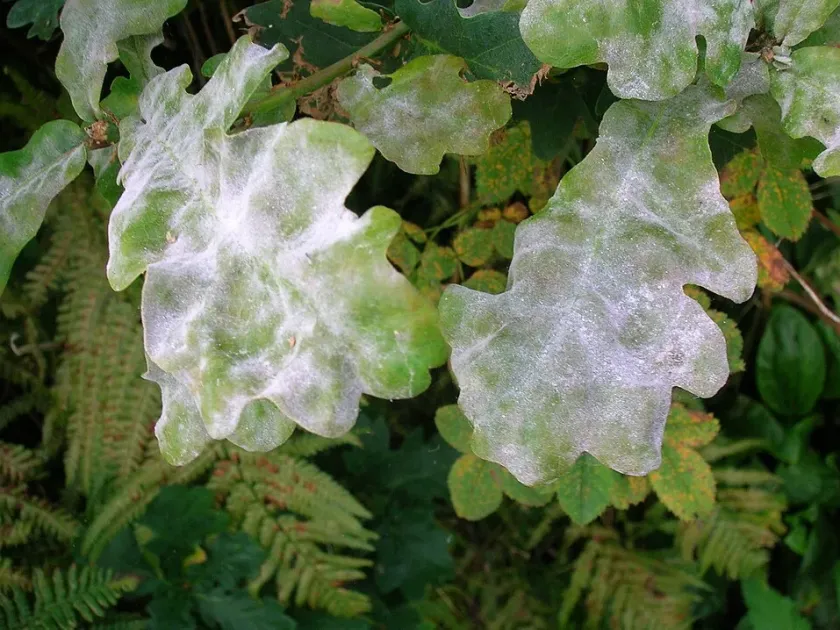
The most distinctive symptom of oak powdery mildew is the appearance of white, powdery patches on both the upper and lower surfaces of leaves. As the disease progresses, these patches expand and merge, eventually covering the entire leaf surface with a dense, white mycelial mat.
Infected leaves often become curled, stunted, and distorted. Young shoots are particularly susceptible; when attacked, they may stop growing prematurely, twist, and eventually suffer from necrosis, leading to dieback of the terminal parts of the twigs.
In mid-to-late summer, small black dots emerge on the white fungal mat. These are the cleistothecia, the sexual reproductive structures of the fungus. Their appearance is a clear diagnostic indicator that the pathogen is preparing for the winter phase of its life cycle.
Unlike other foliar diseases that cause spots or blotches, the mycelial layer of powdery mildew can often be wiped off the leaf surface. However, beneath this layer, the underlying tissue often appears discolored or withered due to the loss of photosynthetic efficiency.
In severe cases, entire branches or even the entire crown of a young tree may appear coated in white dust. This condition is aesthetically detrimental and indicates that the tree is under significant physiological stress, requiring urgent diagnostic and remedial actions.
Pathogen
The causal agent of oak powdery mildew is the pathogenic fungus Erysiphe quercicola, a member of the Ascomycota phylum. Previously classified as Microsphaera alphitoides, this fungus is an obligate parasite that depends entirely on living host tissues for survival and reproduction.
The fungus develops as a superficial mycelium on the surface of leaves and young shoots, appearing as a white, cottony layer. Through specialized structures called haustoria, the pathogen penetrates the epidermal cells of the oak to absorb essential nutrients, thereby weakening the host tree.
Infection cycles begin in the spring, triggered by conidia produced from overwintering mycelium within dormant buds or from cleistothecia (small, dark, spherical fruiting bodies) resting on fallen leaves. These spores are wind-dispersed, allowing the fungus to rapidly colonize new foliage.
The biology of Erysiphe quercicola is highly adapted to the host's phenology. It specifically targets young, actively growing tissues where nutrient concentrations are highest, ensuring optimal conditions for its proliferation throughout the growing season.
Genetic studies have highlighted the adaptability of this pathogen, which explains its wide geographical distribution and ability to survive in diverse climates. As climate patterns shift, the pressure from this fungal disease on oak populations continues to be a significant concern for forestry professionals.
Conditions for development
Oak powdery mildew thrives in conditions of moderate temperatures, typically ranging from 18 to 25 degrees Celsius. These temperatures are optimal for the rapid growth of mycelium and the efficient production of infective conidia.
High relative humidity and frequent dew formation are critical for the successful germination of fungal spores. Environments with poor air circulation, such as densely planted nurseries or shaded forest understories, provide the perfect humid microclimate for the disease to flourish.
Limited direct sunlight is another factor that exacerbates the problem. Trees in shaded positions remain wet for longer periods after rain or morning dew, providing the moisture films necessary for the fungus to establish successful infections.
Excessive nitrogen fertilization can lead to a flush of succulent, tender new growth. This rapid, soft growth is highly attractive and vulnerable to Erysiphe quercicola, leading to higher susceptibility compared to trees with slower, more balanced growth rates.
Prolonged dry spells followed by humid conditions can sometimes lead to localized epidemics. While the fungus needs humidity, it is surprisingly resilient to varying moisture levels once it has successfully colonized the host tissue.
Why it matters
The primary damage caused by oak powdery mildew is the inhibition of photosynthesis. The dense mycelial layer physically blocks sunlight from reaching the chloroplasts, while the haustoria drain the tree of the energy reserves needed for growth and winter dormancy.
For young oaks and seedlings in nurseries, the disease can be lethal. Consistent loss of new shoots disrupts the tree's architecture and vigor, often rendering the saplings stunted or deformed and entirely unsuitable for transplanting or reforestation efforts.
Chronic infestation weakens the overall immune system of the oak tree. Stressed trees are significantly more likely to be attacked by secondary pests, such as wood-boring insects, and are more susceptible to other opportunistic fungal diseases and environmental stressors.
Early leaf drop, which often occurs on heavily infected trees, deprives the tree of its essential food-producing organs during the peak growing season. This leads to reduced carbohydrate storage, which may manifest as reduced growth in the following years.
Economically, this disease represents a major challenge for the nursery industry and urban forestry. Costs are incurred through the need for labor-intensive management, the application of chemical treatments, and the unfortunate loss of valuable specimen trees or nursery stock.
Protection
Management of oak powdery mildew begins with proper site selection and planting density. Providing adequate spacing between trees ensures better airflow and quicker drying of leaves, which significantly inhibits the establishment of the fungus.
Sanitation is a vital component of control. Removing and destroying fallen leaves in the autumn reduces the primary inoculum source, as this is where the fungus survives the winter. This practice is particularly effective in small-scale nurseries and landscape plantings.
Chemical control involves the application of fungicides at the first sign of infection. Both contact fungicides (like sulfur-based products) and systemic fungicides (such as triazoles) can be effective when applied in a rotational program to prevent resistance.
- Application of sulfur-based fungicides for early infection management.
- Usage of systemic triazole fungicides to treat severe infestations.
- Pruning and disposal of heavily infected twigs and branches.
- Balanced fertilization to avoid excessive, succulent shoot production.
Biological control strategies are gaining traction. The use of hyperparasitic fungi that feed on the mildew itself offers a sustainable alternative to chemical sprays. These methods are increasingly used in public parks and urban settings where minimizing chemical footprint is a priority.
Discussion
No discussions yet — be the first.