
Powdery mildew
Erysiphe necator
Description
Symptoms
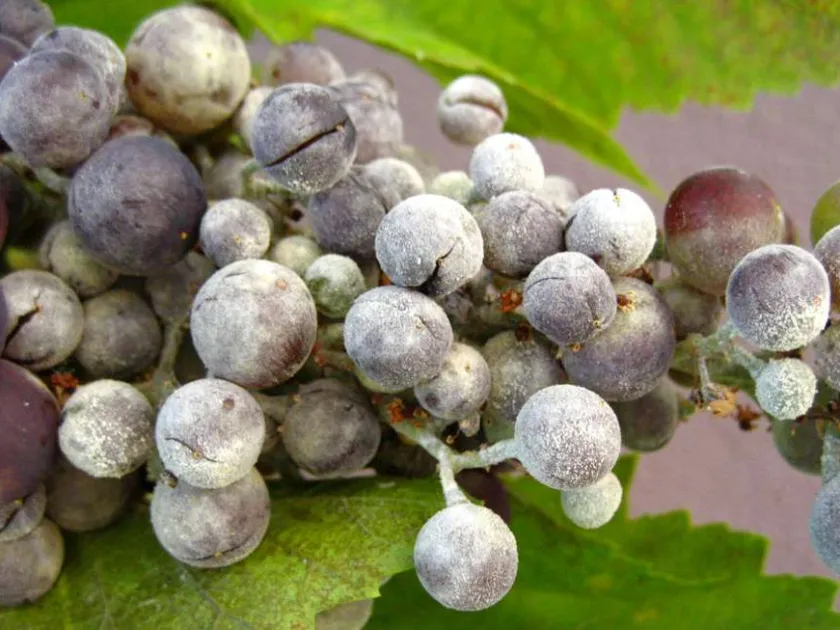
The first sign is the appearance of white to grayish-white fungal patches on the surface of leaves, stems, and fruits.
These patches look like a fine dusting of powder, which is where the common name of the disease originates.
Infected inflorescences may shrivel and fall off, causing significant crop loss before the berries even begin to develop.
As the infected berries expand, the underlying skin remains constrained, leading to severe cracking that exposes the seeds.
A distinct, musty odor is often associated with heavy infestations, often described as resembling rotten fish.
Pathogen
The causative agent of the disease is an obligate parasite, the fungus Erysiphe necator, which specifically infects grapevine tissues.
The fungus feeds by inserting specialized structures called haustoria into the epidermal cells of the host plant.
Overwintering occurs as mycelium within dormant buds or as small, dark fruiting bodies (cleistothecia) located in bark crevices.
As temperatures rise in spring, the fungus resumes growth, releasing spores that are wind-dispersed to initiate new infections.
It is a highly aggressive pathogen that can complete multiple infection cycles during a single growing season.
Conditions for development
The pathogen thrives in moderate temperatures ranging from 20°C to 26°C, with high humidity favoring rapid mycelial growth.
Unlike downy mildew, powdery mildew does not require liquid water to spread; high atmospheric humidity is sufficient for germination.
Shaded, stagnant air within a poorly pruned canopy provides the ideal environment for the fungus to multiply.
Periods of alternating hot days and mild, humid nights are particularly conducive to severe disease outbreaks.
Very high temperatures above 35°C can inhibit the fungus's growth, though they rarely eliminate the infection from the plant tissues.
Why it matters
The primary impact is the complete loss of fruit quality, as infected berries are typically unmarketable and unsuitable for high-quality wine production.
Cracked berries are highly susceptible to secondary invaders, including vinegar flies and various rot-causing fungi like Botrytis.
Severe infections reduce the vine's overall vigor by disrupting photosynthesis and depleting energy reserves in the wood.
Defoliation caused by the fungus impairs the vine's ability to harden off before winter, leading to increased cold damage.
In extreme cases, unchecked powdery mildew can destroy nearly the entire harvest and weaken the vines for the following year.
Protection
Effective management begins with canopy architecture, ensuring that light penetration and airflow are maximized through meticulous pruning.
Leaf removal in the cluster zone is a critical practice to improve fungicide coverage and lower the local humidity levels around the fruit.
A robust fungicide program is necessary, starting early in the season when the first shoots appear.
- Sulfur-based products are traditional and effective as preventatives.
- Systemic fungicides from the triazole and strobilurin classes offer excellent curative potential.
- Maintaining a clean vineyard floor and managing weeds reduces primary inoculum sources.
Rotation of different chemical classes is essential to manage the risk of the pathogen developing resistance to specific active ingredients.
Discussion
No discussions yet — be the first.