
Powdery mildew of beet
Erysiphe betae
Description
Symptoms
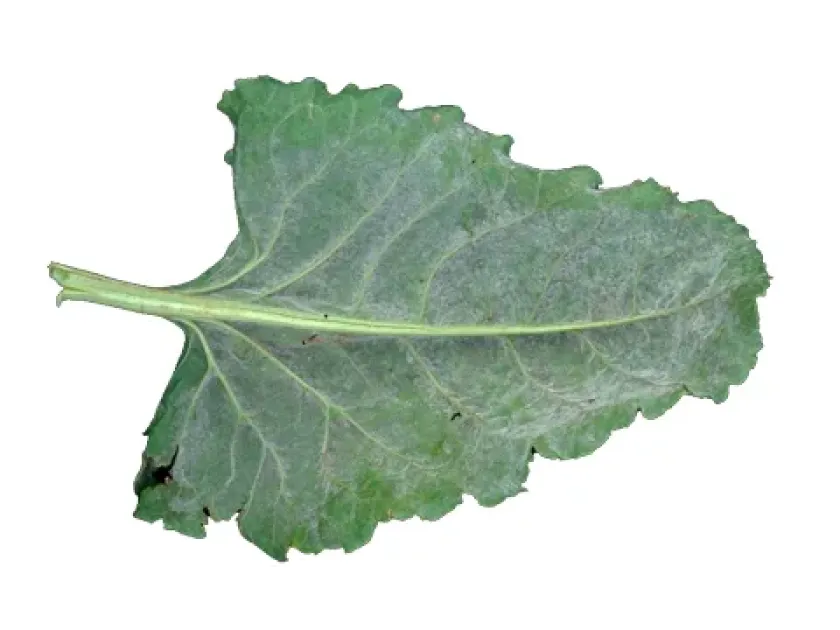
The first signs of the disease appear as small white web-like spots on the underside of older leaves. As the infection progresses, this mycelium spreads to cover both sides of the leaf, eventually creating a dense, white, powdery coating.
As the infection intensifies, the powdery layer may turn grayish or yellowish, covering the petioles and even the stalks of the beet plants. The underlying leaf tissue begins to yellow, wither, and eventually die prematurely.
Infected plants appear stunted and lose turgor, looking noticeably weaker than healthy crops. The foliage becomes brittle and prone to breaking during mechanical operations or high wind events, further reducing the plant's health.
In the final stages of the cycle, tiny black specks appear within the white powdery growth; these are the cleistothecia of the fungus. Their appearance is a clear indicator that the fungus has transitioned into its sexual reproduction phase.
A diagnostic feature of powdery mildew is that the white powdery dust can be easily wiped away with a finger, exposing the discolored or necrotic leaf tissue underneath, which helps distinguish it from bacterial blights.
Pathogen
The causal agent of this disease is the obligate parasitic fungus Erysiphe betae. As an obligate parasite, it relies entirely on living host plant tissues for its survival, growth, and reproduction throughout its entire life cycle.
The fungus infects various members of the Chenopodiaceae family, primarily sugar beet, beetroot, fodder beet, and chard. It can overwinter in the soil on crop residues through the formation of cleistothecia, which are specialized dark fungal fruiting bodies.
During the growing season, the pathogen spreads through airborne conidia that can be carried by wind currents over long distances. The mycelium grows primarily on the leaf surface, attaching itself via haustoria to absorb essential nutrients from the host.
The biological cycle of Erysiphe betae is remarkably rapid, allowing for multiple generations within a single summer. This efficiency enables the fungus to quickly build up a high infection pressure across fields even from a small initial inoculum.
This high level of specialization allows Erysiphe betae to adapt effectively to different environments, making it one of the most persistent and widespread pathogens affecting beet production globally.
Conditions for development
The development of the disease is favored by warm weather, with temperatures ranging from 20 to 25 degrees Celsius. Periodic transitions between sunny days and moderate relative humidity are ideal for rapid spore germination and spread.
Unlike many other fungal plant diseases, powdery mildew does not require liquid water (dew or rain) for spore germination. Consequently, severe outbreaks often occur during dry, hot summers when other fungal diseases are suppressed.
Dense crop stands with poor air circulation create microclimates that trap spores and accelerate the transmission of the fungus between neighboring plants. Improper plant spacing often acts as a major catalyst for rapid infection spread.
Excessive nitrogen fertilization promotes vigorous, succulent vegetative growth, which is highly susceptible to penetration by fungal hyphae. Such lush foliage becomes a primary target for the pathogen during hot and dry weather conditions.
Plant stress factors, such as extreme temperature fluctuations or nutrient deficiencies, weaken the natural immune system of the beet. This makes it easier for the fungus to colonize the leaf tissues much faster than in healthy, well-nourished plants.
Why it matters
The primary economic damage caused by powdery mildew is the loss of photosynthetic leaf area, which leads to reduced root weight and lower sugar content. These yield losses can be substantial if the infection occurs early in the season.
Premature senescence of the foliage forces the plant to divert stored energy from the root to produce new leaves, which further compromises the overall root development and the quality of the sugar produced for industrial processing.
In years with severe infection, yield losses for sugar beet can reach 20% to 30% of potential production. Early-season onset, particularly in July and August, is most critical as it coincides with the primary period of sugar accumulation.
The disease also affects seed-bearing crops, leading to poor seed set and reduced seed viability. This causes significant financial losses for seed production enterprises that rely on high-quality, high-germination seed stock.
Plants weakened by powdery mildew are more susceptible to secondary storage rots after harvest. The compromised tissue loses its natural defense mechanisms, making it an easy target for saprotrophic fungi during storage in piles or silos.
Protection
Cultural control strategies include strict adherence to crop rotation to break the fungus's life cycle. Deep plowing of crop residues is essential for burying the fungal inoculum, which significantly reduces the pressure for the following season.
The use of resistant or tolerant beet varieties is the most cost-effective long-term solution. Modern breeding programs offer a range of hybrids that show decreased susceptibility to Erysiphe betae infection.
Chemical protection involves the application of systemic fungicides, particularly those containing triazoles or strobilurins. Applications should be timed to coincide with the first appearance of symptoms to effectively halt mycelial development.
To prevent the development of fungicide resistance, it is crucial to rotate active ingredients with different modes of action. Proper calibration and application techniques are required to ensure thorough coverage of the foliage for maximum effect.
Regular field monitoring throughout the growing season is necessary to make informed decisions about fungicide applications. An integrated approach, combining good agronomic practices with targeted chemical treatment, ensures stable and profitable yields.
Discussion
No discussions yet — be the first.