
Alliaria powdery mildew
Erysiphe alliariicola
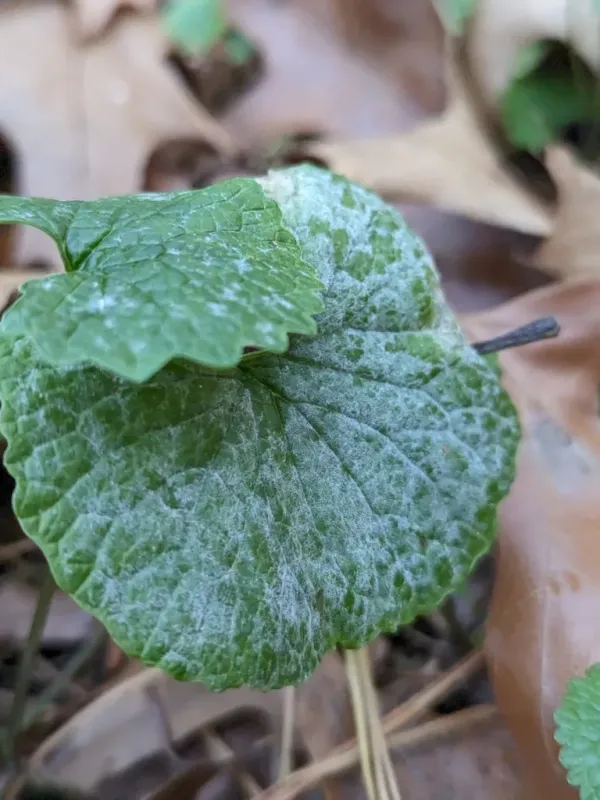
Description
Symptoms
The first and most characteristic sign of the disease is the appearance of a white, web-like or powdery coating on leaves and stems.
Over time, the coating becomes denser, takes on a grayish hue, and can cover the entire surface of the leaf blade or stem.
Underneath the coating, the plant tissue often loses its intense green coloration, gradually turns yellow, and begins to die prematurely.
During severe infection, small black dots—which are the maturing fruiting bodies of the fungus—can be observed on the surface of the mildew.
Plants infected at early stages of development show stunted growth, shoot deformation, and a significant decrease in total vegetative mass.
Pathogen
The causal agent of this disease is an obligate parasitic fungus, Erysiphe alliariicola, which belongs to the order of powdery mildews (Erysiphales).
This pathogen specifically infects plants of the Brassicaceae family, most notably the garlic mustard (Alliaria petiolata).
The life cycle of the fungus involves the growth of mycelium on the surface of the host plant tissues, which then produces conidiophores bearing chains of asexual spores.
At the end of the growing season, the pathogen develops cleistothecia—specialized fruiting bodies that allow the infection to survive throughout the winter in plant debris.
The fungus maintains an almost exclusively ectophytic lifestyle, penetrating the plant's epidermal cells only through specialized feeding structures known as haustoria.
Conditions for development
The development of Erysiphe alliariicola is favored by moderately warm weather combined with high air humidity, typical of late spring or early summer.
Optimal conditions for conidial germination include the presence of liquid water, although high relative humidity also strongly stimulates spore production.
Dense plant stands create a favorable microclimate with limited airflow, which accelerates the rapid spread of infection between neighboring plants.
Dry and hot weather may slow down the active growth of the mycelium, but it facilitates the dispersal of spores through air currents.
The presence of a significant amount of primary infection source, such as overwintered plant debris, is a critical factor for the onset of an epiphytotic.
Why it matters
The primary damage lies in the disruption of photosynthetic processes, as the dense fungal coating physically blocks sunlight from reaching leaf tissues.
The parasitic activity of the fungus drains the plant's energy reserves, redirecting nutrients toward pathogen development instead of healthy organ formation.
Heavy infestation leads to premature leaf drop, which critically reduces the overall vitality of the host plant in its natural habitat.
Damaged tissues become more susceptible to secondary infections, including bacterial rots and other pathogenic fungi.
In the long run, the disease reduces the reproductive capacity of the population, as the plant cannot accumulate enough resources for successful fruit production.
Protection
The most important preventative method is the removal and destruction of plant debris that acts as a reservoir for infection during the cold season.
Implementing horticultural practices aimed at improving airflow within plant stands significantly reduces the likelihood of mass infection.
For cultivated or ornamental plantings, the application of systemic fungicides from the triazole class is effective upon early detection of symptoms.
Preventative treatments with sulfur-based products help create an environment on the leaf surface that is toxic to the germination of fungal spores.
Practicing crop rotation and avoiding excessive nitrogen fertilization, which triggers succulent tissue growth, increases the plant's overall resistance to the fungus.
Discussion
No discussions yet — be the first.