
Entomophthora egressa
Entomophthora egressa
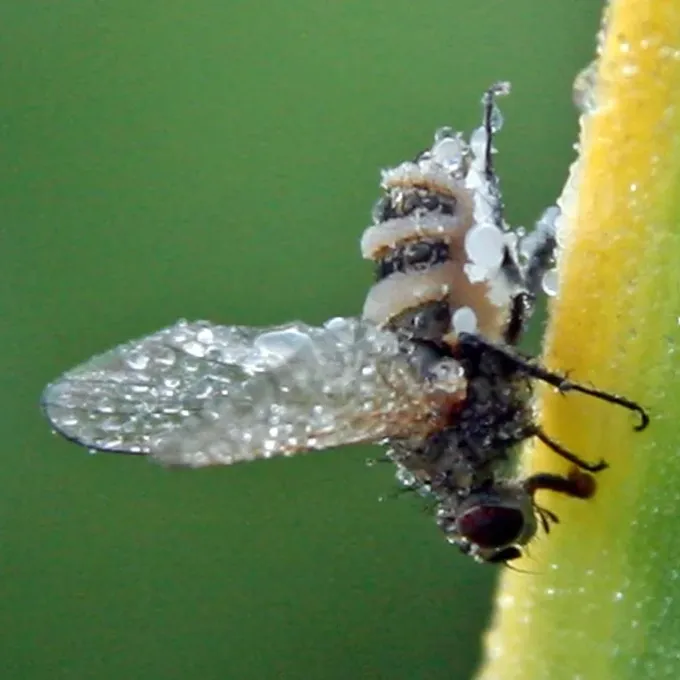
Description
Symptoms
One of the most characteristic signs of infection is a change in the insect's behavior, often involving the host climbing to the top of the plant before expiring.
Upon death, the insect is typically found firmly attached to the substrate, providing an elevated position that facilitates the dispersal of fungal spores by wind.
A visible layer of fungal growth, often appearing as a whitish or gray mat, develops on the surface of the dead host as the fungus matures.
In the field, infected insect populations often show sudden, localized mortality, which helps agronomists identify the presence of the pathogen.
Careful observation reveals that dead insects are often surrounded by clusters of others at various stages of infection, indicating a high transmission rate.
Pathogen
Entomophthora egressa is a specialized entomopathogenic fungus belonging to the order Entomophthorales. It is a biological organism that exclusively infects insects, not plants.
The fungus functions by infecting insect hosts, where it develops as a pathogen that consumes the internal tissues of the insect, eventually leading to its death.
Once the host dies, the fungus emerges through the cuticle to produce conidia, which are essential for its life cycle and the spread of the infection to new hosts.
This species is highly adapted to specific insect orders, making it a powerful tool for natural population control in agricultural landscapes.
Biological studies of this fungus provide insights into potential microbial control strategies against major crop-destroying lepidopteran pests.
Conditions for development
High relative humidity is the most critical environmental factor for the successful development and transmission of Entomophthora egressa.
Moderate temperatures allow the fungus to thrive and propagate effectively within the host, while extreme cold may slow down the infection process.
A high density of the pest population is necessary to sustain and propagate the fungal outbreak, as frequent physical contact between insects is required.
Presence of dew or moisture on plant surfaces aids in spore germination and the initial stage of infection for susceptible insects.
Agricultural practices that promote a humid microclimate within the crop canopy generally support the prevalence of this entomopathogenic fungus.
Why it matters
There is no harm caused to the crops themselves by this fungus. It is categorized as a beneficial organism in the context of agricultural production.
The fungus acts as a natural antagonist to insect pests, providing free biological control and reducing the need for synthetic chemical insecticides.
By causing epizootics among pests, the fungus can significantly lower pest pressure, preserving crop yield without the environmental cost of chemicals.
The reduction in pest populations provided by Entomophthora egressa contributes to the overall stability of the agroecosystem.
Farmers benefit from the natural suppression of lepidopteran larvae, which are among the most destructive pests in various field crops.
Protection
No control measures are needed against this fungus because it is not a plant pathogen; it is a critical component of integrated pest management.
Farmers are advised to manage the field in a way that protects these beneficial fungi, which includes reducing the frequency of broad-spectrum fungicide sprays.
Maintaining ecological balance through crop rotation and preserving natural habitats ensures the survival of entomopathogenic fungal reservoirs.
Monitoring the prevalence of fungal outbreaks in pest populations helps agronomists decide when synthetic interventions can be avoided.
- Minimize broad-spectrum fungicide application.
- Promote humid conditions in the crop canopy.
- Monitor natural pest mortality rates.
Discussion
No discussions yet — be the first.