
Entomophaga praxibuli
Entomophaga praxibuli
Description
Symptoms
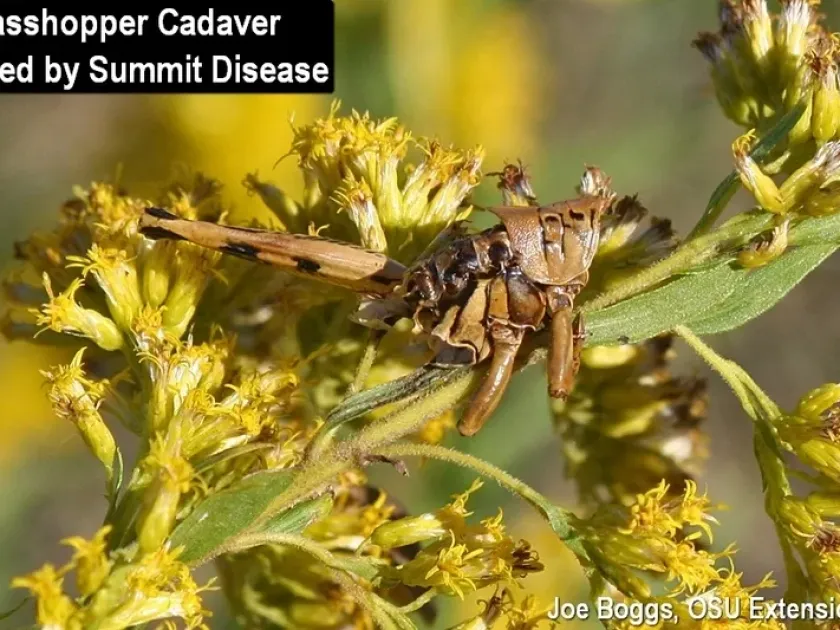
One of the first signs of infection is a distinct change in the host's behavior. Infected insects tend to climb to the upper leaves of plants and remain motionless until death.
The corpse of the insect often appears bloated or discolored due to the massive proliferation of fungal hyphae within the body cavity.
Under conditions of high humidity, a characteristic whitish or cream-colored fungal growth emerges from the insect's body, indicating active spore production.
Mass mortality events within a crop field, characterized by insects firmly attached to stems or leaves, are strong visual markers of an ongoing epizootic caused by the fungus.
A fine dusting of spores may be visible on the leaf surface beneath the cadaver, facilitating the spread of the disease to other susceptible individuals nearby.
Pathogen
Entomophaga praxibuli is an obligate entomopathogenic fungus within the order Entomophthorales. It is highly specialized, primarily targeting beetles, specifically those within the leaf beetle family (Chrysomelidae).
The fungus functions by infecting the insect host upon contact. Once the conidia germinate and penetrate the host cuticle, the mycelium rapidly colonizes the insect's body, consuming internal tissues.
As a natural regulator, it plays a vital role in suppressing pest outbreaks within various agroecosystems without direct involvement of synthetic chemical agents.
The life cycle concludes with the formation of resting spores, which allow the fungus to persist in the soil and leaf litter when hosts are not readily available or conditions are unfavorable.
Biological studies highlight its host-specific nature, making it a subject of interest for integrated pest management strategies aiming to reduce chemical reliance.
Conditions for development
Successful infection and transmission of Entomophaga praxibuli are highly dependent on high relative humidity, typically exceeding 80% to 90%.
The development of the fungus is also temperature-dependent, preferring moderate climatic conditions which facilitate optimal growth and spore germination rates.
The availability of water droplets on leaf surfaces, such as dew or light rain, is essential for the dispersal of conidia and the successful inoculation of new hosts.
High host density is a crucial factor for the rapid spread of the fungus, as it enables efficient contact transmission between infected and healthy insect individuals.
Sheltered environments and areas with dense canopy coverage often provide the microclimate necessary for the sustained activity of this entomopathogenic fungus.
Why it matters
Entomophaga praxibuli poses no threat to crops, as it does not possess the physiological mechanisms to digest or infect plant tissues.
Instead, the presence of this fungus is beneficial to agricultural productivity, as it effectively reduces the pressure from damaging leaf-feeding insects.
By naturally lowering pest populations, it serves as a self-sustaining biocontrol agent that lessens the need for frequent insecticide applications.
However, because its activity is weather-dependent, it cannot always be relied upon as a primary defense, especially during hot and dry seasons.
Overall, it is recognized as a vital component of the natural ecosystem, contributing to the biological equilibrium of the field environment.
Protection
There is no standard control method for Entomophaga praxibuli, as it is considered a beneficial organism that assists in pest suppression.
Farmers are encouraged to minimize the use of broad-spectrum fungicides, which may inadvertently inhibit the growth and survival of beneficial entomopathogenic fungi.
Implementing practices that conserve soil moisture and protect natural habitats for beneficial insects can help maintain and support the fungus population.
Integrating cultural practices like mulching can provide a stable environment for resting spores to overwinter safely in the soil or crop debris.
Promoting a balanced agroecosystem supports the naturally occurring epizootics of the fungus, enhancing the overall resilience of the crop against specific beetle pests.
Discussion
No discussions yet — be the first.