
Entomophaga grylli
Entomophaga grylli
Description
Symptoms
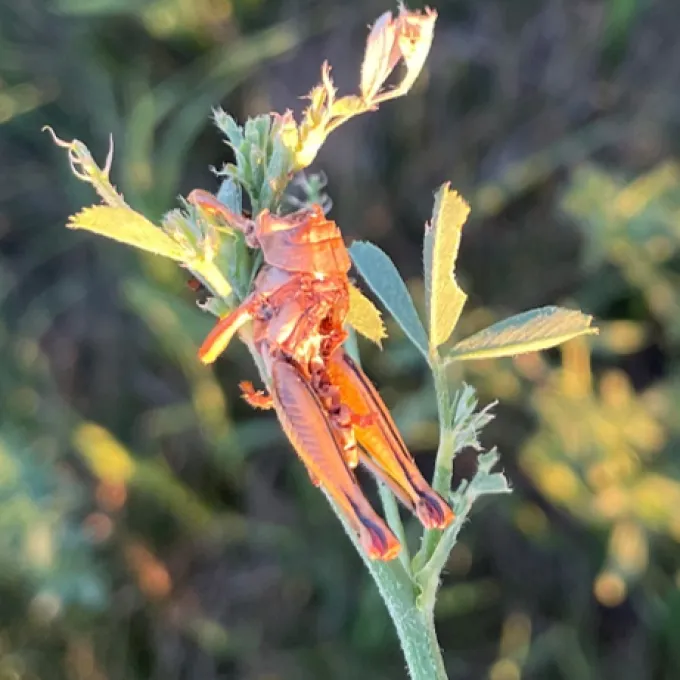
The hallmark of Entomophaga grylli infection is the behavioral modification of the host, commonly known as summit disease.
Infected grasshoppers cease feeding and climb to the highest point of nearby vegetation, such as plant tips, stems, or shrubs, before dying.
The insect grips the substrate firmly with its legs in an upright position, which facilitates the windborne dispersal of spores after the host’s death.
The body of the deceased insect often remains rigid, and in later stages, it may be covered by a layer of fungal mycelium or conidia.
This distinct behavior ensures that the fungus can infect other grasshoppers in the vicinity, effectively spreading the pathogen through the population.
Pathogen
The pathogen is an entomopathogenic fungus belonging to the order Entomophthorales, which specializes in parasitizing Orthoptera.
The fungal cycle involves the production of sticky conidia that can be easily transferred between insects during social contact or environmental movement.
The fungus also produces resistant resting spores, allowing it to persist in the soil for several seasons, awaiting favorable conditions for re-emergence.
Upon contact with the host's cuticle, the fungus utilizes enzymatic secretions to penetrate the exoskeleton and begin internal colonisation.
The mycelium consumes the host's internal tissues, eventually killing the insect after a period of rapid development.
Conditions for development
Environmental conditions play a critical role, with high relative humidity and moderate temperatures being essential for the development of fungal outbreaks.
The presence of surface moisture, such as dew or rainfall, is required for the spores to germinate and infect the insect host successfully.
High host population density serves as a major catalyst for the rapid spread of the fungus, facilitating transmission via frequent interactions.
While extreme drought inhibits fungal activity, the fungus remains viable in its resting spore stage until moisture levels rise again.
Optimal temperatures for mycelial growth typically range between 18°C and 25°C, matching the active growth phase of grasshopper populations.
Why it matters
Entomophaga grylli is considered a highly beneficial biological agent for agriculture because it acts as a natural population regulator for grasshoppers.
Epizootics caused by this fungus can lead to massive mortality among grasshoppers, significantly reducing damage to crops and pastures.
The fungus is host-specific and does not pose any risk to crop plants, humans, or livestock, making it a safe component of integrated pest management.
It provides long-term ecological benefits by reducing the need for chemical insecticides in areas where the fungus is naturally established.
In summary, the harm caused by this fungus is restricted solely to orthopteran insects, turning it into a valuable asset for sustainable agriculture.
Protection
Strategies for leveraging this fungus involve protecting the natural habitat and avoiding excessive use of broad-spectrum fungicides.
Monitoring the presence of the pathogen in the field allows farmers to make informed decisions regarding chemical application during infestation years.
Future agricultural practices aim to develop inoculation techniques, though mass-culturing the fungus for field application remains a technical challenge.
Conservation of natural vegetation and hedgerows helps maintain the microclimatic conditions necessary for fungal survival and propagation.
Integrated management plans should prioritize biological regulation as a primary tool to decrease reliance on synthetic pesticides against grasshopper pests.
Discussion
No discussions yet — be the first.