
Encoelia furfuracea
Encoelia furfuracea
Description
Symptoms
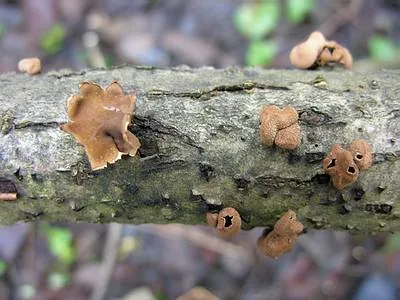
The most distinctive symptom is the presence of brown, cup-shaped fruiting bodies that emerge through the bark. These structures often resemble bran flakes or crusty patches, which gives the fungus its common and scientific names.
Affected bark areas lose their elasticity and eventually begin to crack and peel off. Beneath these sections, one can often find white to brownish fungal mats or mycelial fans, indicating active decomposition of the underlying tissue.
Wilting of the crown and premature yellowing of leaves are frequent secondary symptoms. As the fungus disrupts the phloem and xylem, the tree suffers from a progressive loss of water and nutrient transport, leading to the dieback of branches.
In advanced stages of the infection, deep necrotic ulcers appear on the trunk. If these lesions extend around the circumference of the stem, the tree will experience a total blockage of sap flow, which inevitably results in the tree's death.
The texture of the fruiting bodies varies with humidity. In dry conditions, they appear hard and leathery or cartilaginous; however, when hydrated by rain or high humidity, they become soft and gelatinous, making them more prominent.
Pathogen
The causal agent of this disease is the ascomycete fungus Encoelia furfuracea. It acts as a specialized pathogen that targets the bark and cambial layer of various broad-leaved trees, particularly alder species.
The fungus develops in the form of small, cup-shaped fruiting bodies known as apothecia. These structures arise from a dense mycelium network that colonizes the inner bark and outer sapwood, gradually breaking down the tree's vital tissues.
Biologically, it functions as a xylotrophic pathogen that feeds on wood components such as lignin and cellulose. By secreting enzymatic complexes, the fungus degrades the structural integrity of the wood, transforming living tissue into a substrate for its growth.
The reproductive cycle is heavily dependent on spore dispersal via air currents and moisture. During humid periods, the fungus releases massive amounts of spores that settle on bark fissures or mechanical wounds, initiating new infection cycles.
Mycelial growth can remain latent within the bark for extended periods. It typically awaits environmental stressors, such as drought or physical trauma to the tree, which allow the fungus to overcome the plant's natural defense barriers and spread rapidly.
Conditions for development
High humidity and moisture levels are the primary drivers for the development of Encoelia furfuracea. The fungus thrives when bark remains consistently damp, as this environment provides the necessary hydration for spore germination and colonization.
Poorly managed, dense stands often create microclimates characterized by stagnant air and trapped moisture. This lack of ventilation is highly conducive to the spread of the pathogen, allowing it to colonize new hosts more efficiently.
Tree vigor is a significant factor in disease susceptibility. Plants stressed by environmental factors like extreme temperature fluctuations, soil compaction, or nutrient deficiencies are significantly more prone to successful fungal infection.
Mechanical damage caused by maintenance activities, animal activity, or weather events provides direct entry points for the fungus. These wounds bypass the tree's protective bark barrier, allowing spores to establish deep within the trunk.
Spring and autumn periods offer the most favorable temperature and humidity combinations for the fungus. During these seasons, managers should pay closer attention to identifying potential infection sites before the pathogen gains a firm foothold.
Why it matters
The main impact of this pathogen is the degradation of wood quality, which renders timber commercially worthless. The decay process destroys the mechanical properties of the wood, making it unsuitable for structural or industrial use.
The disease causes premature decline and death of trees, which severely hampers forest regeneration efforts. Extensive outbreaks can lead to the loss of large numbers of trees, causing major ecological and economic disruption in forested areas.
Infected trees become significant safety hazards due to structural weakening. As the fungus consumes the interior wood, the risk of windthrow (uprooting by wind) increases dramatically, posing dangers in public parks, residential areas, and near roads.
The presence of the fungus often invites secondary colonization by various wood-boring insects. These pests take advantage of the tree’s weakened state, accelerating the decline and ensuring that the tree will succumb to the infestation much faster.
The long-term management of infected areas involves high costs for sanitation and removal. Preventing the spread requires constant vigilance and the implementation of expensive silvicultural practices to manage the infection reservoir.
Protection
Sanitation is the most critical component of control. Infected trees or branches should be identified and removed immediately, and the diseased wood must be burned or buried to destroy the fungal spores and stop the cycle of infection.
Maintaining high tree health is essential for prevention. Ensuring trees are well-watered, properly fertilized, and grown in appropriate conditions increases their natural resilience against fungal colonization.
During pruning or thinning operations, it is vital to keep tools sterilized. Using alcohol or fungicidal solutions between cuts prevents the accidental transfer of spores from infected trees to healthy specimens.
Applying protective wound dressings to cuts and accidental bark damage can help prevent spores from entering the tree. These sealants create a temporary barrier until the tree can form its own callus tissue.
- Regular monitoring of bark condition across all trees.
- Prompt removal and destruction of dead wood and debris.
- Thinning stands to improve air circulation and reduce humidity.
- Sterilizing all pruning tools between individual trees.
- Selecting resistant tree species for reforestation in high-risk areas.
Discussion
No discussions yet — be the first.