
Oak diplodia
Diplodia quercivora
Description
Symptoms
The first sign of the disease is premature yellowing and wilting of leaves on individual branches. Affected parts of the canopy stand out in stark contrast against the healthy foliage.
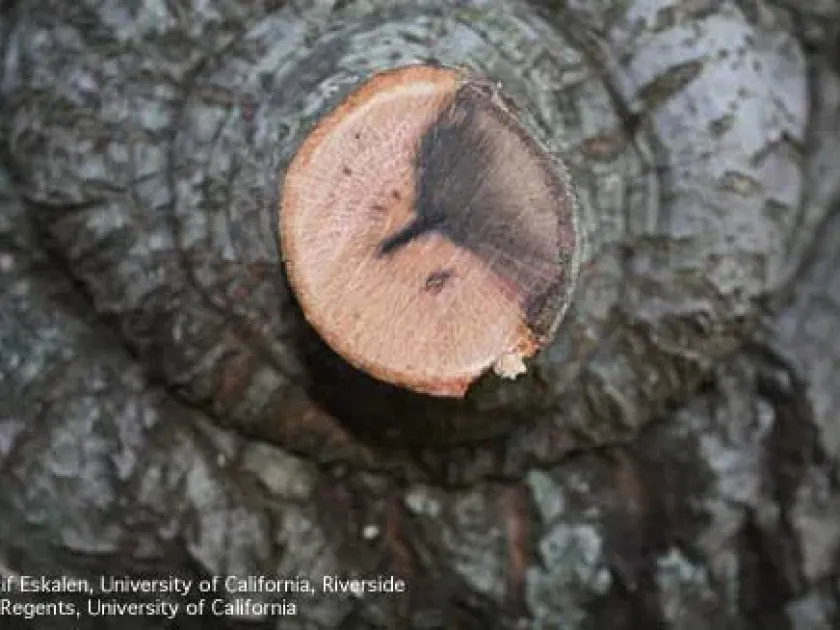
Deep necrotic lesions form on the bark of infected branches and trunks. The bark tissue dies, turns dark, sunken, and eventually cracks, exposing the underlying wood.
Upon close inspection, small black dots can be seen on the surface of the dead bark; these are the fungal pycnidia that break through the periderm.
Infection sites often exhibit exudate discharge, indicating an interruption of normal sap flow and the tree's defensive reaction to the fungal colonization.
Over time, the necrosis spreads around the branch, leading to a complete loss of nutrition for the area located above the infection site, resulting in its eventual desiccation.
Pathogen
The disease is caused by the fungus Diplodia quercivora. This pathogen belongs to the group of fungi known for causing necrotic and cankerous damage to various tree and shrub species.
The fungus develops within the tissues of the bark and cambium, gradually penetrating into deeper layers of the wood. During its life cycle, the pathogen forms pycnidia, which are specialized structures where spores mature.
The infection persists in infected branches, twigs, and fallen bark, where the fungus can survive for long periods in a saprotrophic form. Spores are actively dispersed by wind, rain splashes, and insect vectors.
The biology of the pathogen is closely linked to the physiological weakening of the tree. The fungus's aggressiveness increases significantly when the plant's protective layers are compromised by physical damage.
Oak diplodia is a systemic disease that, under favorable conditions for the fungus, can cover large areas of the canopy and trunk, ultimately causing the death of conductive tissues.
Conditions for development
The primary condition triggering an outbreak is the weakening of trees due to abiotic factors, such as prolonged droughts or extreme temperature fluctuations.
High air humidity and moderately warm weather facilitate the mass release and germination of Diplodia quercivora spores. In these conditions, the fungus becomes particularly virulent.
Violations of silvicultural standards, including excessive stand density, create a favorable microclimate for disease development due to reduced airflow through the canopy.
Various pests, such as bark beetles and wood-boring beetles, act as spore vectors and create entry points for the infection by damaging the integrity of healthy bark.
Anthropogenic factors, including air pollution and mechanical damage to trunks during forestry operations, also significantly increase the risk of oak stand infection.
Why it matters
Oak diplodia poses a serious threat to forestry, as it leads to widespread branch dieback and, in advanced cases, the death of the entire tree canopy.
The disease causes a reduction in biomass increment and degrades the quality of the timber, rendering it unsuitable for high-value construction or carpentry uses.
Stands affected by diplodia become highly susceptible to secondary pests, which complete the destruction of the already weakened trees.
In urban parks and green belts, the disease significantly reduces the aesthetic value of the trees while creating safety hazards due to falling dead branches.
Large-scale infestation sites can lead to the degradation of entire forest ecosystems, necessitating radical sanitary measures, including the removal of infected trees.
Protection
A key control measure is regular monitoring of forest health and the timely execution of sanitary logging to remove infected branches and dead trees.
It is crucial to maintain optimal forest care, avoiding overstocking, and implementing measures to improve tree resilience against adverse environmental conditions.
For high-value oak specimens in ornamental plantings, systemic fungicide treatments can be applied during the active sporulation period of the fungus.
Disinfecting all pruning tools is essential to prevent the mechanical transmission of spores from infected to healthy trees.
Prevention also includes managing populations of xylophagous insects, which act as primary pathogen vectors, using pheromone traps and biological pest control methods.
Discussion
No discussions yet — be the first.