
Soybean Phomopsis
Diaporthe sojae
Description
Symptoms
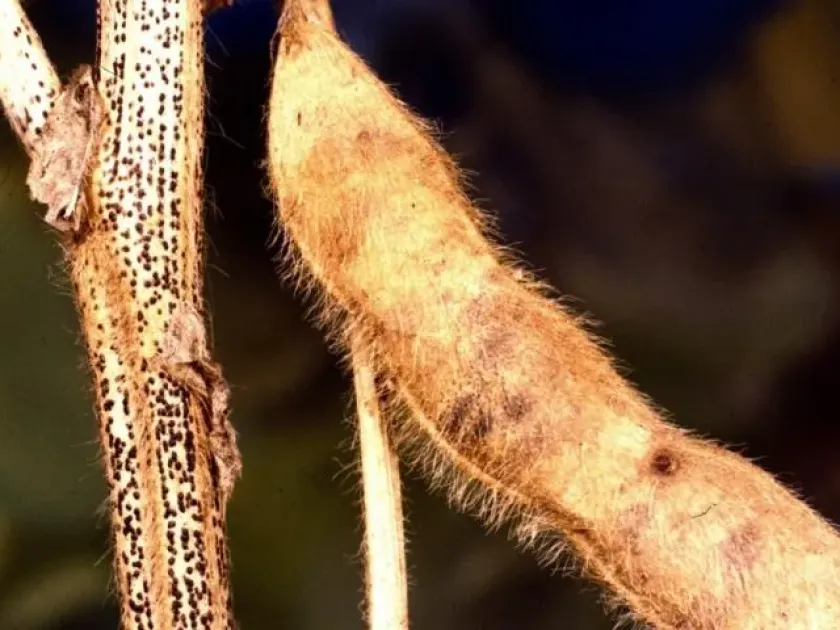
Initial visual symptoms of Phomopsis typically emerge during the pod-filling and maturation stages. Gray or brown irregular lesions appear on stems near the nodes, eventually spreading to encompass entire internodes.
Under close inspection, the affected areas reveal numerous tiny black dots known as pycnidia. These are randomly distributed across the lesions and serve as the primary diagnostic feature of the disease.
Leaves on infected plants may show yellowing and premature abscission. Under high humidity, a grayish-white mycelial mat may develop on stems and pods, leading to severe tissue rotting.
Seeds harvested from infected plants exhibit abnormal characteristics: they often appear shriveled, chalky, dull, or covered in fungal growth. Frequently, these seeds show extremely low germination rates.
Characteristic signs also include splitting of the stem cortex and infection of the pods, which become brittle and lose their commercial value as the fungus continues to consume plant nutrients.
Pathogen
The disease is caused by the fungus Diaporthe sojae (formerly known as Phomopsis sojae). This ascomycete fungus infects plants at all growth stages, entering tissues through stomata or mechanical wounds.
The fungus belongs to the Diaporthaceae family and is highly resilient, surviving in soil and on plant debris. Its lifecycle includes both conidial (anamorph) and perithecial (telemorph) stages, providing multiple pathways for disease transmission.
The pathogen can persist for long periods in seeds, making them the primary source of initial infection. Furthermore, the fungus overwinters effectively on soybean stubble and other legume residues, remaining viable for several years.
The infection process accelerates during seed germination, as the fungal mycelium colonizes the vascular system of the seedling. This often results in systemic infection that remains asymptomatic until the pod-filling stage.
A key biological feature of this pathogen is its ability to remain latent within plant tissues, making early field diagnosis extremely challenging for agronomists.
Conditions for development
Phomopsis development is favored by prolonged rainfall and moderately warm weather during crop maturation. High relative humidity (over 80%) is the critical factor driving active fungal sporulation.
Optimal temperatures for plant infection range between +20°C and +28°C. Rapid fluctuations in moisture and temperature towards the end of the season often trigger disease outbreaks in the field.
Inadequate mineral nutrition and plant stress increase susceptibility to the pathogen. Crops that have already sustained damage from insects or hail are significantly more vulnerable to colonization.
High-density planting creates a humid microclimate within the canopy, which accelerates the spread of fungal spores via wind and rain splashes between adjacent plants.
Poor agricultural practices, such as failing to rotate crops or leaving crop residues on the soil surface, create an ideal environment for the pathogen to thrive and infect subsequent crops.
Why it matters
Soybean Phomopsis causes massive yield losses, frequently reducing harvest volume by 30–50% or more. In severe cases, grain quality drops below acceptable standards, making it unsuitable for processing.
The disease drastically reduces seed germination energy and overall vigor. This often leads to sparse plant populations, even when high-quality seed lots are utilized for planting.
Damage to the plant's vascular system causes premature wilting and tissue necrosis. This disrupts the translocation of nutrients to the pods, resulting in the formation of shriveled, underweight grains.
A reduction in the thousand-kernel weight is a direct consequence of this infection. Additionally, infected seeds may accumulate mycotoxins, posing significant health risks if used for animal feed.
Economic damage is further compounded by the costs associated with fungicide applications and the intensive cleaning required for contaminated seed lots.
Protection
The primary control measure is the use of healthy, certified seed lots. Treating seeds with high-quality systemic fungicides before planting is an essential procedural requirement.
Implementing a crop rotation strategy with a 3–4 year gap between legume crops is highly effective in reducing the soil-borne inoculum density.
Deep incorporation of crop residues is vital, as the fungus relies on these materials for survival. Timely weed management is also necessary, as certain weeds act as alternative hosts for the pathogen.
During the growing season, regular monitoring and preventive fungicide applications, particularly during flowering and early pod formation, are recommended when weather conditions are conducive to disease.
Selecting resistant soybean varieties remains the most cost-effective long-term strategy for minimizing infection risks without the need for intensive chemical interventions.
Discussion
No discussions yet — be the first.