
Phomopsis seed decay
Diaporthe longicolla
Description
Symptoms
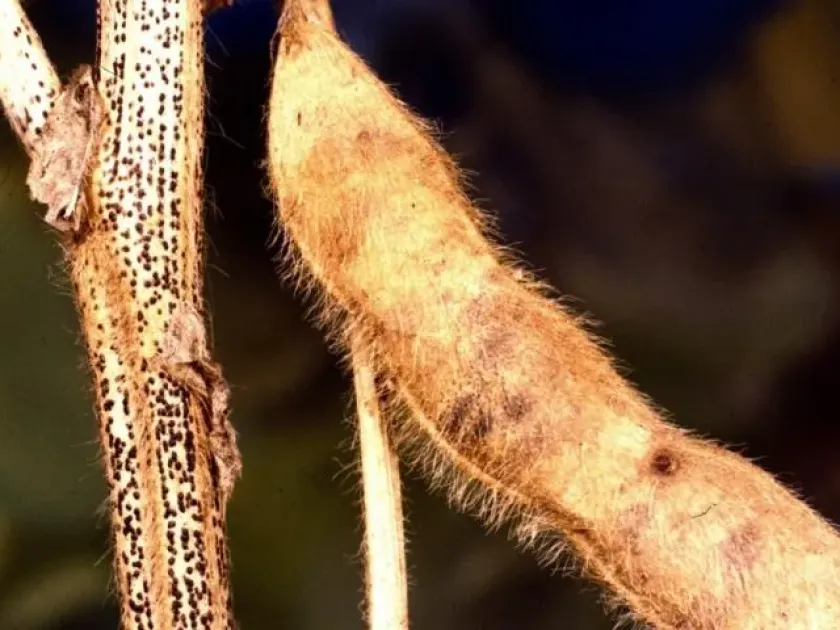
Symptoms of Phomopsis seed decay typically appear on the stems and pods. On the stem, the infection manifests as light brown, elongated lesions that often develop near the nodes and spread upwards or downwards.
As the disease progresses, the epidermis of the stem becomes dotted with small, black, speck-like fruiting bodies known as pycnidia. These are usually arranged in linear rows, which is a key diagnostic feature for field identification.
Pods infected with the fungus may show gray or brown discoloration and premature maturation. Seeds within these pods are often small, shriveled, and may exhibit a white, moldy growth on their surface.
Plants affected by the disease may exhibit premature yellowing and leaf abscission. In severe cases, the entire plant can wither and die prematurely, resulting in a distinct "burned" appearance during the middle of the growing season.
The physical structure of the stem is often compromised by the fungal activity, leading to lodging and premature breakage, which drastically complicates mechanical harvesting and leads to further yield losses.
Pathogen
The disease is caused by the fungus Diaporthe longicolla (formerly known as Phomopsis sojae). This pathogen is widely distributed in soybean-growing regions and is responsible for significant seed quality issues and stem damage.
The life cycle of the pathogen involves both sexual and asexual stages. The fungus survives in crop residues and infected seeds, producing fruiting bodies called pycnidia, which release conidia (spores) that serve as primary and secondary inoculum.
These spores are primarily disseminated by wind, rain splashes, and water runoff within the field. Once the spores land on susceptible host tissue, they penetrate through natural openings or wounds in the plant.
The fungus colonizes the vascular system and parenchyma tissue of the soybean stem, leading to internal decay. It is highly persistent in soil, meaning that repeated planting of soybeans in the same field drastically increases the pathogen population.
Due to its ability to remain latent in plant tissues, the pathogen often goes unnoticed during the early stages of soybean development, manifesting only when the plant begins to senesce or faces environmental stress.
Conditions for development
Phomopsis seed decay is favored by warm, humid weather conditions throughout the growing season. High humidity and rainfall during the flowering and pod-filling stages are critical for the rapid spread of the pathogen.
Temperature plays a crucial role in the development of the disease, with an optimal range between 20°C and 28°C. Periods of continuous moisture allow the conidia to germinate and penetrate the host tissue effectively.
Crop management practices such as high planting density can exacerbate the spread of the disease by reducing airflow and maintaining a high microclimate humidity within the soybean canopy.
Environmental stress, such as drought followed by periods of high moisture, can make soybean plants more susceptible to infection by Diaporthe longicolla. Weakened plants are unable to mount an effective defense against the pathogen.
Continuous cropping of soybeans in the same field creates a buildup of inoculum in the soil and on leftover residue, ensuring that every subsequent crop faces a higher risk of early-season infection.
Why it matters
The impact of Phomopsis seed decay on yield is significant, primarily due to reductions in seed weight and quality. Infected seeds exhibit low germination rates, leading to poor stands in the following season.
Beyond yield loss, the disease decreases the nutritional value of the beans, specifically impacting protein and oil content. This makes the harvest less marketable and unsuitable for high-quality food or feed processing.
Mycotoxin production associated with certain fungal species in the Diaporthe complex can pose risks to livestock if infected grain is used in feed, necessitating strict quality controls.
Harvesting efficiency is severely hampered by lodging and stem breakage. In many cases, combines fail to recover low-hanging pods from infected plants, leading to additional field losses that cannot be compensated.
Economic losses arise not only from reduced output but also from the increased cost of fungicide applications and the necessity of purchasing expensive, disease-free certified seeds.
Protection
Management begins with the use of high-quality, certified seeds that have been screened for the presence of Diaporthe longicolla. Treating seeds with effective systemic fungicides is essential to prevent early-season infections.
Crop rotation is a fundamental management strategy. Rotating soybeans with non-host crops like corn or wheat for at least 3 years effectively reduces the pathogen population in the field.
Deep tillage can help bury infected crop residues, accelerating their decomposition and minimizing the survival of the fungus. However, this must be balanced with soil conservation needs.
Foliar fungicide applications during the R3 (beginning pod) to R5 (beginning seed) growth stages are often necessary in high-pressure environments to protect the developing pods from colonization.
- Choose soybean varieties with documented field tolerance or resistance.
- Maintain balanced soil fertility to ensure strong plant immune response.
- Control weeds that may harbor the fungus as an alternative host.
- Optimize plant spacing to promote canopy ventilation.
- Scout fields regularly to detect symptoms early and apply treatments if necessary.
Discussion
No discussions yet — be the first.