
Diaporthaceae fungi
Diaporthaceae
Description
Symptoms
Initial symptoms often appear as grayish-brown, angular leaf spots surrounded by a yellow halo. These lesions typically start near the leaf veins before spreading toward the petiole and stem.
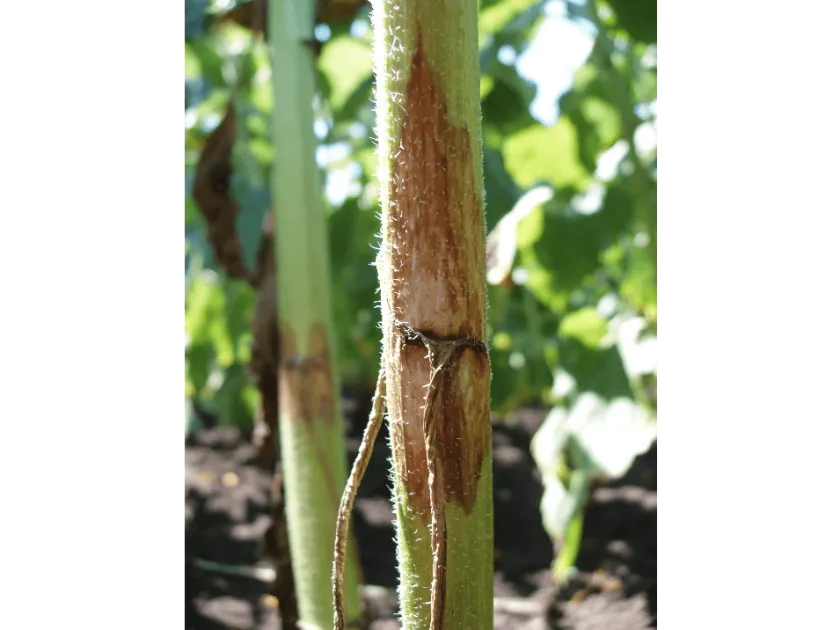
As the infection advances, large, dark-brown or silvery-gray lesions form on the stems. These areas become brittle, causing the stem to crack and making the plant highly vulnerable to lodging under windy conditions.
A hallmark sign is the internal browning and disintegration of the stem pith. This internal decay interrupts the transport of water and nutrients, leading to sudden wilting even when soil moisture levels are adequate.
In advanced stages, small, black, speck-like fruiting bodies called pycnidia can be observed on the surface of the withered stems. Their presence confirms the sporulation phase of the fungus.
- Premature wilting and drying of the foliage from the bottom up.
- Malformed, shriveled seed heads with significantly reduced oil content.
- Increased fragility of the stem, often resulting in plants snapping at the base.
Pathogen
The Diaporthaceae family consists of various fungal species that act as significant plant pathogens. Among the most destructive is Diaporthe helianthi, which is responsible for phomopsis stem blight, a major threat to sunflower cultivation globally.
This type of disease is characterized as a systemic fungal infection that targets the conductive tissues and structural integrity of the plant. The pathogen can survive for several seasons on infected crop residues buried in the soil.
The life cycle of these fungi involves the production of both ascospores and conidia. These reproductive bodies are dispersed through rain splashes and wind, allowing the infection to spread rapidly throughout a field during the growing season.
Once the spores land on susceptible leaves, the fungus germinates and enters the plant through stomata. The mycelium then colonizes the plant's vascular system, eventually causing tissue necrosis and structural decay.
These fungi are highly versatile, adapting their growth rates to match the availability of moisture and specific host conditions, which makes them particularly persistent in agricultural environments.
Conditions for development
The development of Diaporthaceae fungi is heavily dependent on high humidity and moderate temperatures, typically between 20°C and 25°C. These conditions are ideal for spore germination and mycelial expansion.
Prolonged rainfall during the early vegetative stages significantly increases the risk of infection. Water droplets act as the primary vehicle for spreading the pathogen from the soil or lower leaves to the upper canopy.
High plant density creates a microclimate with restricted airflow and high humidity, providing the perfect environment for the fungus to thrive and spread rapidly from plant to plant.
The presence of infected debris from previous harvests is the primary inoculum source. If this debris remains on the soil surface, the fungus can initiate new infections as soon as the environment becomes humid enough.
Imbalanced fertilization, particularly high nitrogen application, can lead to succulent plant tissue that is more easily penetrated by the fungal hyphae, thereby exacerbating the disease severity.
Why it matters
The economic impact of these fungi is substantial, with yield losses often exceeding 50 percent in severe outbreaks. The combination of plant death and lodging makes harvesting difficult and inefficient.
Quality degradation is a major concern, as the fungus affects the seed-filling process, leading to low seed weight and reduced oil yield, which lowers the commercial value of the crop.
Systemic damage to the plant's vascular system prevents efficient nutrient uptake, which results in stunted growth and the inability of the plant to reach its full productive potential.
In cases of early-season infection, entire fields may become unviable, forcing farmers to abandon the crop. This creates a risk for total financial failure in high-value agricultural sectors.
The longevity of the pathogen in the soil means that one year of high infection can lead to persistent issues for several subsequent seasons if proper management practices are not implemented.
Protection
The most effective management strategy is a robust crop rotation program. Rotating with non-host crops for at least 4-5 years helps to deplete the population of the pathogen in the soil.
Selecting resistant or tolerant hybrids is a cornerstone of integrated pest management. Breeding programs continue to focus on improving crop resistance to Diaporthaceae strains.
Deep tillage and crop residue management are essential for burying infected stalks, which accelerates their decomposition and reduces the amount of primary inoculum for the next season.
Proactive application of systemic fungicides at key growth stages—typically during early vegetative growth and prior to flowering—can significantly suppress the progress of the infection.
Balanced plant nutrition, including adequate potassium levels, helps strengthen plant cell walls and improves overall plant health, making the crop more resilient against fungal colonization.
Discussion
No discussions yet — be the first.