
Ringless honey fungus
Desarmillaria tabescens
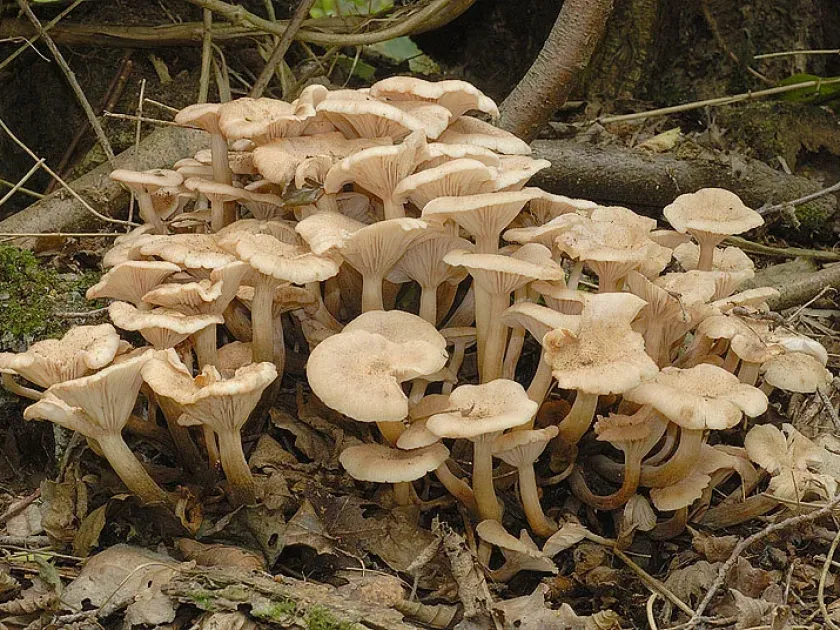
Description
Symptoms
The first clinical symptom is the premature yellowing and dropping of leaves during the summer months. The canopy gradually becomes sparse, and annual shoot growth is significantly stunted.
Clusters of honey-colored to brown fruit bodies are often observed at the base of the stem or on large roots. These fruit bodies typically feature stalks that are fused together at their origin.
Beneath the bark of the affected area, a dense white mat of mycelium can be found. This fungal growth wraps around the root collar, gradually extending into the wood and degrading the tissue.
The wood in the infected zone becomes light-colored, soft, and fibrous. In advanced stages, the tree can become loose in the ground, making it highly susceptible to windthrow.
Tree mortality often occurs unexpectedly, particularly during dry seasons when damaged roots fail to supply sufficient water. The interval between initial symptoms and tree death generally spans several years.
Pathogen
Ringless honey fungus (Desarmillaria tabescens) is a significant fungal pathogen known for causing white root rot and decay of the root collar in various woody plants. Unlike other Armillaria species, it does not produce rhizomorphs, making it a distinct entity in plant pathology.
The pathogen belongs to the Physalacriaceae family and has the ability to attack both weakened and healthy trees. Its mycelium colonizes the root system, systematically destroying wood tissue and disrupting the translocation of water and essential nutrients.
This fungus typically leads a saprotrophic life but readily transitions into a parasite under favorable environmental conditions. Spores are dispersed through wind and splashing rain, infecting wounded bark or exposed roots.
During its growth, the fungus secretes specialized enzymes that break down lignin and cellulose. This process causes the wood to lose its structural integrity, eventually leading to the complete failure of the root system.
Reproduction is characterized by the emergence of fruit bodies, which grow in dense clusters at the base of the infected plant. Peak activity for these fruit bodies occurs in late summer and autumn.
Conditions for development
The development of Desarmillaria tabescens is strongly favored by heavy, waterlogged soils with poor aeration. Excessive moisture provides the necessary environment for spore germination and mycelial spread.
Trees that have been stressed by frost, mechanical injury, or nutrient deficiencies are at a higher risk of infection. A compromised immune system makes it difficult for a tree to resist the encroachment of the fungus.
In garden settings, the disease spreads primarily through root-to-root contact. In dense plantings, the fungus can rapidly jump from an infected specimen to healthy neighboring plants.
Warm and humid weather conditions stimulate the mass production of fruit bodies. The optimal temperature range for active mycelial growth is between +18 and +25 degrees Celsius.
Stumps and decaying wood residues in the orchard serve as persistent reservoirs of infection. The fungus can survive in these remnants for many years, waiting for an opportunity to colonize living roots.
Why it matters
The ringless honey fungus causes extensive economic losses in orchards, particularly in stone fruit species such as peaches, apricots, and cherries. It leads to the rapid decline and death of highly productive trees.
Management is notoriously difficult, and often the only effective solution is the complete removal of the tree and its entire root system, which entails high labor and management costs.
The damage to the root system affects fruit development, leading to reduced size, poor aesthetic quality, and diminished flavor. Consequently, overall orchard yield suffers significantly.
Since the fungus can persist and spread through the soil, an outbreak poses a long-term threat to the entire orchard ecosystem rather than just an individual tree.
Infected sites remain unsuitable for replanting susceptible species for several years. This necessitates long-term fallowing or expensive soil sterilization measures.
Protection
The primary control strategy involves good horticultural practice: maintaining proper soil drainage, ensuring adequate nutrition to support tree vigor, and protecting trees from mechanical injuries.
Regular monitoring of the orchard is essential. If a tree shows signs of infection, it should be removed immediately along with as much of the root system as possible and destroyed by burning.
To isolate infection hotspots, digging trenches around infected trees can prevent further root-to-root contact and limit the spread of the fungus.
Stump removal is a critical step in site preparation. Replanting should be avoided in areas where root rot has been previously identified unless the site has been thoroughly rehabilitated.
- Application of copper-based fungicides to the soil.
- Use of biological control agents (such as Trichoderma species) to suppress pathogenic growth.
- Careful selection of resistant rootstocks for new orchard plantings.
Discussion
No discussions yet — be the first.