
Dematophora root rot of cucurbits
Dematophora pepo
Description
Symptoms
The earliest symptom is typically sudden wilting during the hottest part of the day, with plants appearing to recover at night until the disease reaches an advanced stage.
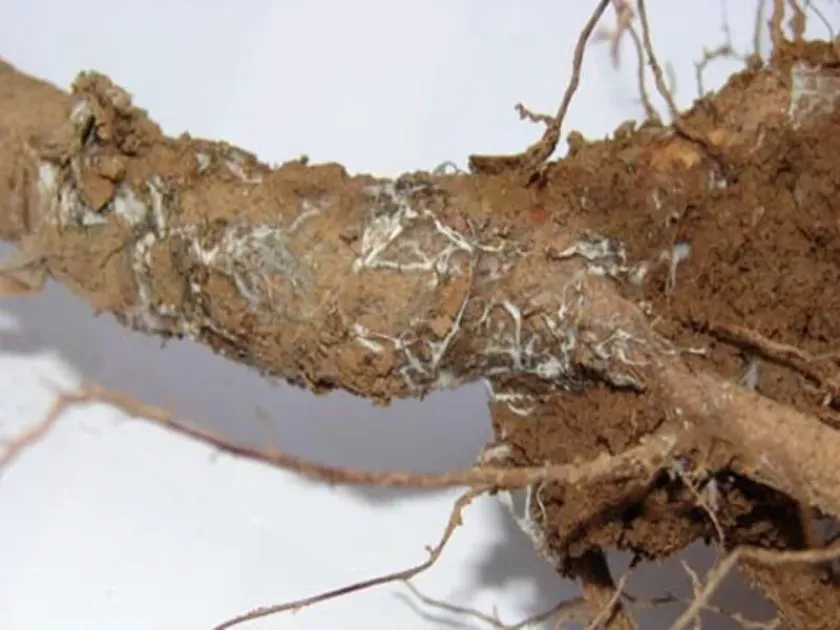
A white or greyish cottony fungal growth is visible on the root surface and crown area. This is a characteristic diagnostic feature of a Dematophora infection.
The roots become soft, brittle, and brown, eventually turning black as the internal vascular tissues collapse and decay. The bark of the root can easily be peeled away.
Foliage chlorosis follows, as the plant can no longer draw sufficient water and nutrients from the soil. Eventually, the leaves dry out, and the entire plant dies.
In humid conditions, small black sclerotia may form on the stem base or surrounding soil particles, which act as persistent survival structures for the fungus.
Pathogen
The disease is caused by the fungus Dematophora pepo (the asexual stage of Rosellinia necatrix), which is a destructive soil-borne pathogen affecting the roots of various crops.
This pathogen survives in the soil as mycelium, sclerotia, and thick-walled resting spores, allowing it to remain viable for many years despite unfavorable environmental conditions.
The fungus produces white, fan-like mycelial mats and rhizomorphs that serve as exploratory structures, enabling the pathogen to move through the soil and infect healthy roots.
It colonizes plant tissues by secreting cell wall-degrading enzymes and toxins, which break down the root cortex and cause the destruction of the plant's vascular system.
Because it is a saprophyte, the pathogen thrives on decomposing organic matter in the soil, which complicates its eradication in fields with high residue levels.
Conditions for development
Moist and poorly drained soils are the primary drivers of this disease. Excessive water promotes the rapid growth of the mycelium and the spread of rhizomorphs.
Optimal temperatures for the fungus range between 18°C and 25°C, making it particularly problematic during early to mid-growing seasons in temperate regions.
High levels of undecomposed organic matter in the soil provide an abundant food source, which boosts the initial population density of the pathogen.
Acidic soil conditions generally favor the development of Dematophora, as the fungus is highly competitive under lower pH levels.
In greenhouse environments, poor ventilation and high humidity levels create a conducive microclimate for the rapid transmission of the pathogen between adjacent plants.
Why it matters
The economic impact of Dematophora root rot is severe, as it causes significant plant mortality and total yield loss in infested patches of the field.
Surviving plants exhibit stunted growth and reduced fruit quality, making them commercially unviable and prone to rapid decay after harvest.
Since the pathogen is long-lived in the soil, its presence can limit land use for cucurbits and other susceptible crops for several seasons.
The disease can spread rapidly within a crop, creating gaps that make irrigation and pesticide application inefficient and costly.
Management costs are significantly increased due to the need for soil sterilization, the removal of infested plants, and potential replanting expenses.
Protection
Preventive strategies must center on long-term crop rotation, avoiding the replanting of cucurbits in the same field for at least 4 to 5 years.
Effective soil management includes improving drainage, maintaining optimal soil pH, and using solarization to reduce the pathogen load in the soil profile.
Sanitation is critical: all infected root systems must be removed and destroyed immediately to prevent the formation and buildup of sclerotia in the soil.
Biological control agents, particularly Trichoderma species, have shown success in suppressing the mycelial growth of the pathogen in the rhizosphere.
- Implement strict irrigation schedules to prevent waterlogging.
- Use certified, disease-free seed and transplant material.
- Avoid over-fertilizing with nitrogen, which can lead to succulent tissues prone to rot.
- Clean farm equipment thoroughly after working in infested areas to prevent spreading soil.
Discussion
No discussions yet — be the first.