
Dematophora root rot
Dematophora arcuata
Description
Symptoms
The first external signs of Dematophora root rot are general tree decline, characterized by chlorosis, wilting, and premature leaf drop. The growth rate of the canopy decreases significantly as the disease progresses.
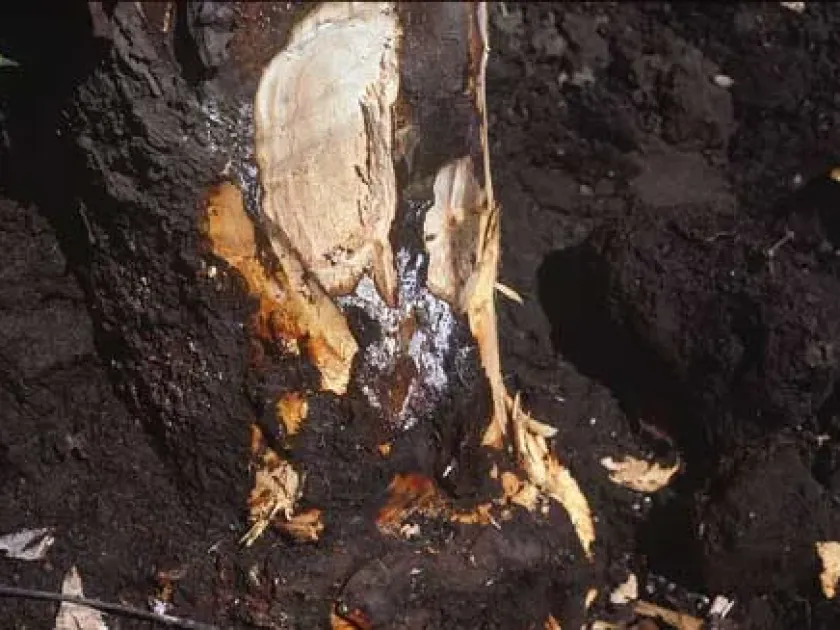
When investigating the roots, a distinct white, felt-like fungal mycelium can be observed covering the root surface. The infected root tissues become softened, turn brown, and emit a noticeable mushroom-like odor.
As the infection advances, the bark of the roots peels away easily from the wood. This diagnostic feature indicates a total loss of structural integrity in the root system due to fungal enzymatic activity.
In advanced stages, the collar of the tree may also show necrosis, leading to girdling. This cuts off the nutrient and water supply from the roots to the rest of the tree, resulting in rapid collapse.
Under humid conditions, the mycelium may spread on the surface of the soil around the base of the plant. This white, web-like growth is a sign of a high level of infestation in the immediate environment.
Pathogen
The disease is caused by the fungus Dematophora arcuata, which is the asexual stage of the pathogen commonly known as Rosellinia necatrix. This fungus is a soil-borne pathogen responsible for severe white root rot in many woody plants.
The fungus spreads primarily through the soil using rhizomorphs—white or grey fungal strands that grow from the infected root system to healthy parts. These structures allow the pathogen to colonize the root bark effectively.
Rosellinia necatrix is capable of long-term survival as a saprophyte on decaying organic matter, such as old roots, stumps, and plant debris left in the soil after the host plant has died.
The life cycle includes the production of conidia, which can spread via soil moisture, irrigation water, or agricultural tools. This mechanism ensures the pathogen's persistence and rapid colonization of vulnerable hosts.
The fungus's ability to produce sclerotia, dormant resting structures, allows it to survive in the soil for several years even in the absence of a live host, making complete eradication extremely difficult.
Conditions for development
High soil moisture is the primary factor favoring the development of this root rot. Poorly drained, waterlogged soils provide the necessary conditions for the rapid growth of the fungal mycelium.
The pathogen thrives in heavy, clay-rich, or compacted soils that lack sufficient aeration. These environmental stressors weaken the plant's resistance, making it more susceptible to fungal invasion.
Temperature plays a crucial role, with warm soil conditions significantly accelerating the colonization process. The fungus is highly active during the spring and summer months when temperatures are moderate to high.
Mechanical damage to roots, caused by soil cultivation, planting, or root-feeding insects, provides entry points for the pathogen. Once it gains access to the inner tissues, the spread is usually irreversible.
Sites with a history of forest clearance or old orchards often contain residual inoculum. Planting susceptible crops in such areas without proper soil preparation and disinfection significantly increases the risk of outbreak.
Why it matters
Dematophora root rot causes significant damage in fruit orchards, nurseries, and vineyards by killing both young saplings and mature trees. The mortality rate in infected areas is very high.
The pathogen has an exceptionally wide host range, attacking various deciduous, evergreen, and woody ornamental plants. This versatility makes it a persistent threat across different agricultural sectors.
Economic losses are compounded by the difficulty of managing the disease. Once a tree is infected, it cannot be recovered, and the site usually becomes unsuitable for replanting for many years.
The disease negatively impacts fruit quality and yield before the plant actually dies. Affected trees produce fewer and smaller fruits, which are often of poor quality and prone to rapid decay.
Because the disease spreads underground, it is often detected too late to save the surrounding trees, which may have already contracted the infection through overlapping root systems.
Protection
Effective management begins with strict sanitation: infected trees must be removed with as much of the root system as possible and destroyed by burning to prevent the spread of inoculum.
Improving soil drainage is essential for suppressing the growth of the pathogen. Well-aerated, dry soil creates a hostile environment for the development of fungal rhizomorphs.
Choosing healthy, disease-free nursery stock and using resistant rootstocks are the most reliable preventive measures against the introduction of the pathogen into new areas.
Biological control using beneficial soil microorganisms, such as Trichoderma species, can help create a competitive environment that inhibits the colonization by Rosellinia necatrix.
Fallowing the land or performing deep soil fumigation before replanting is critical if the site has a history of root rot. Avoiding susceptible crops for several years helps decrease the soil inoculum level.
Discussion
No discussions yet — be the first.