
Cytospora schulzeri
Cytospora schulzeri
Description
Symptoms
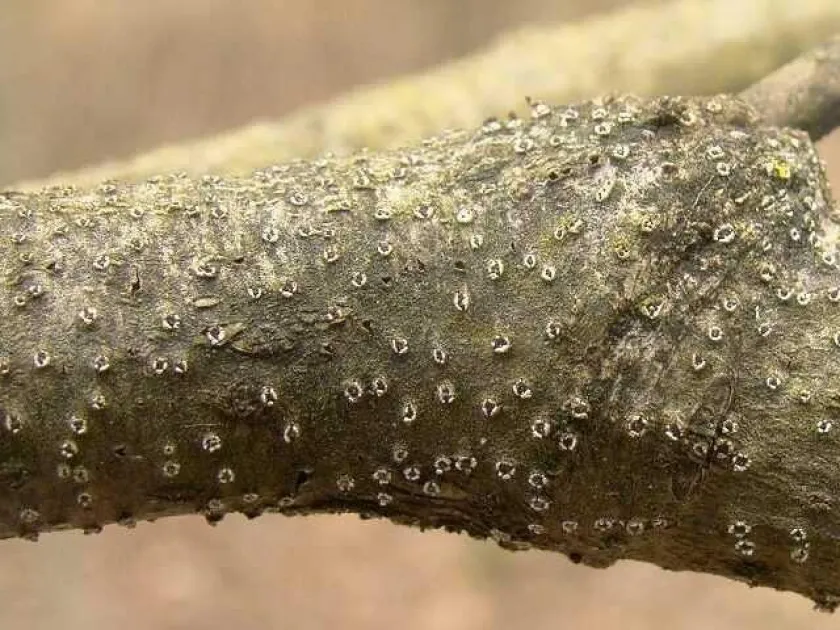
The most visible symptom is the development of sunken, discolored patches on the bark, often ranging from reddish-brown to dark gray. These patches indicate the areas where the bark has died.
Tiny, pimple-like structures, known as pycnidia, appear on the surface of the infected bark. During rainy weather, these release characteristic orange or yellow spore tendrils.
The bark underneath these spots becomes spongy and necrotic. In advanced stages, the bark cracks and peels away from the wood, exposing the decaying underlying tissues.
The foliage on affected branches often shows signs of stress, such as yellowing, wilting, or premature leaf drop. The tree may exhibit dieback starting from the tips of the branches.
- Sunken necrotic bark lesions
- Visible orange spore tendrils
- Spongy, decayed inner bark
- Branch dieback and wilting
- Bark cracking and sloughing off
Pathogen
The causal agent of the disease is the fungus Cytospora schulzeri, a member of the Sphaeriales order. It acts as a facultative parasite, attacking weakened woody plants.
The fungus is primarily found in the cortical tissues. It persists as mycelium within the dead or dying bark, waiting for environmental conditions that allow it to colonize healthy parts.
Once inside, the fungus invades the cambium and phloem layers. This colonization disrupts the vascular system, preventing the transport of water and nutrients throughout the tree.
It reproduces by producing pycnidia — small, flask-shaped structures that emerge through the outer bark. These structures release spores in tendrils when conditions are humid.
Cytospora schulzeri is considered a long-term pathogen, as it can persist on dead branches and debris for many years, acting as a permanent inoculum source.
Conditions for development
The development of Cytospora schulzeri is heavily dependent on the tree's health status. Drought, nutrient deficiency, or poor site conditions make trees highly susceptible.
Mechanical injuries are the primary gateway for infection. Pruning wounds, insect damage, hail, or frost cracks allow the fungal spores to enter the inner tissues.
High humidity and rainfall are essential for the dispersal and germination of spores. Moist conditions allow the spore tendrils to emerge and be splashed onto healthy areas.
Poor orchard management, such as leaving deadwood in the canopy or improper spacing, creates a favorable humid microclimate for the pathogen to thrive and multiply.
Winter injury, including sunscald and bark freezing, is a major trigger for infection, as the damage provides an ideal entry point for the fungus to establish itself.
Why it matters
Cytospora canker is a destructive disease that significantly reduces the lifespan of trees. If a lesion girdles a limb or the main trunk, that part of the tree will inevitably die.
Young trees are especially vulnerable and can be killed in a single season if the fungus colonizes the crown area or the main trunk near the root flare.
The disease negatively impacts fruit production. Since the transport of water and nutrients is blocked, the yield on affected trees decreases, and the fruits remain undersized.
Once established, the disease can spread rapidly within the orchard. A single heavily infected tree can serve as a persistent source of spores, endangering nearby healthy trees.
The economic impact involves the loss of productive trees, the high cost of manual labor for pruning and wound treatment, and the overall reduction in orchard productivity.
Protection
Good cultural practices are the foundation of control. Providing adequate irrigation and balanced nutrition helps maintain tree vigor, making them more resistant to fungal attacks.
Sanitation is critical; all dead or infected branches must be pruned and removed from the orchard. Pruning tools should be disinfected between cuts to avoid cross-contamination.
Applying white latex paint to the trunk helps protect bark from sunscald and extreme temperature fluctuations, thereby reducing the risk of bark cracking.
When localized lesions are found, they should be carefully excised down to healthy, green tissue. The resulting wound should be cleaned and treated with a copper-based fungicide.
Preventive fungicide spraying during the dormant season can help reduce the spore load in the orchard and protect the trees during the early growth stages.
Discussion
No discussions yet — be the first.