
Cytospora ceratophora
Cytospora ceratophora
Description
Symptoms
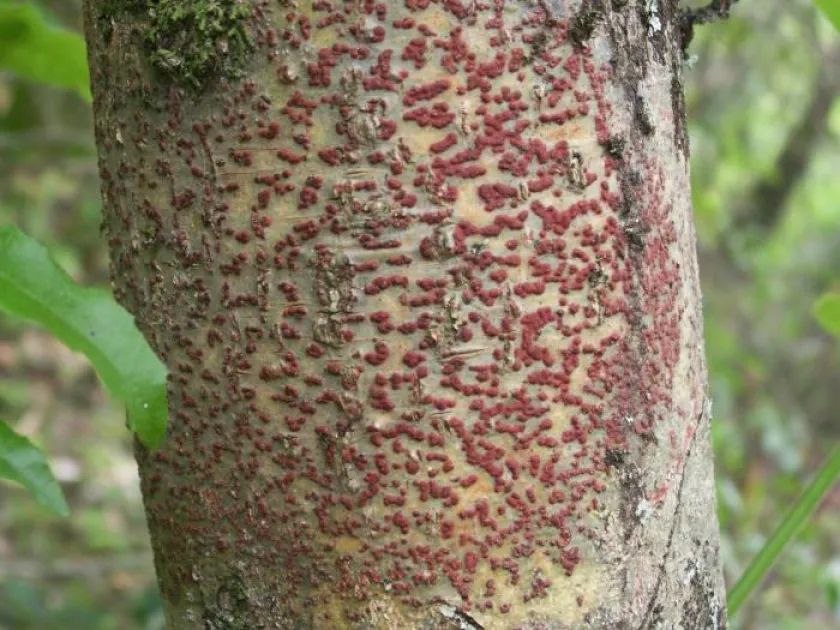
The primary symptom is the development of localized bark necrosis, appearing as sunken, discolored brown or reddish-brown lesions. The affected bark eventually becomes brittle and prone to cracking.
Tiny pimple-like structures, which are the pycnidia, become visible on the surface of the necrotic bark. During wet weather, these produce visible spore masses that appear as yellowish or orange tendrils.
Infected branches often show premature leaf wilting, flagging, and subsequent dieback. The wood underneath the infected area typically exhibits significant discoloration and decay.
As the disease progresses, the bark may peel away from the wood entirely. In cases of girdling, the entire branch or tree distal to the infection point will die due to the disruption of water and nutrient transport.
Early diagnosis is challenging, but subtle changes in bark texture and color in areas around pruning wounds or bark cracks are usually the first indicators of an active infection.
Pathogen
The causal agent of this disease is the ascomycete fungus Cytospora ceratophora, belonging to the Sordariomycetes class. It acts as a facultative parasite that targets stressed or weakened woody plants.
The fungal life cycle involves the formation of pycnidia, specialized fruiting bodies that produce large quantities of conidia. Under high humidity, these spores are released in characteristic thread-like masses.
Infection primarily occurs through bark wounds, frost cracks, sunscalds, or improper pruning cuts. Once inside, the fungus invades the phloem and cambium, systematically destroying tissue integrity.
Unlike obligate parasites, Cytospora ceratophora is highly resilient and capable of surviving as a saprotroph on deadwood, providing a constant reservoir for infection within the orchard.
The fungus is highly adaptive to various environmental stresses, allowing it to persist in the host tissue for extended periods before causing significant symptoms.
Conditions for development
Fungal development is heavily influenced by temperature fluctuations, particularly the alternation of freezing and thawing during late winter and early spring, which stresses the tree.
High humidity and prolonged periods of rainfall are essential for spore germination and dispersal. Rain splash helps move spores from infected pycnidia to healthy parts of the canopy.
Trees suffering from drought, nutrient deficiency, or poor soil conditions are significantly more susceptible to infection, as their natural defense mechanisms are compromised.
Mechanical injuries resulting from poor pruning techniques, wind damage, or insect boring activity provide open entry points for the pathogen to establish a colony.
Dense, poorly ventilated plantings retain moisture on the bark surface for longer periods, creating an ideal microclimate for Cytospora ceratophora to thrive and spread.
Why it matters
The greatest threat is the rapid progression of bark necrosis, which can lead to girdling of the main trunk or scaffold branches, causing the death of mature trees.
Economic damage manifests as a significant reduction in fruit yield and quality, as nutrient flow is severely hindered by the necrotic lesions.
The disease drastically reduces the tree's cold hardiness, making it more prone to frost injury and secondary infestations by other pests and pathogens.
In nursery environments, this fungus can cause catastrophic losses of young stock, leading to significant financial setbacks for commercial growers.
The infectious nature of the spores means that if left unchecked, the disease can quickly spread through an entire orchard, necessitating the removal of high-value trees.
Protection
Preventive measures focus on cultural practices: adequate irrigation and balanced fertilization are essential to maintain tree vigor and resistance to fungal attacks.
Strict hygiene during pruning is mandatory. Tools must be disinfected frequently, and all pruning cuts should be treated with appropriate wound sealants or fungicides.
Sanitation is critical; all infected branches showing symptoms must be pruned back into healthy tissue and removed from the site to minimize the inoculum source.
Protecting trunks and scaffold branches from sunscald by applying white latex paint or lime wash helps prevent the primary entry points for the fungus.
- Regular application of preventative fungicides during the growing season.
- Effective control of wood-boring insects and rodents.
- Monitoring trees for early symptoms of bark stress.
- Removing dead wood and debris from the orchard floor.
Discussion
No discussions yet — be the first.