
Striated bird's nest fungus
Cyathus striatus
Description
Symptoms
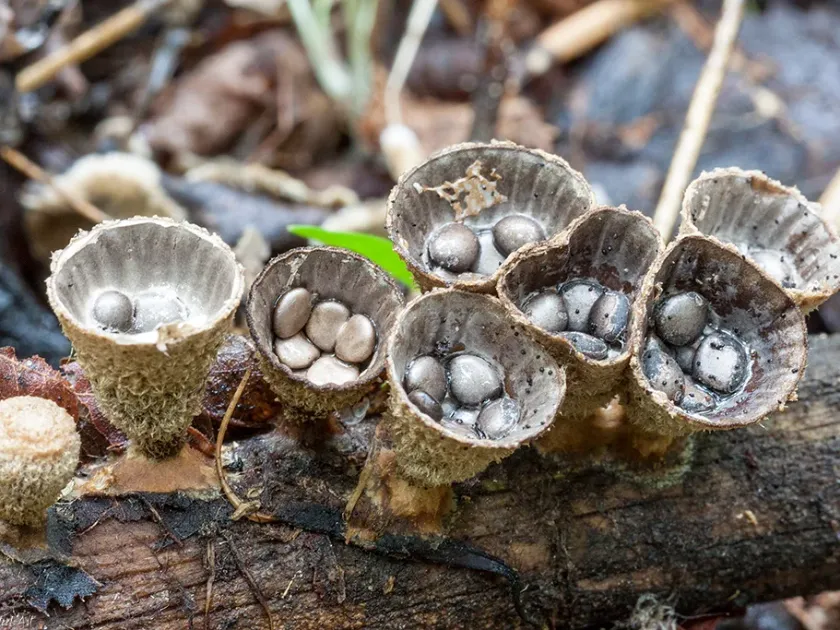
The most visible sign of this fungus is the presence of small, cone-shaped fruiting bodies that measure approximately 1-2 centimeters in height.
The interior of these cups displays distinct, dark vertical striations (lines), which provide the diagnostic feature that separates it from other similar fungal species.
The "nest" contains several grey or black lens-shaped peridioles, which contain the spores necessary for the fungus to reproduce and spread.
The fungus is often found in dense colonies, clustered together on rotting wood, mulch, or damp, nutrient-rich soil after periods of significant rainfall.
Early-stage fruiting bodies may be covered by a thin membrane called an epiphragm, which eventually ruptures to expose the spore-filled cups.
Pathogen
Cyathus striatus, commonly known as the striated bird's nest fungus, is a saprotrophic fungus belonging to the Agaricaceae family. It is vital to note that it is not a plant pathogen and does not infect living plant tissues.
This fungus plays a crucial ecological role by decomposing decaying organic matter, such as wood chips, straw, and dead plant materials, thereby recycling nutrients back into the soil.
The life cycle of the fungus is fascinating, involving the production of cup-shaped fruiting bodies that act as splash cups to disperse their spore-containing peridioles when raindrops hit them.
Since it lacks the ability to penetrate or feed on healthy plants, it poses no threat to vegetables, flowers, or ornamental crops in the garden environment.
In professional agronomy, this species is considered a bio-indicator of high organic content in the soil rather than a sign of disease outbreak.
Conditions for development
High moisture levels are the primary requirement for the growth and development of Cyathus striatus colonies.
The fungus thrives in shady, sheltered environments where organic debris, such as bark mulch or wood mulch, remains consistently damp.
Moderate temperatures ranging from 15°C to 25°C provide an optimal environment for mycelial growth and the subsequent formation of fruiting bodies.
Proper airflow is a limiting factor; areas with stagnant air and poor soil drainage are significantly more susceptible to colonization by this species.
A surplus of uncomposted or fresh organic matter in the garden serves as a perfect substrate for the fungus to establish its mycelial network.
Why it matters
There is no agricultural harm associated with the striated bird's nest fungus; it is essentially harmless to all cultivated crops.
No symptoms of necrosis, rot, wilting, or nutrient deficiency are induced by this organism, as it does not compete with living plants for resources.
Concerns from gardeners are usually related to the appearance of the fungus, which may be mistaken for a dangerous infestation of ornamental or edible plants.
Excessive growth can act as a visual prompt to review garden sanitation, specifically suggesting that the mulch layer may be too thick or too moist.
Since it is a beneficial decomposer, its presence generally indicates a healthy, active process of soil organic matter transformation.
Protection
Because the fungus is a harmless saprotroph, chemical control measures are entirely unnecessary and not recommended for standard agricultural practice.
- Ensure proper garden drainage to prevent long-term soil waterlogging.
- Use fully decomposed compost instead of raw, fresh wood materials for mulching.
- Increase sunlight exposure by thinning overgrown canopy branches if possible.
- Regularly rake or turn over mulch layers to promote surface drying and aeration.
- Avoid over-mulching around the base of sensitive plant stems.
Focusing on general horticultural hygiene and proper moisture management is the most effective and sustainable way to reduce the visible population of these fungi.
Discussion
No discussions yet — be the first.