
Description
Symptoms
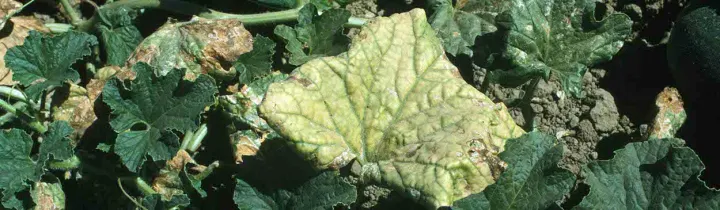
Initial symptoms of the infection typically appear on the oldest leaves at the base of the plant, slowly progressing towards the newer growth.
The characteristic sign is interveinal chlorosis, where the leaf tissue turns yellow while the veins remain distinctively green, creating a stark contrast.
As the disease progresses, the leaves often become thickened, brittle, and leathery because the accumulated carbohydrates cannot be transported away due to blocked phloem.
In watermelon crops, infected plants show reduced fruit set and fruit deformation, significantly impacting the yield and overall harvest quality.
The distribution of the disease in the field often appears in patches, corresponding to areas where winged aphids initially landed and began feeding.
Pathogen
The disease is caused by the Cucurbit aphid-borne yellows virus (CABYV), which belongs to the Polerovirus genus. This virus is a phloem-limited pathogen that affects the plant's vascular system.
The virus is transmitted by several aphid species, with the cotton aphid (Aphis gossypii) being the most significant vector in agricultural settings.
Transmission occurs in a persistent manner; the aphid acquires the virus after feeding on an infected plant and remains infectious for the rest of its life.
The virus cannot be transmitted mechanically, through soil, or by contact between plants. Its spread is entirely dependent on the movement and feeding behavior of aphid vectors.
This pathogen has a narrow host range, primarily infecting members of the Cucurbitaceae family, including watermelon, cucumber, melon, and squash.
Conditions for development
The spread of the virus is directly linked to the population dynamics of aphids, which thrive in moderately warm and dry weather conditions.
Wild cucurbit weeds often act as primary reservoirs for the virus, allowing aphids to acquire the pathogen before moving onto cultivated fields.
Optimal temperatures for aphid reproduction, ranging from 20°C to 28°C, accelerate the rate at which the virus spreads through a crop.
Dense planting patterns and the proximity of new crops to older, infected cucurbit fields significantly increase the risk of rapid disease transmission.
The flight activity of winged aphids during the peak growing season is the primary driver for the widespread incidence of the virus across large areas.
Why it matters
The primary damage caused by the virus is the inhibition of nutrient translocation, which leads to stunted plant growth and overall weakening of the crop.
Infected watermelon plants produce fewer fruits, and the fruits that do develop are often smaller, poorly flavored, and commercially unacceptable.
Severe infections lead to premature senescence of the foliage, which reduces the plant's photosynthetic capacity and ability to recover from stress.
Viral infection leaves the plant susceptible to secondary attacks from other pathogens, including various types of rots and powdery mildew.
Economic impact can be substantial, with crop losses often exceeding 50% in areas where aphid populations are left uncontrolled during the early stages of growth.
Protection
Because there is no cure for the viral infection itself, the focus of management is exclusively on the control of the aphid vectors.
Systemic insecticides should be applied as soon as the first aphids are detected in the field to prevent the onset of viral transmission.
Weed management around the field edges is crucial, as removing host weeds eliminates the virus reservoir that allows the disease to persist.
- Utilize floating row covers to physically exclude aphids from young plants during the early, most vulnerable stage of growth.
- Practice proper crop rotation and maintain isolation distances from older cucurbit plantings.
- Monitor aphid populations regularly using yellow sticky traps to time insecticide applications effectively.
- Encourage natural enemies of aphids, such as ladybugs and lacewings, as part of an integrated pest management approach.
Choosing resistant or tolerant cucurbit varieties is the most sustainable long-term strategy for managing the impact of this viral disease.
Pathogens and affected parts
Affects crops · 1
Discussion
No discussions yet — be the first.