
White pine blister rust of cedar
Cronartium kurilense
Description
Symptoms
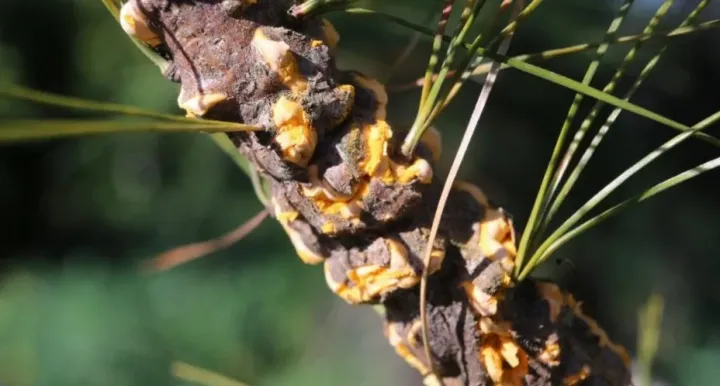
The most distinctive symptom is the presence of yellow-orange aecial blisters erupting through the bark. As these structures mature, they rupture, revealing the mass of spores inside and leaving behind a ragged appearance on the bark surface.
Infected areas often show signs of swelling or localized thickening of the bark. Over time, the bark in these areas may crack and die, exposing the underlying wood, which often becomes heavily resinous as the tree attempts to seal the wound.
Needles on infected branches turn yellow and eventually drop prematurely. The affected branches become brittle and dry out, leading to canopy thinning and a loss of the tree's typical dense appearance.
On older trunks, the disease often results in large, perennial cankers. These necrotic lesions are deep, persistent, and weaken the structural integrity of the tree, making it prone to breakage during strong winds.
Monitoring the secondary host, Pedicularis, is a useful diagnostic tool. Small, rust-colored spots on the undersides of the lousewort leaves in summer indicate that the fungus is actively present and spreading within the area.
Pathogen
The disease is caused by the rust fungus Cronartium kurilense, an obligate parasite with a complex life cycle. It requires two distinct hosts to complete its development: cedar (Korean pine) for the aecial stage and Pedicularis (lousewort) species for the telial stage.
The fungus infects the bark and cambium of the tree. As a systemic disease, it disrupts the movement of nutrients and water, eventually weakening the entire host plant and potentially leading to the death of the tree.
During the spring and early summer, the fungus produces aecia, which appear as orange-colored blisters on the bark. These structures burst to release aeciospores that are disseminated by wind to infect alternate host plants.
The mycelium of the pathogen is highly persistent and can survive within woody tissues for many years. It spreads through the phloem and cambium, eventually girdling the trunk or branches and causing significant physiological stress.
Development of the fungus is highly dependent on environmental conditions, particularly high humidity and moderate temperatures. Moisture is essential for the germination of spores, making valleys and low-lying areas high-risk zones for outbreaks.
Why it matters
This rust is particularly devastating for young cedar stands. If a canker forms on the main trunk, it will eventually girdle the tree, causing the death of all parts of the tree above the infection point.
The disease significantly reduces seed production, which is a major concern for both forestry regeneration and wildlife that depend on the cedar nuts. Infected trees often drop cones before they are fully mature.
The weakened state of the tree makes it highly susceptible to secondary infestations by wood-boring insects. These pests often accelerate the mortality rate, turning an already sick tree into a breeding ground for further forest damage.
The economic impact is substantial, including the loss of high-value timber and natural forest resources. Extensive infection cycles necessitate expensive sanitary forest management practices to prevent further spread.
In forest nurseries, the fungus can devastate entire batches of seedlings, leading to significant losses in reforestation projects and disrupting the supply chain for new forest plantations.
Protection
The primary preventive strategy is the eradication of the alternate host, Pedicularis, in the vicinity of cedar plantations. Removing these plants from a radius of several hundred meters can effectively stop the infection cycle.
Regular sanitary pruning and the removal of infected trees are essential to maintain stand health. All infected materials must be burned or buried immediately to destroy the spores and prevent them from spreading.
Chemical control involving systemic fungicides may be used in nurseries to protect valuable seedlings. These treatments must be applied strategically during periods when spores are known to be most active.
Careful site selection is critical for new plantings. Avoiding areas with poor air drainage or persistent high humidity helps minimize the conditions required for the fungus to germinate and spread.
Genetic research focusing on breeding resistant cultivars is the long-term solution. Developing cedar varieties with natural resistance to Cronartium kurilense is vital for the future security of Korean pine forests.
Discussion
No discussions yet — be the first.